• Skip to primary navigation
  • Skip to main content
  • Skip to primary sidebar
  • Skip to footer
  • Home
  • About
  • The Magazine
  • Events
  • Partners
  • Products
  • Contact
  • Jobs and Careers
  • Advertise
  • Facebook
  • Instagram
  • Twitter
  • Subscribe
American Police Beat

American Police Beat Magazine

Law Enforcement Publication

  • Home
  • Leadership
    • Developing and enhancing assertiveness
      Clarifying your “true north”
      The job has changed — have you?
      Perpetual recognition of line-of-duty deaths
      Understanding the boundaries of professional relationships with the...
  • Topics
    • Leadership
      • Developing and enhancing assertiveness
        Clarifying your “true north”
        The job has changed — have you?
        Perpetual recognition of line-of-duty deaths
        Understanding the boundaries of professional relationships with the...
    • Editor’s Picks
      • Smile and let them swing
        The job has changed — have you?
        The days that follow
        Perpetual recognition of line-of-duty deaths
        Let’s get moving!
    • On the Job
      • Coffee shop intel
        Curbing teen takeovers
        2026 Top Cops
        High-rise rescue in Brooklyn
        Swift thinking
    • Labor
      • Why more staff won’t fix your operational slowdowns
        Drama in Georgia: Mayor fires entire police department for...
        Smile and let them swing
        The Promise Gap
        Cut the cops, save a dollar?
    • Tech
      • The virtual beat
        Training with an AI partner?
        NYC’s electric vehicle fleet for LE passes milestone
        New Mexico license plate readers save lives, lead to “precise...
        A modern field guide to understanding research in policing
    • Training
      • Rules or results?
        Enhance your preparedness
        Good enough never is
        Pushback as a training signal
        Let’s get moving!
    • Policy
      • The impact of the Graham v. Connor decision
        Mexican cartels recruit like industry titans on both sides of the...
        Police and local government leaders join forces to build community...
        Police pause license plate readers
        Corruption, collusion and impunity
    • Health/Wellness
      • Down to divorce
        The days that follow
        Addressing stress, vicarious trauma and burnout
        Nervous system regulation
        The nature of the job
    • Community
      • Working community connections
        Cops promote National Donate Life Month
        Police officer kicks up social media praise
        Donning denim in solidarity with victims and survivors of sexual...
        Improving autism awareness
    • Offbeat
      • “Teenage Mutant Ninja Deer” rescued
        An unexpected burglar
        Police humor only a cop would understand
        Not eggzactly a perfect heist
        Pizza … with a side of alligator?
    • We Remember
      • Unsung heroes: New York City correction officers
        National Police Week 2026
        Shooting of Chicago police officers prompts call for new regulations...
        The sacrifice continues
        A Tribute to Fallen Heroes
    • HOT Mail
      • The War on Cops Continues Unabated
  • On the Job
    • Coffee shop intel
      Curbing teen takeovers
      2026 Top Cops
      High-rise rescue in Brooklyn
      Swift thinking
  • Labor
    • Why more staff won’t fix your operational slowdowns
      Drama in Georgia: Mayor fires entire police department for...
      Smile and let them swing
      The Promise Gap
      Cut the cops, save a dollar?
  • Tech
    • The virtual beat
      Training with an AI partner?
      NYC’s electric vehicle fleet for LE passes milestone
      New Mexico license plate readers save lives, lead to “precise...
      A modern field guide to understanding research in policing
  • Training
    • Rules or results?
      Enhance your preparedness
      Good enough never is
      Pushback as a training signal
      Let’s get moving!
  • Policy
    • The impact of the Graham v. Connor decision
      Mexican cartels recruit like industry titans on both sides of the...
      Police and local government leaders join forces to build community...
      Police pause license plate readers
      Corruption, collusion and impunity
  • Health/Wellness
    • Down to divorce
      The days that follow
      Addressing stress, vicarious trauma and burnout
      Nervous system regulation
      The nature of the job
  • Community
    • Working community connections
      Cops promote National Donate Life Month
      Police officer kicks up social media praise
      Donning denim in solidarity with victims and survivors of sexual...
      Improving autism awareness
  • Offbeat
    • “Teenage Mutant Ninja Deer” rescued
      An unexpected burglar
      Police humor only a cop would understand
      Not eggzactly a perfect heist
      Pizza … with a side of alligator?
  • We Remember
    • Unsung heroes: New York City correction officers
      National Police Week 2026
      Shooting of Chicago police officers prompts call for new regulations...
      The sacrifice continues
      A Tribute to Fallen Heroes
  • HOT Mail
    • The War on Cops Continues Unabated
  • About
  • The Magazine
  • Events
  • Partners
  • Products
  • Contact
  • Jobs and Careers
  • Advertise
  • Subscribe
Search

Editor's Picks

Stay awake and alert on the job

Research-backed strategies to help fight fatigue

Dr. Stephanie Barone McKenny Published July 20, 2021 @ 8:00 am PDT

iStock.com/naotake

What is the craziest thing you ever did to stay awake?

“Drank multiple Red Bulls and did a push-up contest in the middle of the night with the graveyard crew, usually at 0330–0430 — the hardest time to stay awake.”
— Homicide detective

“Back when it was legal, get a super-large coffee as big as a convenience store had. I put ice in it so you can cool it down, and then take the ephedrine, caffeine and aspirin fat burners they used to sell, because that will ramp your system up, although it’s probably so unhealthy. I put the ice in the coffee so I could chug it rather than sip it and try to get the caffeine into my system quicker. Then throw a monster SKOAL dip (tobacco) in your lip after that. Then drive with the windows down, even if it’s fall or winter on the East Coast where it’s freezing.” — SWAT officer

“SERE School? Overnight call for medical emergencies? Tough to answer … falling asleep (not staying awake) is more my challenge.” — Former military officer/JTTF

“Slap myself in the face. Shower, if possible, with cold water … Pulled the hair off my arm.”
— Gang supervisor

The opportunity for sleep is nonexistent or very limited in some settings, but the job must still be completed. These situations are particularly common in law enforcement, military and emergency operations where lives may be lost if the mission is not performed. The performers tend to be high-risk operators in high personal risk situations where not just PRs but perfection is routinely expected, and when failure is not an option.

When you absolutely have to stay awake, but you are double-dog tired, implement fatigue countermeasures proven by research to work for high-risk operators. These strategies will take law enforcement alertness and performance to the next level.

Strategic napping

Taking naps is good medicine when you are tired. Research proves the absolute best fatigue countermeasure is getting eight consecutive, uninterrupted hours of sleep per 24-hour cycle, but the next best thing is the power nap to catch up to the eight. This is called strategic napping, and it powers up performance.

Why? Naps minimize alertness declines and satisfy the body’s physiological drive for consolidated sleep.

When? Take the naps prior to a night of continuous work or close to the beginning of long duty periods. Place naps early in the sleep deprivation period, because it is easier to prevent rather than restore fatigue.

How long? Take two- to four-hour naps when possible, because they are considered optimal for arresting performance declines associated with continuous work without sleep. Take even short naps (20–30 minutes in length) when possible because they will enhance your productivity and safety.

Where? Create a suitable nap environment. Make it dark and cool like a cave or a Las Vegas hotel room. Make it comfortable. Minimize noise and distractions. Use a sleep mask, ear plugs and/or some type of masking sound when not in control of the environment.

Stimulant medications

Caffeine should be considered a “first line” pharmacological approach to sustaining alertness and performance. Do not use stimulant medications other than caffeine and prescription medications.

Why? Caffeine minimizes the effects of sleep deprivation (although only temporarily). The body will quickly adjust to the effects of caffeine, so heavy caffeine consumers may not get the boost they really need.

How much? One size does not fit all, especially because some people are more sensitive to caffeine and other stimulants. Generally, however, the minimum amount of caffeine recommended to sustain alertness in sleep-deprived people is 200 mg every two hours — essentially the equivalent of one short Starbucks coffee — but this is only in the midst of long-term periods devoid of sleep opportunities (such as a SWAT call-out). On the other hand, research proves that some aspects of performance return to well-rested levels with a single 600 mg dose — the equivalent of, say, one-and-a-half Pike Place brewed venti cups. Generally speaking, though, a daily dose limit for caffeine of 800 mg should not be exceeded for most people. Cops are flesh and blood, not machines. The best bet: use caffeine only when really needed because tolerance develops, and then more caffeine is needed to get the same boost.

When? Do not consume caffeine less than five hours prior to the next sleep break. It interferes with circadian cycles and delays the onset of sleep. You will be awake when you want to be asleep, and then this would present another problem.

Rest breaks

Implement brief and frequent rest breaks when feasible.

Why? Rest breaks bolster alertness. They are mildly effective, but proven.

When? Breaks should be liberally distributed during the work period, especially when things are routine, repetitive, long and/or monotonous (such as data entry or other administrative tasks).

Exercise

Research shows that short, non-strenuous spurts of exercise increases law enforcement personnel’s ability to stay awake and stay alert.

Why? Short bouts of moderate physical exercise each hour will temporarily increase arousal, reduce sleepiness and improve cognitive performance. Heavy exercise is more likely to induce sleepiness.

How much? Try 10-minute bouts of moderately difficult physical activity per hour. Walk at, say, a 15-minute-per-mile pace on the station treadmill for 10 minutes (as opposed to a 20-minute-per-mile lollygag, a 10 minute-per-mile jog or an all-out run). This is just to stimulate your brain activity to keep you alert. Do not overdo it.

Postural changes 

Work while standing up rather than while sitting down (whenever possible) in order to stay awake and alert. If the task necessitates sitting, sit upright. Do not slouch. Do not recline. Do not put your head back on the chair. Do not lie down. Do not move your body in the direction of a sleep position.

Why? The positive effects of such postural adjustments are seen in brain activity patterns and in one’s ability to monitor and respond to monotonous reaction-time tasks.

Environmental manipulations

Environmental changes make a difference in alertness. Change the temperature. Change the lighting. Do anything to minimize the effects of boredom when sleepy. And yet, not everything works.  

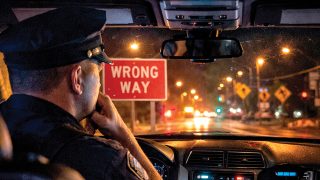
What works when driving? Exposure to cold air. Listening to the car radio (and, for better reaction times, listen to lively music and not audiotapes or radio programs).

What does not work when driving? Aiming air vents at face. Rolling down the windows. Turning up the radio. Pinching or slapping yourself! Do not bother with these strategies! Research proves there is no benefit. These strategies will not do the job.

Physical fitness

Stay in good physical condition. This is also an effective strategy to maintain or increase psychological resilience. But do not count on physical fitness alone to make oneself fatigue resistant.

Why? Physically fit people can withstand longer periods of physical activity or other demands on the body. If the work is mental rather than physical, however, there is likely no benefit to physical fitness.

Generally applicable techniques

Engage in stimulating conversation to keep the brain active. Rotate duties to minimize boredom. Squirm around in the seat. Stretch to enhance physiological arousal. Avoid sugary, fat-laden foods that may result in feelings of sluggishness. And always remember, the number one strategy to maximize alertness and performance today at work and in life — eight consolidated hours of sleep last night.

Dr. Stephanie Barone McKenny

Dr. Stephanie Barone McKenny

Dr. Stephanie Barone McKenny is the chair of the International Association of Chiefs of Police (IACP) Police Psychological Services Section (PPSS). She proudly served the men and women of the Los Angeles Police Department for over 20 years and continues to provide consultation to law enforcement agencies around the world as her mission. She is also a diplomate in sports psychology. All correspondence concerning this article should be addressed to Dr. McKenny at smckenny@gmail.com.

View articles by Dr. Stephanie Barone McKenny

As seen in the July 2021 issue of American Police Beat magazine.
Don’t miss out on another issue today! Click below:


SUBSCRIBE TODAY!

Categories: Editor's Picks, On the Job

Primary Sidebar

Recent Articles

  • The impact of the Graham v. Connor decision
  • Coffee shop intel
  • Developing and enhancing assertiveness
  • Mexican cartels recruit like industry titans on both sides of the border — and it’s working
  • Down to divorce
  • Unsung heroes: New York City correction officers
  • The virtual beat
  • Why more staff won’t fix your operational slowdowns
  • Training with an AI partner?
  • Curbing teen takeovers

Footer

Our Mission
To serve as a trusted voice of the nation’s law enforcement community, providing informative, entertaining and inspiring content on interesting and engaging topics affecting peace officers today.

Contact us: info@apbweb.com | (800) 234-0056.

  • Facebook
  • Instagram
  • Twitter

Categories

  • Editor’s Picks
  • On the Job
  • Labor
  • Tech
  • Training
  • Policy
  • Health/Wellness
  • Community
  • Offbeat
  • We Remember
  • Jobs and Careers
  • Events

Editor’s Picks

Smile and let them swing

Smile and let them swing

May 16, 2026

The job has changed — have you?

The job has changed — have you?

May 15, 2026

The days that follow

The days that follow

May 11, 2026

Perpetual recognition of line-of-duty deaths

Perpetual recognition of line-of-duty deaths

May 10, 2026

Policies | Consent Preferences | Copyright © 2026 APB Media, LLC | Website design, development and maintenance by 911MEDIA

Open

Subscribe

Close

Receive the latest news and updates from American Police Beat directly to your inbox!

  • This field is for validation purposes and should be left unchanged.