• Skip to primary navigation
  • Skip to main content
  • Skip to primary sidebar
  • Skip to footer
  • Home
  • About
  • The Magazine
  • Events
  • Partners
  • Products
  • Contact
  • Jobs and Careers
  • Advertise
  • Facebook
  • Instagram
  • Twitter
  • Subscribe
American Police Beat

American Police Beat Magazine

Law Enforcement Publication

  • Home
  • Leadership
    • Understanding the boundaries of professional relationships with the...
      Why you should lead from 30,000 feet
      Public perception and trust
      When performance reviews are a waste of time
      Taking a page from Toyota’s playbook
  • Topics
    • Leadership
      • Understanding the boundaries of professional relationships with the...
        Why you should lead from 30,000 feet
        Public perception and trust
        When performance reviews are a waste of time
        Taking a page from Toyota’s playbook
    • Editor’s Picks
      • Liability challenges in contemporary policing
        When performance reviews are a waste of time
        Proactive wellness visits
        Taking a page from Toyota’s playbook
        Law enforcement’s missing weapon
    • On the Job
      • Villains and heroes in the Big Apple
        Right place, right time — again
        Some good news on crime
        Mom-to-be named Cop of the Year
        Fatherly instincts save boy from icy water
    • Labor
      • The Promise Gap
        Cut the cops, save a dollar?
        Labor release under fire
        Who’s watching the watchmen?
        Crime and punishment (or lack thereof) in Seattle
    • Tech
      • New Mexico license plate readers save lives, lead to “precise...
        A modern field guide to understanding research in policing
        Gear that moves with you
        A new breed of cop car
        The future of patrol is here
    • Training
      • The five minutes before the ambulance
        Navigating danger
        Critical thinking in police training
        Threshold neuroscience
        Integrated virtual reality training
    • Policy
      • Corruption, collusion and impunity
        E-bikes spark public safety concerns
        Try racing without wheels
        Law enforcement accreditation: Why it matters
        Liability challenges in contemporary policing
    • Health/Wellness
      • Addressing stress, vicarious trauma and burnout
        Nervous system regulation
        The nature of the job
        Promoting organizational wellness
        Telling cops to get more sleep isn’t working
    • Community
      • Improving autism awareness
        Shop with a Cop
        Community engagement: What is it moving forward?
        Contradictory crossroads
        Back-to-school season brings out police support nationwide
    • Offbeat
      • An unexpected burglar
        Police humor only a cop would understand
        Not eggzactly a perfect heist
        Pizza … with a side of alligator?
        Wisconsin man charged with impersonating Border Patrol agent twice in...
    • We Remember
      • Heroes of the World Trade Center
        Forty heroes: United Airlines Flight 93
        The Pentagon
        A nation propelled to war, lives changed forever
        A Christmas loss
    • HOT Mail
      • The War on Cops Continues Unabated
  • On the Job
    • Villains and heroes in the Big Apple
      Right place, right time — again
      Some good news on crime
      Mom-to-be named Cop of the Year
      Fatherly instincts save boy from icy water
  • Labor
    • The Promise Gap
      Cut the cops, save a dollar?
      Labor release under fire
      Who’s watching the watchmen?
      Crime and punishment (or lack thereof) in Seattle
  • Tech
    • New Mexico license plate readers save lives, lead to “precise...
      A modern field guide to understanding research in policing
      Gear that moves with you
      A new breed of cop car
      The future of patrol is here
  • Training
    • The five minutes before the ambulance
      Navigating danger
      Critical thinking in police training
      Threshold neuroscience
      Integrated virtual reality training
  • Policy
    • Corruption, collusion and impunity
      E-bikes spark public safety concerns
      Try racing without wheels
      Law enforcement accreditation: Why it matters
      Liability challenges in contemporary policing
  • Health/Wellness
    • Addressing stress, vicarious trauma and burnout
      Nervous system regulation
      The nature of the job
      Promoting organizational wellness
      Telling cops to get more sleep isn’t working
  • Community
    • Improving autism awareness
      Shop with a Cop
      Community engagement: What is it moving forward?
      Contradictory crossroads
      Back-to-school season brings out police support nationwide
  • Offbeat
    • An unexpected burglar
      Police humor only a cop would understand
      Not eggzactly a perfect heist
      Pizza … with a side of alligator?
      Wisconsin man charged with impersonating Border Patrol agent twice in...
  • We Remember
    • Heroes of the World Trade Center
      Forty heroes: United Airlines Flight 93
      The Pentagon
      A nation propelled to war, lives changed forever
      A Christmas loss
  • HOT Mail
    • The War on Cops Continues Unabated
  • About
  • The Magazine
  • Events
  • Partners
  • Products
  • Contact
  • Jobs and Careers
  • Advertise
  • Subscribe
Search

On the Job

Officer mistakes a falling acorn for a gunshot

Here’s why it could easily happen again

Scott Savage Published April 22, 2024 @ 6:00 am PDT

Okaloosa County Sheriff’s Office

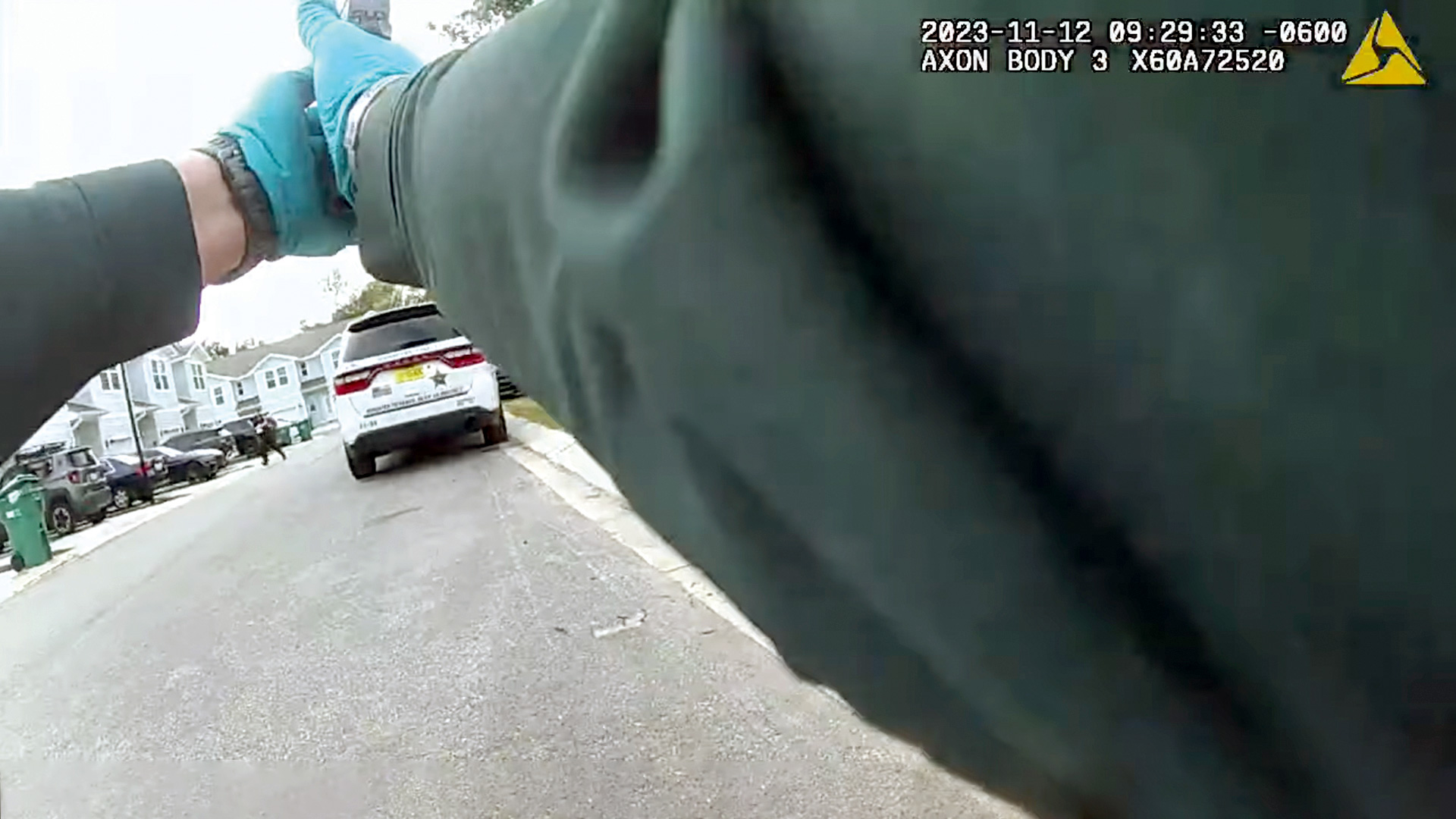
Early this year, body-worn camera footage was released that showed a Florida deputy mistaking a falling acorn striking his vehicle with the sound of a gunshot. He then shot several rounds at the handcuffed and unarmed prisoner sitting in the patrol car. The video went viral, both within and outside policing. Perhaps even more tragic than the incident is the fact that the rest of the law enforcement industry won’t get a chance to learn why it happened, nor how to prevent it from happening again. 

Let’s first consider what we know about the incident and then discuss what is preventing us from learning from it. The video is available at youtu.be/iVNnxr2SGFg.

Here’s what we know:

  • A deputy responded to a theft call. He patted down, handcuffed and secured the suspect in the back of his patrol car. 
  • The victim (the suspect’s girlfriend) showed responding deputies a photo of the suspect holding a silencer, suggesting he may have had access to firearms. 
  • Upon determining there was PC for an arrest for theft, the deputy returned to his vehicle intending to conduct a full custody search of the suspect. 
  • As he approached, an acorn fell from a tree and struck the top of the patrol car, causing a loud staccato sound. 
  • The deputy later stated he thought the sound was a gunshot from a suppressed weapon. He also believed he had been shot because he felt an impact on his torso, and his legs suddenly lost their normal function. 
  • In fact, the deputy had not been shot and the suspect was unarmed. 
  • The agency concluded his shooting was an unreasonable use of force and was outside of its use-of-force policy. 
  • The local prosecutor declined to file charges against the deputy. 
  • The deputy resigned.

(Source: Okaloosa County Sheriff’s Office Administrative Investigation report dated January 5, 2024.) 

Even an untrained observer could watch the video and find fault with the deputy’s response, but that isn’t where our analysis should end. As one astute poster on LinkedIn noted, “Just blaming this on somebody not doing their job well enough … that’s like pointing at a laceration and proclaiming ‘Cut!’ OK, but like why, how, and what do we do about it?” 

Exactly! What are we doing about it? Sadly, I am afraid the answer is nothing.

We must investigate the “why”

Law enforcement officers will watch the viral video, criticize the actions of the deputy and share silly memes of acorns on their social media feeds — but they will not learn a thing. The reason is that no investigation into the “why” will be conducted. 

The deputy’s agency completed an investigation looking for policy violations and found them. The local prosecutor’s office completed an investigation looking for criminal violations and declined to charge the deputy. But who is investigating why this happened? Who is examining the human factors or whether training played a role? In plain terms, we will never get to know why this happened and how to avoid this happening again, because no one is asking why. The deputy himself is not incentivized to share his story with researchers, and neither is the agency, because it will all be used against them in the inevitable civil lawsuit.

If this had been an aviation mishap, the authorities would come in and investigate the “why.” The investigation would culminate in a report that the aviation industry could read and learn from. There would be data on things like how many hours the pilot slept in the preceding nights. The industry would then use the findings to make changes in training and procedures. Wouldn’t it be amazing if law enforcement mishaps were studied like that, instead of only being analyzed for fault? Just think of how much the profession could advance! Certainly, the other investigations (administrative and criminal) needed to be conducted, but it’s tragic that is where the investigations stop.

How can officers learn from this event?

So, what are officers left to do? Many officers have watched the video and posted their criticism on social media. They believe they would never have taken such action. But without a robust analysis of what occurred, how can any of us say for certain how things like priming, post-traumatic stress, sleep deprivation or any number of other factors might impact our decision-making? 

Some commenters on social media posted things like, “This guy never should have been a cop! Why are they hiring people like this?” — implying the deputy lacked the kind of mental acuity or stress tolerance needed to be a cop. Those same commenters may be shocked to learn the deputy in this case was a graduate of West Point, an officer in the U.S. Army’s Special Forces and twice deployed to tours in Afghanistan. Without knowing more, the deputy certainly seems like someone with the proper background to thrive in a high-stress environment. 

Some commented that the deputy’s agency had dealt with several life-threatening incidents in the time preceding the shooting and suggested those incidents played a role. 

Unfortunately, we’ll never know. We will never have a chance to learn from this incident beyond whatever assumptions can be gleaned simply from watching the video. Certainly, the video does tell us a lot, and we can and should learn from it. But, if you were captured on video in a highly controversial shooting, I bet you would say that the video doesn’t tell the whole story. 

The agency’s investigative report concluded that the deputy subjectively believed he had been shot, but it wasn’t objectively reasonable for him to use deadly force. Wouldn’t it be good for the rest of us to know what factors caused the deputy to honestly believe he was shot, even believing his own legs were no longer functioning properly? This deputy, like every cop, is a human, with human performance capabilities, fallibilities and limitations. Because we all have brains, it is vital that we understand how those brains work and what causes our fallible brains to believe things that aren’t true.

Final thoughts

When an important judicial decision is made, it creates what is known as case law. Law enforcement officers are expected to read those new decisions and modify how they conduct themselves accordingly. To me, it seems most case law decisions are about the use of force. Yet there is no similar system that allows officers to learn from nonjudicial aspects of force encounters, and there are many. Imagine how policing could improve if, instead of just investigating incidents to find blame, we also investigated incidents to learn how to prevent them from happening in the first place.

Scott Savage

Scott Savage

Scott Savage is an active-duty law enforcement officer in Northern California. He is also the founder of the Savage Training Group, a professional law enforcement training organization. For more information, go to savagetraininggroup.com.

View articles by Scott Savage

As seen in the April 2024 issue of American Police Beat magazine.
Don’t miss out on another issue today! Click below:


SUBSCRIBE TODAY!

Categories: On the Job

Primary Sidebar

Recent Articles

  • Heroes of the World Trade Center
  • The Promise Gap
  • Corruption, collusion and impunity
  • The five minutes before the ambulance
  • New Mexico license plate readers save lives, lead to “precise policing”
  • Addressing stress, vicarious trauma and burnout
  • Understanding the boundaries of professional relationships with the boss
  • E-bikes spark public safety concerns
  • Improving autism awareness
  • Cut the cops, save a dollar?

Footer

Our Mission
To serve as a trusted voice of the nation’s law enforcement community, providing informative, entertaining and inspiring content on interesting and engaging topics affecting peace officers today.

Contact us: info@apbweb.com | (800) 234-0056.

  • Facebook
  • Instagram
  • Twitter

Categories

  • Editor’s Picks
  • On the Job
  • Labor
  • Tech
  • Training
  • Policy
  • Health/Wellness
  • Community
  • Offbeat
  • We Remember
  • Jobs and Careers
  • Events

Editor’s Picks

Liability challenges in contemporary policing

Liability challenges in contemporary policing

February 27, 2026

When performance reviews are a waste of time

When performance reviews are a waste of time

February 26, 2026

Proactive wellness visits

Proactive wellness visits

February 25, 2026

Taking a page from Toyota’s playbook

Taking a page from Toyota’s playbook

February 23, 2026

Policies | Consent Preferences | Copyright © 2026 APB Media, LLC | Website design, development and maintenance by 911MEDIA

Open

Subscribe

Close

Receive the latest news and updates from American Police Beat directly to your inbox!

  • This field is for validation purposes and should be left unchanged.