• Skip to primary navigation
  • Skip to main content
  • Skip to primary sidebar
  • Skip to footer
  • Home
  • About
  • The Magazine
  • Events
  • Partners
  • Products
  • Contact
  • Jobs and Careers
  • Advertise
  • Facebook
  • Instagram
  • Twitter
  • Subscribe
American Police Beat

American Police Beat Magazine

Law Enforcement Publication

  • Home
  • Leadership
    • Perpetual recognition of line-of-duty deaths
      Understanding the boundaries of professional relationships with the...
      Why you should lead from 30,000 feet
      Public perception and trust
      When performance reviews are a waste of time
  • Topics
    • Leadership
      • Perpetual recognition of line-of-duty deaths
        Understanding the boundaries of professional relationships with the...
        Why you should lead from 30,000 feet
        Public perception and trust
        When performance reviews are a waste of time
    • Editor’s Picks
      • Let’s get moving!
        Heroes of the World Trade Center
        The Promise Gap
        Corruption, collusion and impunity
        Liability challenges in contemporary policing
    • On the Job
      • Testing the waters — literally
        Frankpledge to forensics: A brief history of law enforcement
        Villains and heroes in the Big Apple
        Right place, right time — again
        Some good news on crime
    • Labor
      • The Promise Gap
        Cut the cops, save a dollar?
        Labor release under fire
        Who’s watching the watchmen?
        Crime and punishment (or lack thereof) in Seattle
    • Tech
      • New Mexico license plate readers save lives, lead to “precise...
        A modern field guide to understanding research in policing
        Gear that moves with you
        A new breed of cop car
        The future of patrol is here
    • Training
      • Pushback as a training signal
        Let’s get moving!
        The five minutes before the ambulance
        Navigating danger
        Critical thinking in police training
    • Policy
      • Police pause license plate readers
        Corruption, collusion and impunity
        E-bikes spark public safety concerns
        Try racing without wheels
        Law enforcement accreditation: Why it matters
    • Health/Wellness
      • The days that follow
        Addressing stress, vicarious trauma and burnout
        Nervous system regulation
        The nature of the job
        Promoting organizational wellness
    • Community
      • Improving autism awareness
        Shop with a Cop
        Community engagement: What is it moving forward?
        Contradictory crossroads
        Back-to-school season brings out police support nationwide
    • Offbeat
      • An unexpected burglar
        Police humor only a cop would understand
        Not eggzactly a perfect heist
        Pizza … with a side of alligator?
        Wisconsin man charged with impersonating Border Patrol agent twice in...
    • We Remember
      • A Tribute to Fallen Heroes
        Markers of service and remembrance
        Tragedy strikes Baker to Vegas
        Heroes of the World Trade Center
        Forty heroes: United Airlines Flight 93
    • HOT Mail
      • The War on Cops Continues Unabated
  • On the Job
    • Testing the waters — literally
      Frankpledge to forensics: A brief history of law enforcement
      Villains and heroes in the Big Apple
      Right place, right time — again
      Some good news on crime
  • Labor
    • The Promise Gap
      Cut the cops, save a dollar?
      Labor release under fire
      Who’s watching the watchmen?
      Crime and punishment (or lack thereof) in Seattle
  • Tech
    • New Mexico license plate readers save lives, lead to “precise...
      A modern field guide to understanding research in policing
      Gear that moves with you
      A new breed of cop car
      The future of patrol is here
  • Training
    • Pushback as a training signal
      Let’s get moving!
      The five minutes before the ambulance
      Navigating danger
      Critical thinking in police training
  • Policy
    • Police pause license plate readers
      Corruption, collusion and impunity
      E-bikes spark public safety concerns
      Try racing without wheels
      Law enforcement accreditation: Why it matters
  • Health/Wellness
    • The days that follow
      Addressing stress, vicarious trauma and burnout
      Nervous system regulation
      The nature of the job
      Promoting organizational wellness
  • Community
    • Improving autism awareness
      Shop with a Cop
      Community engagement: What is it moving forward?
      Contradictory crossroads
      Back-to-school season brings out police support nationwide
  • Offbeat
    • An unexpected burglar
      Police humor only a cop would understand
      Not eggzactly a perfect heist
      Pizza … with a side of alligator?
      Wisconsin man charged with impersonating Border Patrol agent twice in...
  • We Remember
    • A Tribute to Fallen Heroes
      Markers of service and remembrance
      Tragedy strikes Baker to Vegas
      Heroes of the World Trade Center
      Forty heroes: United Airlines Flight 93
  • HOT Mail
    • The War on Cops Continues Unabated
  • About
  • The Magazine
  • Events
  • Partners
  • Products
  • Contact
  • Jobs and Careers
  • Advertise
  • Subscribe
Search

Training

Dealing with combative subjects

Dave Bryant Published July 22, 2024 @ 6:00 am PDT

istockphoto.com//kali9

We spend a good deal of training time teaching law enforcement officers how to use firearms safely and effectively. We also teach verbal skills to gain compliance from a population that often has no respect for authority. “De-escalation” is a term in vogue that has long replaced “ask ’em, tell ’em, make ’em,” which was the progression before we more specifically defined levels in a force continuum.

It is always best to win with words. Contrary to what some of the public and media believe, LEOs take extreme risks to avoid using deadly force even when it is clearly justified. It is good that we are reluctant to use our guns, but we need to always be aware that it may be necessary. All our confrontations are armed confrontations since we carry weapons, even if the subject brings none. Keeping our tools from being used against us is always a concern.

In the fluid dynamics of human combat, our objective can change from control to survival in a second.

Where we are deficient is the huge middle area where words won’t work and deadly force is not appropriate. Many LEOs are so reluctant to put their hands on a criminal that their failure to act causes the situation to escalate, ultimately making greater levels of force necessary. We tend to get mentally locked into being dependent on our tools. We expect them to work as they did in training, with the subject being neatly handcuffed. A few well-placed baton strikes should gain compliance, right? But what if you have a combative Rodney King who is numbed by drugs? Do you keep striking him along with your colleagues until he submits? What happens when the Taser fails to make that perfect connection for instant incapacitation? Or a spray of OC just pisses off a drunk? Couple this with our citizens’ perception of appropriate use of force and the problem becomes clear. The public has been trained by Hollywood that we can magically control aggressive opponents without injury if we choose to. Real violence is so upsetting to bystanders that they quickly sympathize with the criminal who is actively resisting, reframing him as the “victim” of
police brutality.

Mike Tyson, a street thug doing robberies for which he was convicted as a juvenile delinquent and locked up before turning his talent for fighting into a successful boxing career, wisely observed, “Everybody has a plan until they get punched in the face.” Today’s police recruits may have never been in a fight. That experience may be overwhelming for them. If it first happens on the street, the result can be tragic if they respond inappropriately with either too little or too much force for the situation. As trainers, we can provide some “environmental inoculation” by adding wrestling in the academy. Although it helps, it cannot simulate the overwhelming fear that comes from having another human being actively trying to kill you.

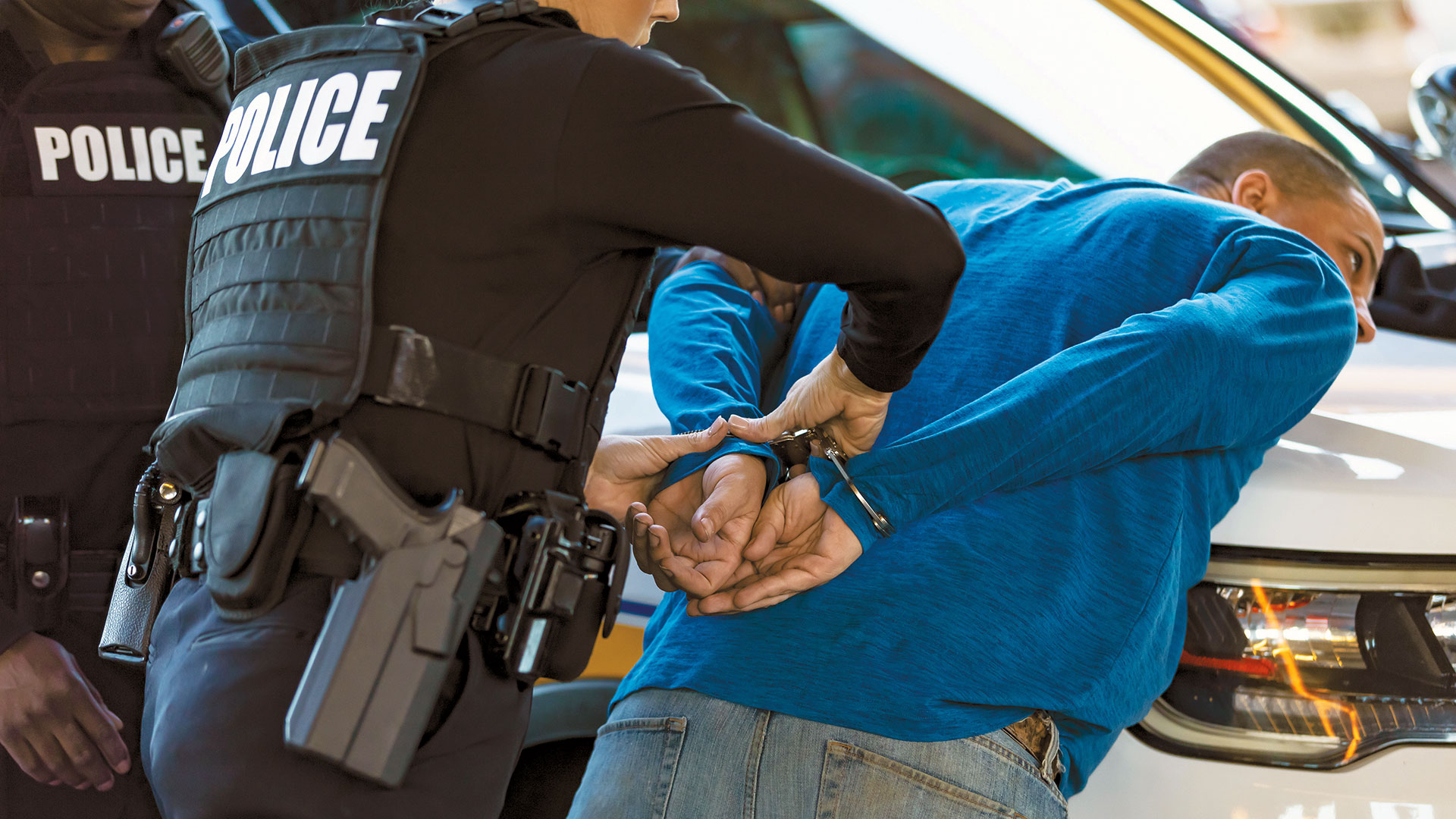
Recognizing the dynamics of human combat and the limitations of our tools can help us in these situations. Experience is ideal, but you must survive a lot of trial and error to gain that wisdom. You dramatically enhance your skills by getting some ground fighting training. Jiu-jitsu or sport judo can put some great techniques in your tactical tool kit. Of course, fighting on a soft, well-lit mat, with a referee, provides only a fraction of the intensity of fighting on the street with infinite deadly variables. But you will gain confidence and become more comfortable going hands-on with an adversary. Keep in mind that the goal of these games is to pin the opponent on their back or get them to tap out in submission. That differs from our goal, which is to get a resisting criminal face down with their hands cuffed behind their back.

Our tactics will vary depending on whether we are winning or losing the fight and can change quickly during the encounter. We must adapt to those changes to survive the battle and be able to articulate them in order to survive the litigation and criticism that is sure to follow.

We want to gain compliance using words alone if possible. What force is used will be determined solely by the person we are confronting and the choices they make. Our response to their behavior will either embolden them or deter them from more aggressive action. Controlling perception is important in influencing their choices and avoiding force. Obviously, some criminals feel they have nothing to lose and will fight regardless, so we must be prepared for them too. Timing is everything. Going hands-on too late can be as perilous as too early. Certainly, you want to “give peace a chance,” but when it is clear that your subject is unwilling, delay may appear as weakness, which can necessitate even higher levels of force.

There are relevant psychological and physiological aspects to fighting. Stress is a factor that is reduced by the confidence that comes from training. Breathe deeply. During physical combat, adrenaline kicks in and you will not feel pain as much. Your opponent is also experiencing this, in addition to any drugs or mental illness they bring to the encounter. That’s why many pain compliance techniques that work great in training suddenly are ineffective on the street.

When we are winning the fight, we can use minimal force to gain the control necessary to get the offender handcuffed. This is where understanding the mechanics of control holds like armbars and wristlocks really pays off. However, when we are losing, everything changes. When we fight to survive, we use whatever is necessary to get back to controlling the aggressor or preventing them from killing us. In the fluid dynamics of human combat, our objective can change from control to survival in a second. Generally, the longer the fight goes on, the more likely you are to get hurt or have to hurt your adversary. You must win every encounter. You may not win by arrest, but you must win by surviving. I highly recommend you seek to obtain that warrior mindset from folks like Dave Grossman, the Street Survival seminars from Calibre Press or other qualified experts who have actually been there.

Take care of yourself and stay safe.

Dave Bryant

Dave Bryant

Dave Bryant is a retired police officer with over 30 years of experience with several agencies. He is an FDLE and NRA law enforcement instructor and active member of IALEFI. He has a private business as a polygraph examiner in Tampa, Florida. He can be reached at SenseiDave@msn.com.

View articles by Dave Bryant

As seen in the July 2024 issue of American Police Beat magazine.
Don’t miss out on another issue today! Click below:


SUBSCRIBE TODAY!

Categories: Training

Primary Sidebar

Recent Articles

  • A hero’s legacy through a mother’s love
  • The days that follow
  • Perpetual recognition of line-of-duty deaths
  • A Tribute to Fallen Heroes
  • NLEOMF Fund announces March 2026 Officers of the Month
  • Markers of service and remembrance
  • Testing the waters — literally
  • Police pause license plate readers
  • Tragedy strikes Baker to Vegas
  • Frankpledge to forensics: A brief history of law enforcement

Footer

Our Mission
To serve as a trusted voice of the nation’s law enforcement community, providing informative, entertaining and inspiring content on interesting and engaging topics affecting peace officers today.

Contact us: info@apbweb.com | (800) 234-0056.

  • Facebook
  • Instagram
  • Twitter

Categories

  • Editor’s Picks
  • On the Job
  • Labor
  • Tech
  • Training
  • Policy
  • Health/Wellness
  • Community
  • Offbeat
  • We Remember
  • Jobs and Careers
  • Events

Editor’s Picks

Let’s get moving!

Let’s get moving!

April 27, 2026

Heroes of the World Trade Center

Heroes of the World Trade Center

April 24, 2026

The Promise Gap

The Promise Gap

April 22, 2026

Corruption, collusion and impunity

Corruption, collusion and impunity

April 21, 2026

Policies | Consent Preferences | Copyright © 2026 APB Media, LLC | Website design, development and maintenance by 911MEDIA

Open

Subscribe

Close

Receive the latest news and updates from American Police Beat directly to your inbox!

  • This field is for validation purposes and should be left unchanged.