Officer-involved shootings suck. Having to shoot with one hand in an officer-involved shooting would suck even more. There’s no reason to make a bad day even worse, so we need to practice and be ready for those worst-case scenarios.
None of us practices one-handed shooting skills as often as we should. It took me being embarrassed at the 2022 Gulf Coast IDPA Championship to get serious about my single-hand shooting skills. It wasn’t practicing the skills needed to save my life. It wasn’t practicing because I know officers who had to shoot one-handed to prevail in a gunfight. It was ego, plain and simple. My performance in competition embarrassed me, and I decided that wasn’t going to happen again. Ego.
Intentional training helps refine movement patterns, whereas mindless repetition reinforces bad technique.
Reality bites
The fact is that most shooters perform very poorly when they need to shoot with either strong hand or support hand only. But if they ever need to do this in a fight for their lives, they will need to be very good on demand. Ask Ukiah, California, Police Sergeant Marcus Young (ret.) about the need to fight effectively with only one hand.
On March 7, 2003, Young and 17-year-old police cadet Julian Covella responded to a local Walmart on a shoplifting call. After arriving and taking a young female into custody, Young and Covella escorted her to the patrol car and placed her in the back seat. The female’s boyfriend was none too pleased with this turn of events and decided his girlfriend was not going to jail.
As the male approached, he was a real-life depiction of evil: tattoos of Satan horns on his forehead and a violent streak, with the history to back it up. As he got closer, Young commanded him to take his hands out of his pockets. When his hands came out, he was holding a fixed-blade hunting knife in his left hand and a Smith & Wesson Model 637 revolver in his right.
Young grabbed the knife hand and twisted the suspect’s arm, feeling something snap and pop, but the suspect refused to let go. Instead, a bright flash and searing heat erupted as Young realized he had been shot in the face at close range. Four more rounds struck Young’s right arm, rib cage and back.
Young tried to draw his duty weapon, but his strong arm was completely paralyzed. He attempted to use his support hand to draw his pistol, but his hand was ripped open, with torn tendons visible through the wounds. Young told Covella to remove the Beretta .40 S&W pistol from the holster and put it in his hand.
During this time, the devil in human form had entered the patrol car and was trying to access the Remington 870 shotgun and the HK33 rifle, which were locked in the vehicle gun racks.
Young fired his first shot through the car door but failed to hit the demon. His second shot also missed, causing the demon to turn and face him. The third round hit the devil squarely in the forehead, but instead of stopping him, it knocked him into the vehicle’s front seat. The round penetrated the skin but traveled along the skull before exiting the rear crown of his head. Since it never penetrated the skull, the wound was gruesome but not life-threatening.
Young fired a fourth time, knocking the devil still and causing him to die at the scene. Somewhat poetically, the fight-stopping wound occurred when he had presented his buttocks toward Young, and the final shot penetrated his butt, traveled deep inside, pierced his liver and came to a stop in his neck. The good guy had prevailed over evil.
By no means is this the only example. Another notable case was when FBI Special Agent Edmundo Mireles used one-handed shooting skills to prevail in one of the most well-known law enforcement gunfights in U.S. history. On April 11, 1986, Mireles was badly wounded in the famous Miami shootout but finished the gunfight by wounding one suspect with shotgun blasts after cycling and firing a pump-action shotgun with one hand during the gun battle. He then advanced on the two suspects, who were trying to flee in a vehicle, and finished the fight with headshots fired with one hand from his handgun.
These are only two well-known and widely publicized examples of law enforcement heroes using one-handed shooting skills to prevail under the worst possible conditions. If it can happen to them, it can happen to you.
Tips for success
We all need to work on our one-handed skills, and the first step is to admit we have a problem. So, my name is Todd Fletcher, and I am a one-handed training avoider.
Now that we have admitted our problem and accepted it, let’s get to work. First, anytime I have a practice session, I will work on one-handed shooting skills. Maybe not a lot, but I will do something strong-hand only and support-hand only. Every time.
Quality repetitions over quantity is the goal. Work with purpose instead of trying to reach a certain number. This high-quality work, with controlled form, builds superior performance instead of wasting time and ammunition on too many lazy reps. Intentional training helps refine movement patterns, whereas mindless repetition reinforces bad technique. When it comes to mental focus, this quality work requires being present and “in the moment,” allowing you to recognize subtle muscle movements and sight movement.
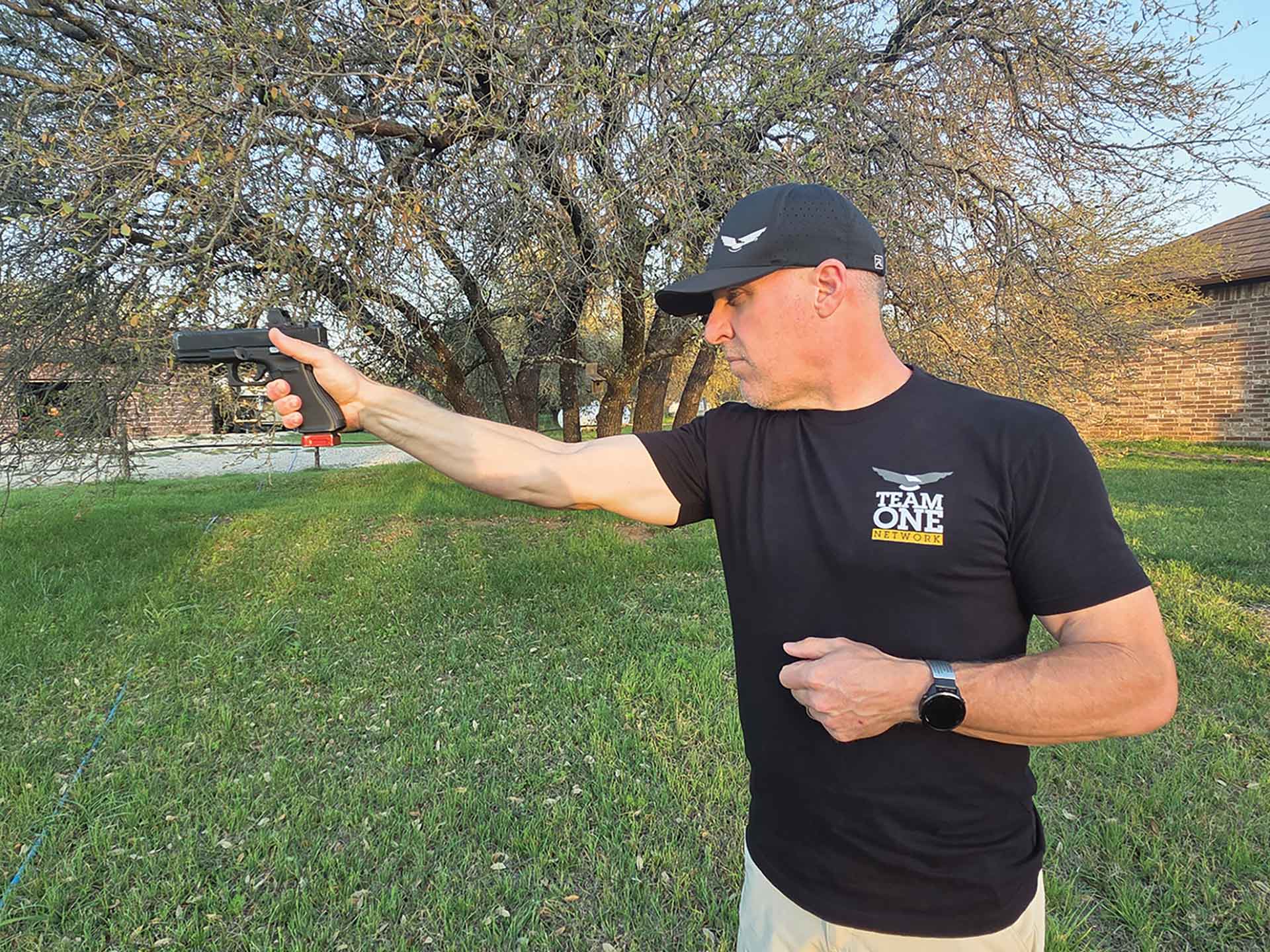
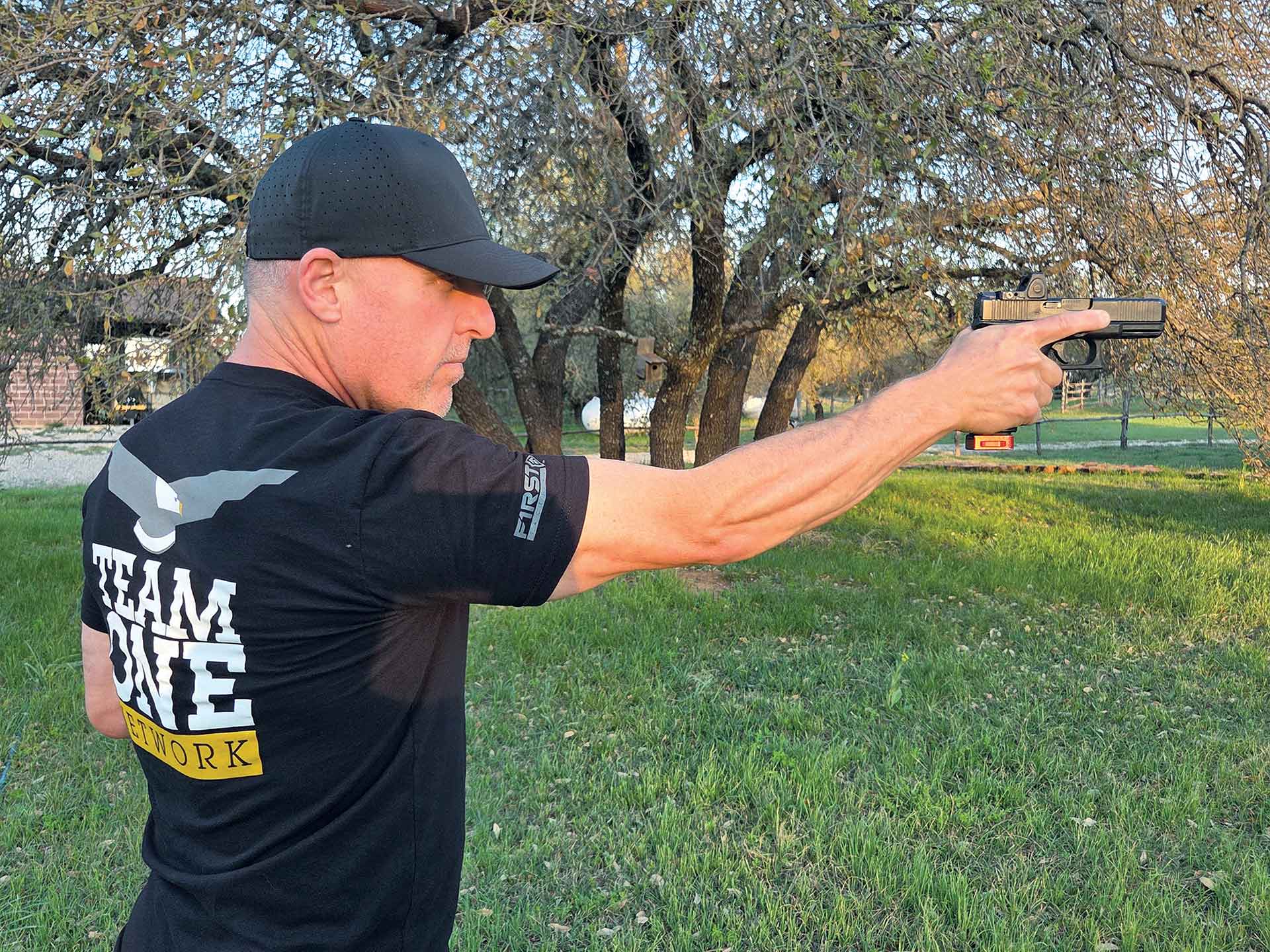
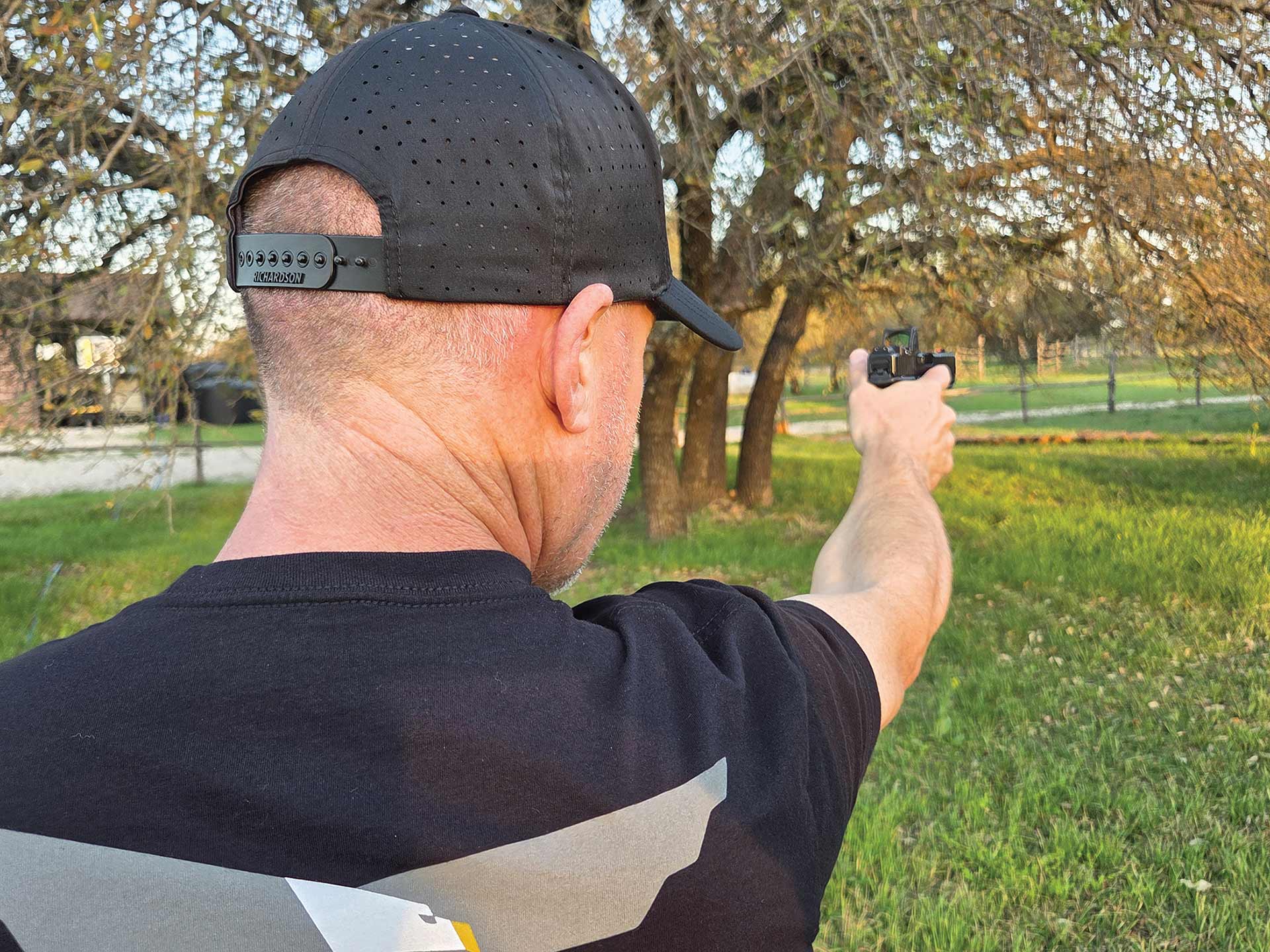
When it comes to form, Team Sig professional shooter Mason Lane describes one-hand-only shooting as, “Your pistol is the remote, and the target is a laggy TV.” Push the pistol out toward the target and into your eye-target line, as if getting the remote closer to the TV will help it work better.
A lot of officers, me included, were taught to slightly cant the pistol inward, but pushing your shoulder and pistol forward while maintaining a slight bend in the elbow has helped me shoot much more accurately and recover the pistol back on target faster between shots. Faster recovery equals faster sight acquisition, which equals faster and more accurate shots on target.
As I push the pistol out, I rotate my shoulder forward to get it behind the pistol and in line with my arm. This keeps recoil moving back and up, like I’m used to seeing and feeling when shooting with two hands. Predictable sight travel means faster sight acquisition. And like I said above, that means more accuracy and faster follow-up shots.
Practice the hard stuff
The next time you’re heading to the range for some live-fire training, or working on dry-fire skills, make sure you take the time to get some quality repetitions doing strong-hand and support-hand-only training. It won’t be as fun or exciting as run-and-gun, go-fast CDI operator stuff, but it just might save your life. Ask Sergeant Marcus Young and Special Agent Ed Mireles what they think about working these skills.

Todd Fletcher
As seen in the May 2026 issue of American Police Beat magazine.
Don’t miss out on another issue today! Click below: