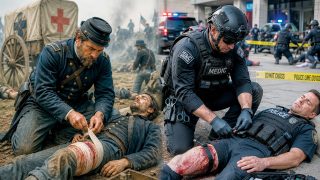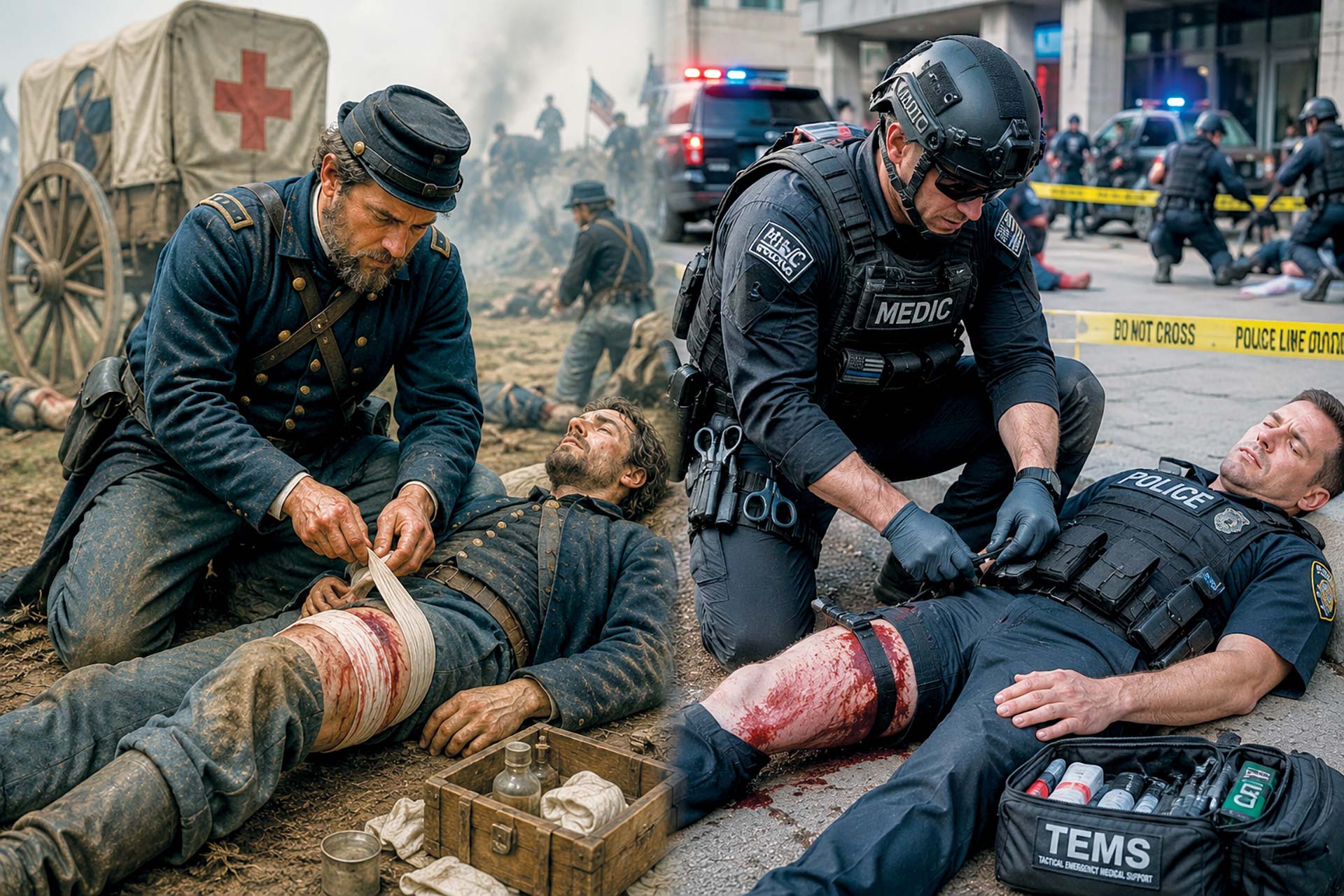
Tactical medicine is “good medicine in bad places.” It is a specialized medical discipline that provides immediate, lifesaving care to personnel in high-threat environments — officer-down situations, active shooter scenes, hostage crises and mass-casualty incidents. Trained sworn personnel treat injuries and preserve the team’s operational readiness.
This article highlights high-profile critical incidents that did and did not use tactical medicine, the American Civil War roots of tactical medicine and how you can be trained in tactical medicine. Key takeaways are also shared.
High-profile incidents that did not use tactical medicine
9-1-1 call: “Officer needs help, shots fired at the Bank of America on Laurel Canyon.” The 1997 North Hollywood shootout, also known as the “battle of North Hollywood,” involved two suspects, more than 300 LAPD officers, approximately 2,000 rounds of ammunition (most of it fired by the two suspects) and lasted 44 minutes. Twelve officers and eight civilians were injured, pinned down by gunfire (or simply unable to extricate themselves) and unable to access or be transported to EMS. At the time of this shooting, tactical medicine and modern “active shooter” protocols did not exist for patrol officers. Police were trained to establish perimeters and wait for SWAT while paramedics staged blocks away until a scene was secure. This left officers relying on basic first aid and self-rescue.
9-1-1 call: “It looked like the guy had a semi-automatic pistol. He went in, he just started firing.” The 2011 shooting at a constituent meeting in Tucson, Arizona, known as the “terror in Tucson,” involved one suspect who shot 33 rounds and lasted 19 seconds. Six died and 14 were wounded, including U.S. Representative Gabrielle Giffords, who was shot in the head. At the time of
this shooting, standard EMS protocols dictated that paramedics stage away from active violence. Tactical medicine was strictly reserved for SWAT teams and military units.
9-1-1 call: “We’ve got a whole bunch of people shot out here and no rescue.” The 2012 Aurora, Colorado, movie theater shooting, known as the “Batman cinema shooting,” involved one suspect who fired 65 rounds from a semi-automatic rifle, six rounds from a shotgun and five rounds from a .40-caliber handgun. Twelve people were killed and 70 were injured (including
58 who were directly shot). At the time of this shooting, widespread law enforcement and fire department training in tactical medicine was not standard practice in the U.S. Medically trained law enforcement personnel would have been an invaluable resource to save lives.
This specialized discipline bridges the gap between active threats and emergency care.
A high-profile incident that prominently used tactical medicine
The Inland Regional Center in San Bernardino, California, was the site of a deadly terrorist attack and mass shooting in 2015. Forward-deployed officers trained in tactical medicine entered the building alongside SWAT. Tactical triage included rapidly assessing and tagging victims with medical tape while navigating a smoky, sensory-overload environment. Immediate trauma care — tourniquets, occlusive chest seals and wound-clot dressings — was provided. Improvisation and immediate rescue included using blankets and chairs to extract the wounded. An immediate casualty collection point for primary triage and treatment was established in the parking lot and then later moved farther out to a golf club. Rapid trauma transport included using a continuous flow of patrol vehicles to rush critical shooting victims to nearby trauma centers. There was no waiting for RAs.
The success of medical interventions in chaotic, dangerous environments led to the adoption of the Hartford Consensus (2013), which integrates police and fire-rescue personnel to rapidly enter active-threat scenes and stop preventable deaths.
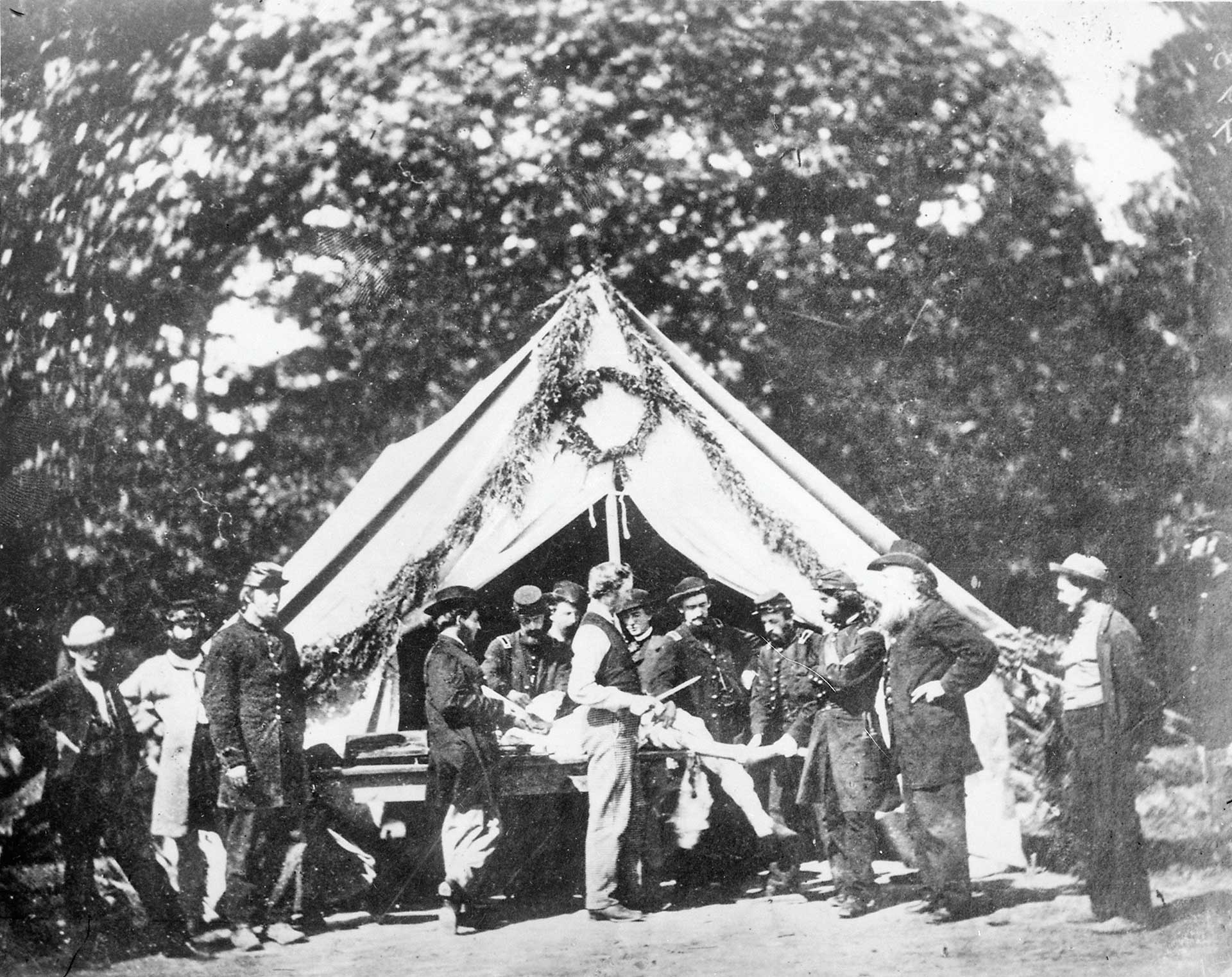
The Civil War and the Letterman Plan
Tactical medicine and modern trauma care trace their foundational roots to the American Civil War. The unprecedented casualty rates necessitated revolutionary changes in battlefield organization, triage and rapid evacuation, shaping the way military and civilian first responders operate today.
Physicians began to view disease differently. Disease was no longer seen as an imbalance of the body that required bleeding to cure soldiers. Civil War doctors began to believe that illness was caused by something outside the body and spread from person to person — contagious disease.
Steps taken to ensure proper medical care of wounded soldiers. Wounded soldiers were transported more efficiently to medical facilities via the very first ambulances. The Union Army hired the Ambulance Corps to transport the wounded. A more efficient medical process was also provided to wounded soldiers. Stop 1 was the dressing station, where injuries were examined, bleeding was stopped and wounds were bandaged. If treatment was successful, soldiers could return to battle. Stop 2 was surgery at the field hospital. Field hospitals, which sometimes took on the appearance of entire tent cities, were typically located one and a half to two miles away. They could also be established in churches, schools, homes or even large tents.
Development of critical tools for healing. Two drugs were used for anesthesia during surgeries. Chloroform was fast-acting and was therefore used in the field. Ether was used in the slower-paced general hospitals because it did not work as quickly as chloroform and lacked some of chloroform’s side effects, including patient vomiting, loss of strength and overexcitement.
Medical procedures to save lives. Amputation was the most common surgical procedure during the Battle of Gettysburg, with more than 60,000 recorded cases, and it saved lives. It was the quickest solution for a shattered limb. It was also the best chance to prevent infection, because antibiotics did not exist during that era, and to prevent excessive blood loss due to hemorrhage. If the amputation occurred in the first 24 hours, a soldier’s chance of dying was 27%. If performed after those critical first hours, the rate increased to 52%. Sometimes, it simply came down to sacrificing the limb to save the life.
Commonplace nature of disease and infection during battle. Two out of every three soldiers died from disease. Of those who died from battle wounds, 39% actually died from infection resulting from those wounds. That is why amputation could save a soldier’s life. Diarrhea and dysentery were the most commonly treated illnesses and were also the illnesses most responsible for soldier deaths. During the first two years of the Civil War, for example, 27% of all illnesses treated by Confederate physicians were related to diarrhea.
Compromised setting of a battleground and its geography. Human geography included the roads that allowed for the quick and efficient transportation of Union forces, including the Ambulance Corps. It also included buildings, as residential homes in town were used as hospitals and shelters for the troops. Physical geography included land cover that helped minimize heat stroke and other severe health problems.
Trailblazing Union doctor revolutionized combat medicine and pioneered hygiene and diet standards. Jonathan Letterman was known as the “father of battlefield medicine” and an “organizational genius.” He established the first professional Ambulance Corps, reorganized military hospital care closer to the battlefield site, improved medical supply and much more. He served as the medical director of the Army of the Potomac. He developed the Ambulance Corps system for removing the wounded from the battlefield and a system of division field hospitals. He also improved soldiers’ diets and sanitary conditions. Even plants and herbs were used as crops and substitution foods, herbal medicines and healthcare for bullet-torn bodies.
How today’s law enforcement officers can be trained in tactical medicine
Tactical Emergency Medical Support (TEMS) courses (e.g., NorCal TacMed, STOPS Medical and Kentucky Tactical EMS) are intensive one-week (40-hour) courses. Federal Law Enforcement Training Centers (FLETC) host Basic Tactical Medical Instructor Training Programs (BTMITP). Check the Commission on POST standards for regional law enforcement training requirements in California.
Key takeaways
- Tactical medicine saves officers’ lives. This specialized discipline bridges the gap between active threats and emergency care. The main priority is controlling massive hemorrhages while under intense psychological and environmental stress.
- Civil War medicine laid the foundational systems for modern emergency care and trauma response. Faced with unprecedented casualties, military surgeons developed modern triage, ambulance evacuations and hospital structures, directly shaping the emergency medicine and public health protocols upon which our great nation currently relies.
- You can learn these skills. You can bridge the critical, life-threatening window of time before traditional EMS can safely enter a scene. You can render aid to bystanders or victims who are trapped. You can instantly treat your own injuries or those of your partners.

Dr. Stephanie Barone McKenny and Trinity McKenny
As seen in the July 2026 issue of American Police Beat magazine.
Don’t miss out on another issue today! Click below: