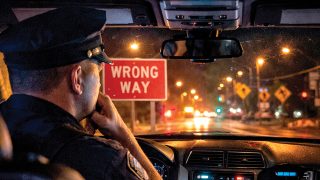
We’re all starring in a movie that’s starting to feel more like Blade Runner than L.A. Confidential. Artificial intelligence (AI) has officially jumped the curb, moving from the imaginary pages of a sci-fi script into the very real patrol cars and training centers of everyday policing.
This is the emergence of a Multi-Cognitive Workplace™, where officers are using AI for report writing, body camera review, predictive analytics and mental health assessment.[1]First look: Adding AI to simulator training. Police Magazine. (2025, June 18). policemag.com/articles/first-look-adding-ai-to-simulator-training. It’s in the training room, too, where VR simulation includes unscripted conversations with AI agents.1 In many agencies, you’re already expected to use these tools daily — and the reactions in the field appropriately range from curiosity to concern.
Law enforcement professionals evaluate tools based on performance and reliability. A flashlight either shines or it doesn’t; a radio either transmits or it breaks up. When working with predictive analytics like facial recognition or weapon detection, you know to train with a critical eye and question everything. But how do you work with AI that actually works pretty well?
Training with AI is training to work with AI
When a computer spits out a list of search results, your brain responds to a dataset. It’s a tool, like your flashlight. But when a tool answers in full sentences, mirrors your tone and offers advice with absolute confidence, your brain responds as if you’ve just met an officer with years of experience. You trust their perspective and quickly feel a sense of collaboration, activating your social brain.
The human brain reads tone and judges confidence to determine intent, threat or need. When a digital suspect or victim responds with zero hesitation, it triggers a signal of certainty. The brain recognizes this voice as a human-like presence and prioritizes social interaction over tactical data.
The brain doesn’t process these conversational signals the same way it processes the beam of a flashlight. We have dedicated neural pathways designed to help us show others we are trustworthy while also evaluating the integrity and reliability of others. We spend our lives reading tone, judging confidence and deciding in milliseconds whether the person we’re talking to sounds like they know their stuff. This helps us make rapid decisions in high-stakes situations.
Working with AI to improve cognitive load capacity?
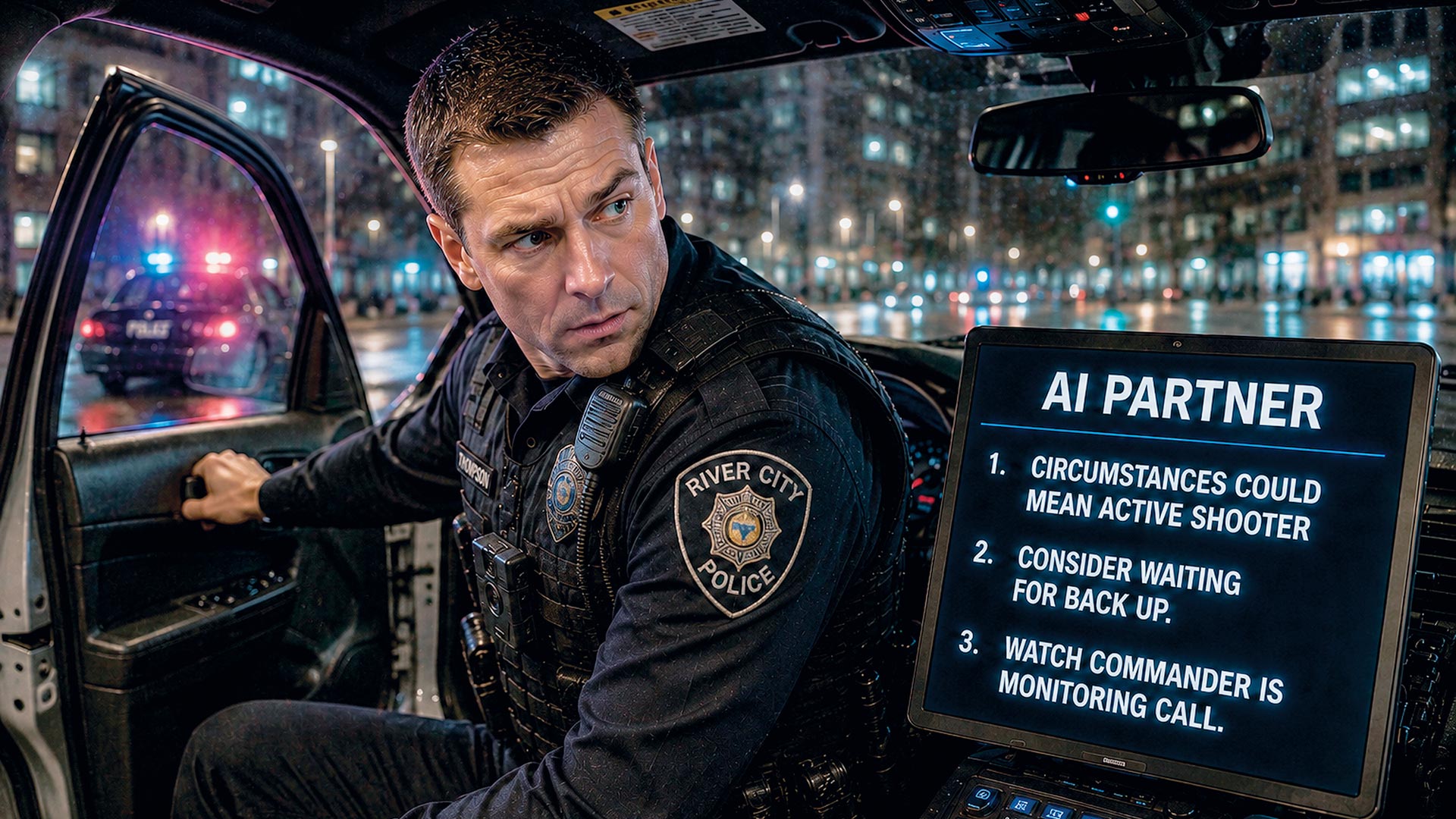
An officer’s cognitive load has a tipping point. You’re already watching hands, scanning the backdrop, listening to the radio and managing a physiological spike. Adding a human-like AI component to the mix introduces a new relationship to manage.
However, training under this added weight offers a unique opportunity. By intentionally integrating these complex social signals into high-stress scenarios, we have the potential to build a more robust mental schema. Just as physical training increases muscular capacity, training in a multi-cognitive environment forces the brain to adapt to higher levels of complexity.
Whether the AI is being helpful, hallucinating, getting escalated or acting like a partner, your brain stays in a loop of social awareness. You’re evaluating the tool and the outputs at the same time you’re evaluating the potential threat. This extra layer of uncertainty is weight you can’t afford to carry — unless you’ve trained to carry it. By leaning into this complexity during training, officers can expand their cognitive bandwidth, learning to process the machine’s input without sacrificing tactical intuition.
AI as an instructor’s force multiplier
When used in training, AI shouldn’t replace the instructor, but rather provide them with another tool to assist and assess officer performance. While an instructor is focused on the officer’s actions and control of the simulation, the AI can act as a secondary observer, tracking granular data points — like how many times an officer repeated a command.
This allows for a debrief based on objective metrics. It gives the instructor the data to show an officer exactly where their communication stalled, or where their cognitive load began to interfere with their verbal clarity or situational awareness.
Proceed with caution
Unlike a general-purpose chatbot, AI in a professional training environment must be built with strict tactical guardrails. When configured to stay on topic and adhere to specific training objectives, the AI remains a disciplined training partner, focusing the interaction on the skills that matter most in the field.
Whether it is a tool for data, detecting anomalies or providing feedback after a scenario, integrating AI demands a focus on digital literacy. Training must reinforce that the human is the lead and the AI is simply a high-tech ride-along. Because the most important brain on patrol still belongs to the person wearing the badge.
*Multi-Cognitive Workplace™ is the trademark of Jeanine Stewart, Ph.D., and Maven McLeod LLC.

Joy VerPlanck, DET, and Jeanine Stewart, Ph.D.
As seen in the June 2026 issue of American Police Beat magazine.
Don’t miss out on another issue today! Click below:
References
| 1 | First look: Adding AI to simulator training. Police Magazine. (2025, June 18). policemag.com/articles/first-look-adding-ai-to-simulator-training. |
|---|