 Editor’s note: This is part 5 of a nine-part series reflecting on the September 11, 2001, terror attacks ahead of their 25th remembrance this year. Retired Port Authority Police Officer Bobby Egbert, a 9/11 first responder veteran, examines the lasting impact the attacks had on the law enforcement profession and the ways our country and world were changed forever.
It has been nearly 25 years since 2,977 people, including 72 law enforcement officers and 343 firefighters, were killed when radical Islamist terrorists attacked the U.S. As we approach the 25th remembrance of those attacks, we have become painfully aware that the sacrifices of September 11 first responders continue.
That historic day saw first responders rush to the attack sites of the World Trade Center in Lower Manhattan; the Pentagon in Arlington County, Virginia; and a field near Shanksville, Pennsylvania, where United Airlines Flight 93 crashed. In the aftermath, many of those responders toiled for months in the noxious environment resulting from those attacks. There was more suffering to come.
In Lower Manhattan, fears were raised about potential harm to the health of first responders, area workers and residents populating local neighborhoods. Those fears were at first allayed by Christine Todd Whitman, the then-administrator of the Environmental Protection Agency (EPA), in a September 18, 2001, report in which she said, “Given the scope of the tragedy from last week, I am glad to reassure the people of New York and Washington, D.C., that their air is safe to breathe and their water is safe to drink.” The report continued with Whitman stating, “… We’re going to make sure everybody is safe.”
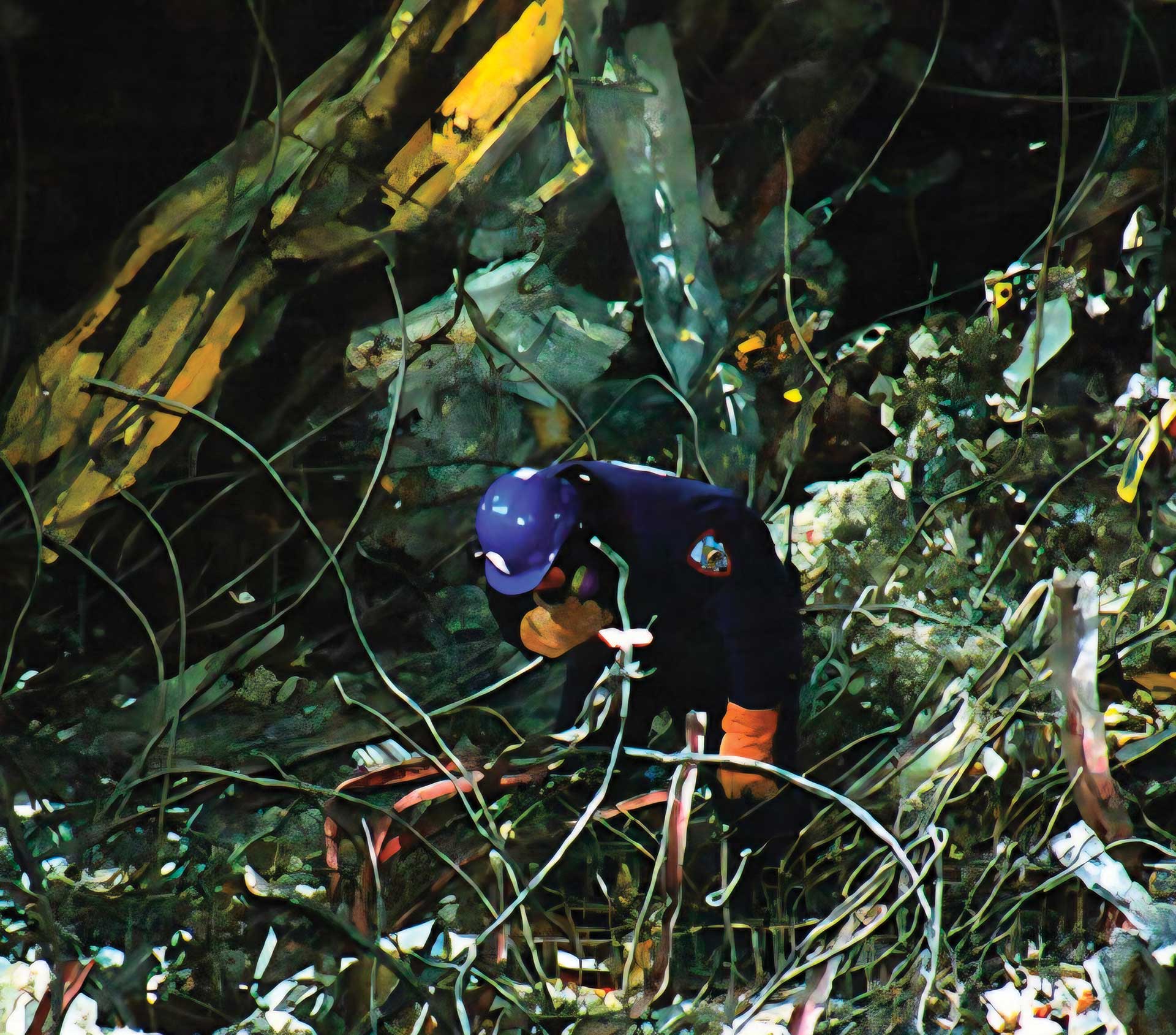
That report was met with skepticism by many responders who were working a minimum of 12 hours a day in recovery operations at the three sites. The recovery work at the World Trade Center lasted for nine months.
On September 11, conditions at the World Trade Center after the Towers collapsed were such that breathing and seeing became difficult. Lower Manhattan was consumed by thick plumes of noxious smoke from fires that continued to burn for several months. Yet police officers, firefighters, correction officers and construction workers continued rescue and recovery work at America’s deadliest-ever crime scene. First responders at the Pentagon and the Shanksville crash site faced similar conditions while trying to make sense of what would never be understood.
On January 5, 2006, 34-year-old New York City Police Detective James Zadroga succumbed to a respiratory disease. He was the first NYPD officer whose death was attributed to exposure to the toxic environment during his 450 hours of work in the remains of the World Trade Center.
Zadroga’s passing raised awareness of 9/11-related health issues that led to a series of congressional acts authorizing medical coverage for all 9/11 victims through 2090.
In September 2021, Newsweek reported that the September 11 Victim Compensation Fund, in its “20th Anniversary Special Report,” found that 9/11-related illnesses have resulted in more deaths than those killed on September 11, 2001. According to a September 2025 ABC News report, the New York City police and fire departments reported that more of their members have died from 9/11-related illnesses than were killed on September 11, 2001.
New York City Police Benevolent Association President Pat Hendry said of the continued sacrifice, “For New York City police officers, September 11, 2001, isn’t just a page in the history books. We live with its effects every day. A quarter-century later, we are still losing dozens of active and retired police officers each year to 9/11-related illnesses.”
The New York City numbers do not include those who have perished in other agencies, such as the Port Authority Police Department, New York State Police, New York City Department of Correction, New Jersey State Police, New York State court officers and many other first responder agencies.
“Port Authority police officers were the first of the first responders to the World Trade Center on September 11, 2001. Thirty-seven members of our department paid with their lives on that horrible day. Hundreds more spent countless hours working in the nine-month rescue and recovery operation,” Port Authority Police Benevolent Association President Frank Conti said. “Many of those officers suffer from 9/11-related illnesses contracted during their heroic work. Unfortunately, a number of our officers have succumbed to those illnesses.”
Port Authority Police Officer Anthony Mezzacappa responded to the World Trade Center on September 11, 2001, and in the days that followed. His wife, Maryanne, said that when he returned home on September 11, he was covered with the dust, ash and debris of the destroyed Towers.
Maryanne knew her husband wasn’t feeling well for many years after September 11. She said, “He hid it.”
Anthony was diagnosed with a cancer that apparently raised his doctor’s suspicions and led the doctor to ask whether he had been at the World Trade Center.
Police Officer Mezzacappa succumbed to his cancer on May 14, 2024. His illness was determined to be contracted during his selfless work at the World Trade Center.
Maryanne, reminiscing about her husband, said, “I often think about the families that lost their loved ones on September 11 and how grateful I am to have had him for all those years after 9/11.”
“Anthony’s sacrifice is part of the long, heroic history of the Port Authority Police Department and serves as a reminder to all who have come to the PAPD since September 11, 2001, of the dangers of their chosen profession,” Conti said.
New York City Department of Correction officers joined the PAPD, NYPD and other law enforcement agencies in responding to the World Trade Center as the attacks unfolded. Correction Officer Rich Palmer said in a National September 11 Memorial and Museum “In Their Own Voices” interview that he was in his office in Lower Manhattan when hijacked American Airlines Flight 11, a Boeing 767, was intentionally crashed into the North Tower of the World Trade Center. He immediately responded and began rescuing people attempting to escape the Towers. He recalled seeing the huge explosion of the second aircraft striking the South Tower.
In the same interview, Palmer discussed his health issues related to the toxic environment in which he was working. He said, “I have many health issues. Every day I take 18 medications to survive.”
Benny Boscio, president of the New York City Correction Officers’ Benevolent Association, said, “Like our fellow first responders, New York City correction officers proudly answered the call of duty and spent months assisting with the rescue and recovery efforts following the aftermath of the terrorist attacks on September 11, 2001.”
Boscio added, “In the years since those devastating attacks, approximately 800 uniformed and non-uniformed members of our department became ill from the toxins they inhaled day in and day out from the fumes of smoke that burned endlessly from Ground Zero. Tragically, over 40 of those heroes died from their 9/11-related illnesses.”
Fifteen years after the attacks, former EPA Administrator Whitman seemed to apologize for stating that the air at the World Trade Center was safe to breathe. She said, “I’m very sorry that people are sick. I am very sorry that people are dying, and if the EPA and I in any way contributed to that, I’m sorry.” Whitman went on to say, “We did the very best we could at the time with the knowledge we had.”
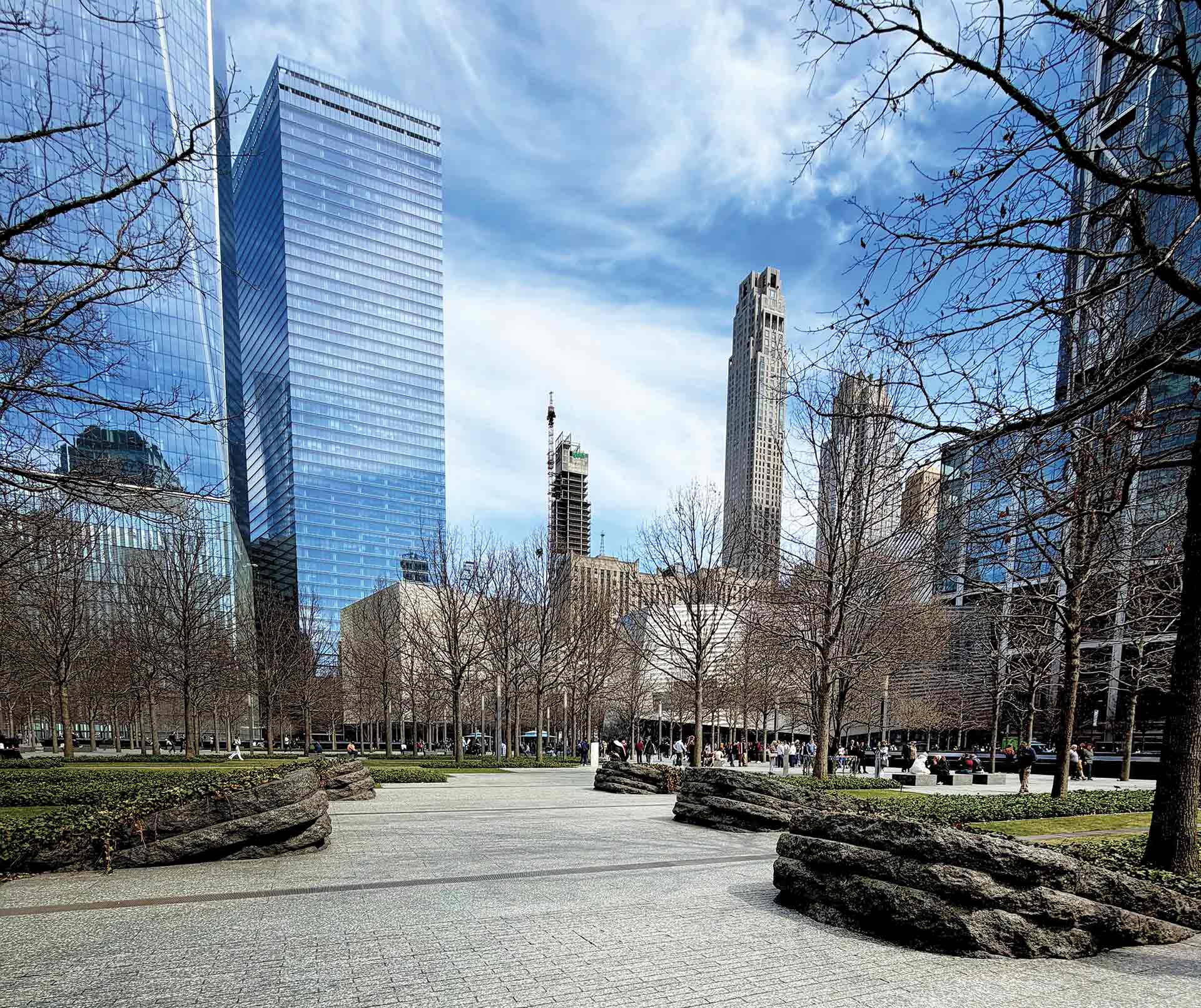
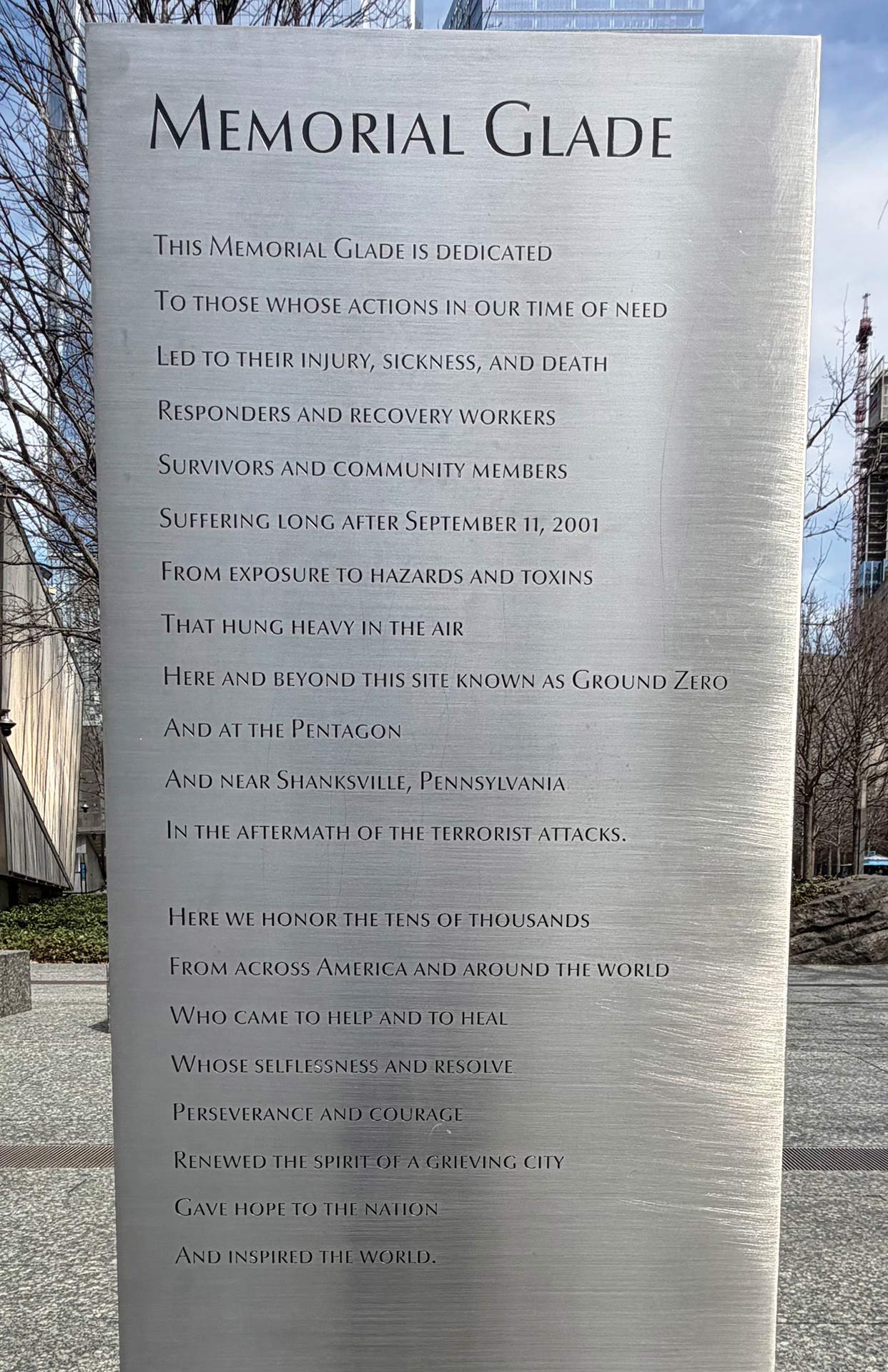
On May 19, 2019, 17 years after the formal closing of the World Trade Center Rescue and Recovery efforts, the 9/11 Memorial opened the Glade. The 9/11 Memorial website,
911memorial.org, explains the Glade, stating, “It is a dedicated space to first responders, recovery workers and those who have died or are suffering from health-related issues as a result of the attack.”
The Glade was constructed on the 9/11 Memorial grounds near the Survivor Tree, which miraculously survived the attacks. It sits on the approximate footprint of the ramp that responders used to access the wreckage of the Twin Towers and continue their recovery work.
During the month of May, law enforcement officers honor their profession’s fallen heroes during National Police Week. Many will travel to Washington, D.C., the location of the National Law Enforcement Officers Memorial, to remember and pay tribute to those who died in the line of duty.
Each year, the number of names of fallen officers on the memorial’s walls increases. Those names now include those who have perished as a result of their work and exposure during the rescue and recovery efforts in New York City; Arlington, Virginia; and Shanksville, Pennsylvania — and remind us all: the sacrifice continues.

Bobby Egbert
As seen in the May 2026 issue of American Police Beat magazine.
Don’t miss out on another issue today! Click below: