
• Skip to primary navigation
  • Skip to main content
  • Skip to primary sidebar
  • Skip to footer
  • Home
  • About
  • The Magazine
  • Events
  • Partners
  • Products
  • Contact
  • Jobs and Careers
  • Advertise
  • Facebook
  • Instagram
  • Twitter
  • Subscribe
American Police Beat

American Police Beat Magazine

Law Enforcement Publication

  • Home
  • Leadership
    • Developing and enhancing assertiveness
      Clarifying your “true north”
      The job has changed — have you?
      Perpetual recognition of line-of-duty deaths
      Understanding the boundaries of professional relationships with the...
  • Topics
    • Leadership
      • Developing and enhancing assertiveness
        Clarifying your “true north”
        The job has changed — have you?
        Perpetual recognition of line-of-duty deaths
        Understanding the boundaries of professional relationships with the...
    • Editor’s Picks
      • Smile and let them swing
        The job has changed — have you?
        The days that follow
        Perpetual recognition of line-of-duty deaths
        Let’s get moving!
    • On the Job
      • Coffee shop intel
        Curbing teen takeovers
        2026 Top Cops
        High-rise rescue in Brooklyn
        Swift thinking
    • Labor
      • Why more staff won’t fix your operational slowdowns
        Drama in Georgia: Mayor fires entire police department for...
        Smile and let them swing
        The Promise Gap
        Cut the cops, save a dollar?
    • Tech
      • The virtual beat
        Training with an AI partner?
        NYC’s electric vehicle fleet for LE passes milestone
        New Mexico license plate readers save lives, lead to “precise...
        A modern field guide to understanding research in policing
    • Training
      • Rules or results?
        Enhance your preparedness
        Good enough never is
        Pushback as a training signal
        Let’s get moving!
    • Policy
      • The impact of the Graham v. Connor decision
        Mexican cartels recruit like industry titans on both sides of the...
        Police and local government leaders join forces to build community...
        Police pause license plate readers
        Corruption, collusion and impunity
    • Health/Wellness
      • Supporting your peer support team
        Down to divorce
        The days that follow
        Addressing stress, vicarious trauma and burnout
        Nervous system regulation
    • Community
      • Working community connections
        Cops promote National Donate Life Month
        Police officer kicks up social media praise
        Donning denim in solidarity with victims and survivors of sexual...
        Improving autism awareness
    • Offbeat
      • “Teenage Mutant Ninja Deer” rescued
        An unexpected burglar
        Police humor only a cop would understand
        Not eggzactly a perfect heist
        Pizza … with a side of alligator?
    • We Remember
      • Unsung heroes: New York City correction officers
        National Police Week 2026
        Shooting of Chicago police officers prompts call for new regulations...
        The sacrifice continues
        A Tribute to Fallen Heroes
    • HOT Mail
      • The War on Cops Continues Unabated
  • On the Job
    • Coffee shop intel
      Curbing teen takeovers
      2026 Top Cops
      High-rise rescue in Brooklyn
      Swift thinking
  • Labor
    • Why more staff won’t fix your operational slowdowns
      Drama in Georgia: Mayor fires entire police department for...
      Smile and let them swing
      The Promise Gap
      Cut the cops, save a dollar?
  • Tech
    • The virtual beat
      Training with an AI partner?
      NYC’s electric vehicle fleet for LE passes milestone
      New Mexico license plate readers save lives, lead to “precise...
      A modern field guide to understanding research in policing
  • Training
    • Rules or results?
      Enhance your preparedness
      Good enough never is
      Pushback as a training signal
      Let’s get moving!
  • Policy
    • The impact of the Graham v. Connor decision
      Mexican cartels recruit like industry titans on both sides of the...
      Police and local government leaders join forces to build community...
      Police pause license plate readers
      Corruption, collusion and impunity
  • Health/Wellness
    • Supporting your peer support team
      Down to divorce
      The days that follow
      Addressing stress, vicarious trauma and burnout
      Nervous system regulation
  • Community
    • Working community connections
      Cops promote National Donate Life Month
      Police officer kicks up social media praise
      Donning denim in solidarity with victims and survivors of sexual...
      Improving autism awareness
  • Offbeat
    • “Teenage Mutant Ninja Deer” rescued
      An unexpected burglar
      Police humor only a cop would understand
      Not eggzactly a perfect heist
      Pizza … with a side of alligator?
  • We Remember
    • Unsung heroes: New York City correction officers
      National Police Week 2026
      Shooting of Chicago police officers prompts call for new regulations...
      The sacrifice continues
      A Tribute to Fallen Heroes
  • HOT Mail
    • The War on Cops Continues Unabated
  • About
  • The Magazine
  • Events
  • Partners
  • Products
  • Contact
  • Jobs and Careers
  • Advertise
  • Subscribe
Search

Health/Wellness

Supporting your peer support team

The hidden load borne by helpers

Dr. Cherylynn Lee Published June 20, 2026 @ 6:00 am PDT

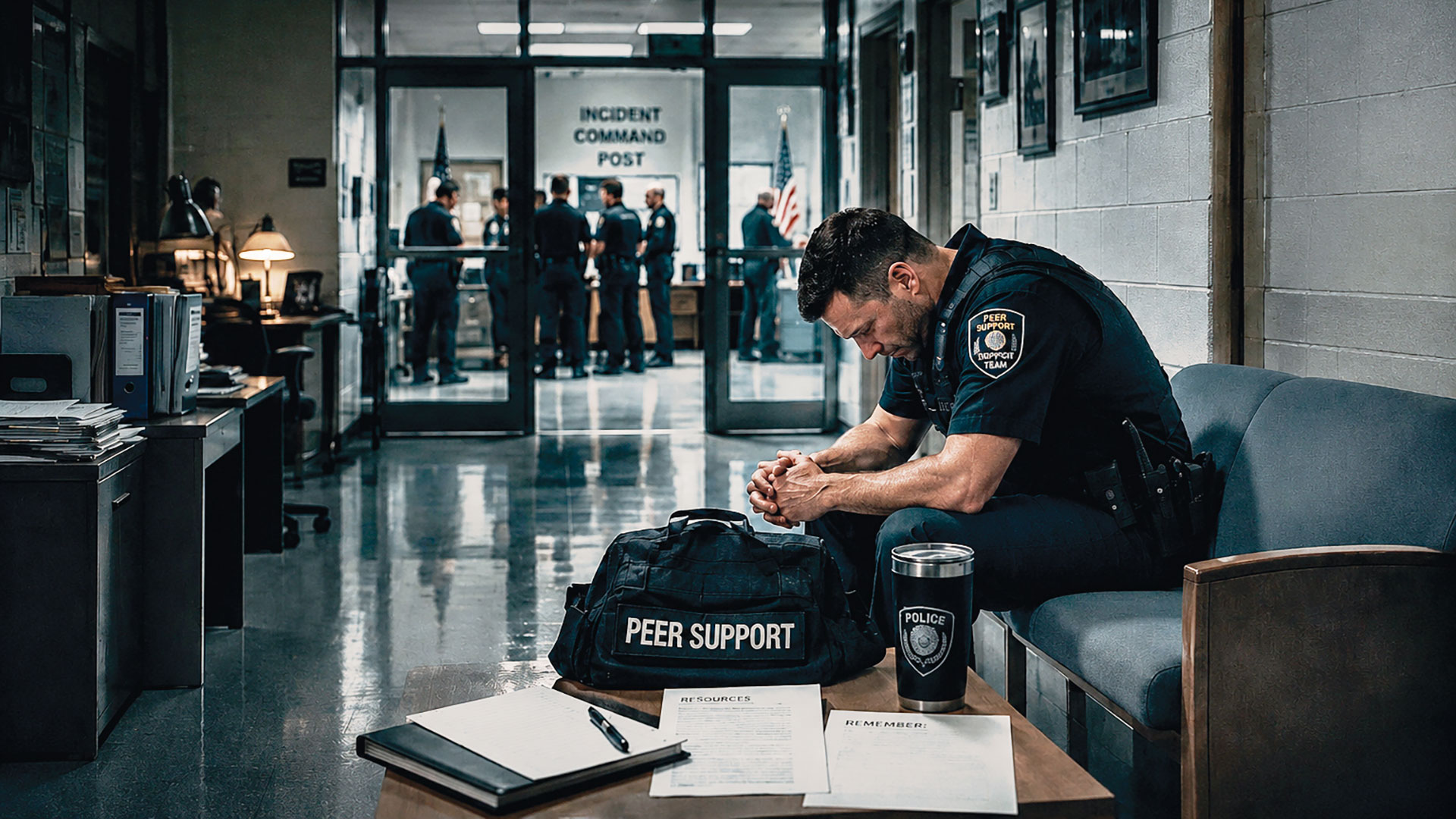
Generated by 911MEDIA staff

Law enforcement culture has long recognized the psychological load carried by those who serve. Stress, trauma and moral injury are not anomalies in policing; they are embedded in the work itself. For peer support team members, however, this load is compounded. They carry not only their own experiences, but also the emotional weight of their colleagues.

The psychological load of the job

Every officer understands the baseline: chronic stress, repeated exposure to trauma and moments that challenge one’s moral framework. This is the job. Over time, these exposures can shape behavior and emotional functioning in predictable ways: apathy, difficulty experiencing joy, emotional withdrawal, overworking, increased alcohol use, isolation and even the exhaustion that comes with everyday conversation. 

For peer support members, these effects do not disappear — they amplify.

The hidden burden of peer support

Peer supporters often operate under a unique set of stressors:

  • Stress shows up as uncertainty — “Am I doing this right?”
  • Trauma emerges as secondary exposure — absorbing the stories, feeling helpless when not present on scene, replaying what could have been done differently.
  • Moral injury surfaces in quiet self-judgment — “I should have known my guy wasn’t OK,” or “How do I admit I’m burned out in my role as a peer supporter when the mission is to help my colleagues?”

There is also the identity conflict: How do you raise your hand and ask for help when you are the one others rely on?

Tactical readiness has clear boundaries and endpoints. Emotional readiness does not. Without structure, it becomes constant, invisible and draining.

Recognizing when peer supporters are struggling

Peer team supervisors and team leads must remain vigilant. Signs of strain in peer supporters often mirror those they are trying to help:

  • Overcommitting to cases 
  • Avoidance of outreach or follow-ups 
  • Isolation from the team 
  • Increased cynicism or irritability 
  • Clear signs of burnout 

Supporting the supporters

Mitigating stress, trauma and moral injury within peer teams requires intentional structure. One of the things we are good at in law enforcement is operationalizing things: preplanned warrant services, crisis negotiations, investigations, calls for service. Peer support should be no different. As the culture shifts toward adopting organizational wellness as a “need-to-have” instead of a “nice-to-have,” we should consider operationalizing it. Think about it this way: If you are a part of incident command during a critical incident such as an OIS, you don’t want to be thinking about who to call, what the role of the peer team is, how to deploy them and what the boundaries and legal implications might be. You want to ring the bell and trust that it will play out just like you do when you call in your investigators and union representatives.

Being emotionally on call is fundamentally different from being tactically on call. Tactical readiness has clear boundaries and endpoints. Emotional readiness does not. Without structure, it becomes constant, invisible and draining.

Addressing stress

To address stress in peer teams, consider the following:

  • Provide scripts or prompts to help new team members initiate conversations or respond to colleagues seeking help. I am not suggesting that they recite these exactly or that you preplan their side of the conversation, but it could be something as simple as “Hey, your sergeant reached out to peer support and expressed some concern for you. She said you’re going through some family stuff. How are you holding up?”
  • Match peers appropriately to those seeking support. Don’t just randomly assign peer members to department members on a rotating basis. Know your people. 
  • Ensure resources are easily accessible. Provide the peers with a list of both departmental and independent resources. Peers are often the conduit between their colleagues and higher levels of support, and they should have that information at the ready.
  • Conduct regular team debriefs. Talk with the team about what is working, what could be improved and what kind of training they would like to have.

Addressing trauma

To address trauma in peer teams, consider the following:

  • Build in consistent one-on-one check-ins with team leaders. This helps the team lead assess if the peer is becoming burnt out; it also helps the peer feel supported and allows them to off-gas some of what they’re absorbing.
  • Encourage peer supporters to personally experience available resources such as therapy, so they can speak with credibility when recommending them.

Addressing moral injury

To address moral injury in peer teams, consider the following:

  • Normalize exposure to difficult cases and the emotional responses that follow.
  • Create space for honest conversations about burnout — especially when it stems from helping co-workers. 
  • Acknowledge systemic frustrations, such as gaps in organizational care, including workers’ compensation processes. These issues aren’t ones that peers can solve for their colleagues, and that may leave them feeling helpless. 

Other helpful considerations 

Have clear and non-punitive opt-out options. Maybe when the peer joined the team two years ago, they were in a good place psychologically and emotionally, but now they’re not. Give them an opportunity to pause their role on the team or leave the team if needed. 

Encourage formal recognition of their contributions. The measure of a good peer team is not just in the work, but in the ability to keep conversations confidential (outside of admissions of crimes and policy violations). By the very nature of this standard, most of the department shouldn’t know what the team is doing. Consider unit citation awards, peer supporter of the year and internal team recognition. 

In totality, peer support teams are one of the most valuable assets in modern law enforcement. The effectiveness of these teams depends on how well we support the supporters. If we fail to care for our peer supporters, we risk weakening the very system designed to sustain our people — and it’s our people who are our greatest asset, every time.

Dr. Cherylynn Lee

Dr. Cherylynn Lee

Dr. Cherylynn Lee is a police psychologist and works full-time for the Santa Barbara Sheriff’s Office as the Behavioral Sciences manager, overseeing the mental health co-response teams, CIT training and Wellness Unit, including Peer Support. As part of her duties, Dr. Lee is a member of the county’s threat management team and serves on the crisis negotiation response teams for both the Santa Barbara Sheriff’s Office and the Santa Barbara Police Department. Dr. Lee has a private practice in the Santa Ynez Valley where she sees first responders exclusively, specializing in trauma, post-traumatic stress, mindfulness and job performance improvement. She can be reached at crl5034@sbsheriff.org.

View articles by Dr. Cherylynn Lee

As seen in the June 2026 issue of American Police Beat magazine.
Don’t miss out on another issue today! Click below:


SUBSCRIBE TODAY!

Categories: Health/Wellness

Primary Sidebar

Recent Articles

  • Supporting your peer support team
  • The impact of the Graham v. Connor decision
  • Coffee shop intel
  • Developing and enhancing assertiveness
  • Mexican cartels recruit like industry titans on both sides of the border — and it’s working
  • Down to divorce
  • Unsung heroes: New York City correction officers
  • The virtual beat
  • Why more staff won’t fix your operational slowdowns
  • Training with an AI partner?

Footer

Our Mission
To serve as a trusted voice of the nation’s law enforcement community, providing informative, entertaining and inspiring content on interesting and engaging topics affecting peace officers today.

Contact us: info@apbweb.com | (800) 234-0056.

  • Facebook
  • Instagram
  • Twitter

Categories

  • Editor’s Picks
  • On the Job
  • Labor
  • Tech
  • Training
  • Policy
  • Health/Wellness
  • Community
  • Offbeat
  • We Remember
  • Jobs and Careers
  • Events

Editor’s Picks

Smile and let them swing

Smile and let them swing

May 16, 2026

The job has changed — have you?

The job has changed — have you?

May 15, 2026

The days that follow

The days that follow

May 11, 2026

Perpetual recognition of line-of-duty deaths

Perpetual recognition of line-of-duty deaths

May 10, 2026

Policies | Consent Preferences | Copyright © 2026 APB Media, LLC | Website design, development and maintenance by 911MEDIA

Open

Subscribe

Close

Receive the latest news and updates from American Police Beat directly to your inbox!

  • This field is for validation purposes and should be left unchanged.


