• Skip to primary navigation
  • Skip to main content
  • Skip to primary sidebar
  • Skip to footer
  • Home
  • About
  • The Magazine
  • Events
  • Partners
  • Products
  • Contact
  • Jobs and Careers
  • Advertise
  • Facebook
  • Instagram
  • Twitter
  • Subscribe
American Police Beat

American Police Beat Magazine

Law Enforcement Publication

  • Home
  • Leadership
    • Understanding the boundaries of professional relationships with the...
      Why you should lead from 30,000 feet
      Public perception and trust
      When performance reviews are a waste of time
      Taking a page from Toyota’s playbook
  • Topics
    • Leadership
      • Understanding the boundaries of professional relationships with the...
        Why you should lead from 30,000 feet
        Public perception and trust
        When performance reviews are a waste of time
        Taking a page from Toyota’s playbook
    • Editor’s Picks
      • Liability challenges in contemporary policing
        When performance reviews are a waste of time
        Proactive wellness visits
        Taking a page from Toyota’s playbook
        Law enforcement’s missing weapon
    • On the Job
      • Villains and heroes in the Big Apple
        Right place, right time — again
        Some good news on crime
        Mom-to-be named Cop of the Year
        Fatherly instincts save boy from icy water
    • Labor
      • Cut the cops, save a dollar?
        Labor release under fire
        Who’s watching the watchmen?
        Crime and punishment (or lack thereof) in Seattle
        Labor leadership out in the field
    • Tech
      • New Mexico license plate readers save lives, lead to “precise...
        A modern field guide to understanding research in policing
        Gear that moves with you
        A new breed of cop car
        The future of patrol is here
    • Training
      • The five minutes before the ambulance
        Navigating danger
        Critical thinking in police training
        Threshold neuroscience
        Integrated virtual reality training
    • Policy
      • Corruption, collusion and impunity
        E-bikes spark public safety concerns
        Try racing without wheels
        Law enforcement accreditation: Why it matters
        Liability challenges in contemporary policing
    • Health/Wellness
      • Addressing stress, vicarious trauma and burnout
        Nervous system regulation
        The nature of the job
        Promoting organizational wellness
        Telling cops to get more sleep isn’t working
    • Community
      • Improving autism awareness
        Shop with a Cop
        Community engagement: What is it moving forward?
        Contradictory crossroads
        Back-to-school season brings out police support nationwide
    • Offbeat
      • An unexpected burglar
        Police humor only a cop would understand
        Not eggzactly a perfect heist
        Pizza … with a side of alligator?
        Wisconsin man charged with impersonating Border Patrol agent twice in...
    • We Remember
      • Forty heroes: United Airlines Flight 93
        The Pentagon
        A nation propelled to war, lives changed forever
        A Christmas loss
        York County ambush leaves three officers dead, others critically...
    • HOT Mail
      • The War on Cops Continues Unabated
  • On the Job
    • Villains and heroes in the Big Apple
      Right place, right time — again
      Some good news on crime
      Mom-to-be named Cop of the Year
      Fatherly instincts save boy from icy water
  • Labor
    • Cut the cops, save a dollar?
      Labor release under fire
      Who’s watching the watchmen?
      Crime and punishment (or lack thereof) in Seattle
      Labor leadership out in the field
  • Tech
    • New Mexico license plate readers save lives, lead to “precise...
      A modern field guide to understanding research in policing
      Gear that moves with you
      A new breed of cop car
      The future of patrol is here
  • Training
    • The five minutes before the ambulance
      Navigating danger
      Critical thinking in police training
      Threshold neuroscience
      Integrated virtual reality training
  • Policy
    • Corruption, collusion and impunity
      E-bikes spark public safety concerns
      Try racing without wheels
      Law enforcement accreditation: Why it matters
      Liability challenges in contemporary policing
  • Health/Wellness
    • Addressing stress, vicarious trauma and burnout
      Nervous system regulation
      The nature of the job
      Promoting organizational wellness
      Telling cops to get more sleep isn’t working
  • Community
    • Improving autism awareness
      Shop with a Cop
      Community engagement: What is it moving forward?
      Contradictory crossroads
      Back-to-school season brings out police support nationwide
  • Offbeat
    • An unexpected burglar
      Police humor only a cop would understand
      Not eggzactly a perfect heist
      Pizza … with a side of alligator?
      Wisconsin man charged with impersonating Border Patrol agent twice in...
  • We Remember
    • Forty heroes: United Airlines Flight 93
      The Pentagon
      A nation propelled to war, lives changed forever
      A Christmas loss
      York County ambush leaves three officers dead, others critically...
  • HOT Mail
    • The War on Cops Continues Unabated
  • About
  • The Magazine
  • Events
  • Partners
  • Products
  • Contact
  • Jobs and Careers
  • Advertise
  • Subscribe
Search

Policy

Corruption, collusion and impunity

Inside Mexico’s cartel structure

Leon Boyer Published April 21, 2026 @ 10:50 am PDT

Dave Edmonds

The United States’ largest trading partner is its southern neighbor, Mexico, accounting for over 16% of total trade.[1]census.gov/foreign-trade/statistics/highlights/topcm.html Yet Mexico is home to a multitude of criminal gangs, regional criminal organizations and transnational criminal organizations, as well as six foreign terrorist organizations. Unlike in the U.S., criminal organizations are deeply rooted in Mexican society and part of the social fabric. Collectively, Mexican cartels and criminal organizations employ one-fifth of the Mexican workforce.[2] doi.org/10.1126/science.adh2888 American law enforcement officers in every corner of the country are impacted by the actions of Mexican criminal organizations. The old adage that “knowledge is power” is relevant for American law enforcement seeking to understand what motivates cartels, how they operate and what may be helpful when encountering Mexican citizens on American streets.

In June 1971, President Nixon declared drug abuse to be America’s “public enemy number one.” The major flaw in the terminology of the “war on drugs” is the basic fact that wars are fought against people, not commodities. We have fought this war targeting those who profit from, manufacture, deliver, sell, smuggle, traffic and consume illegal drugs. We have dismantled cartels in Colombia and Mexico, removed drug kingpins like Pablo Escobar, Joaquín “El Chapo” Guzmán, Ismael “El Mayo” Zambada and, most recently, Nemesio “El Mencho” Oseguera. We have even removed indicted governmental leaders involved in the drug trade, such as Panama’s Manuel Noriega and Venezuela’s Nicolás Maduro.[3]justice.gov/opa/media/1422326/dl More money is spent today on this war than ever before,[4]statista.com/statistics/618857/total-federal-drug-control-spending-in-us yet the same products remain on our streets, along with additional ones such as synthetic opioids. For some, it is the equivalent of trying to stop a boat from sinking by simply scooping out leaking water with a cup while leaving the hole untouched.
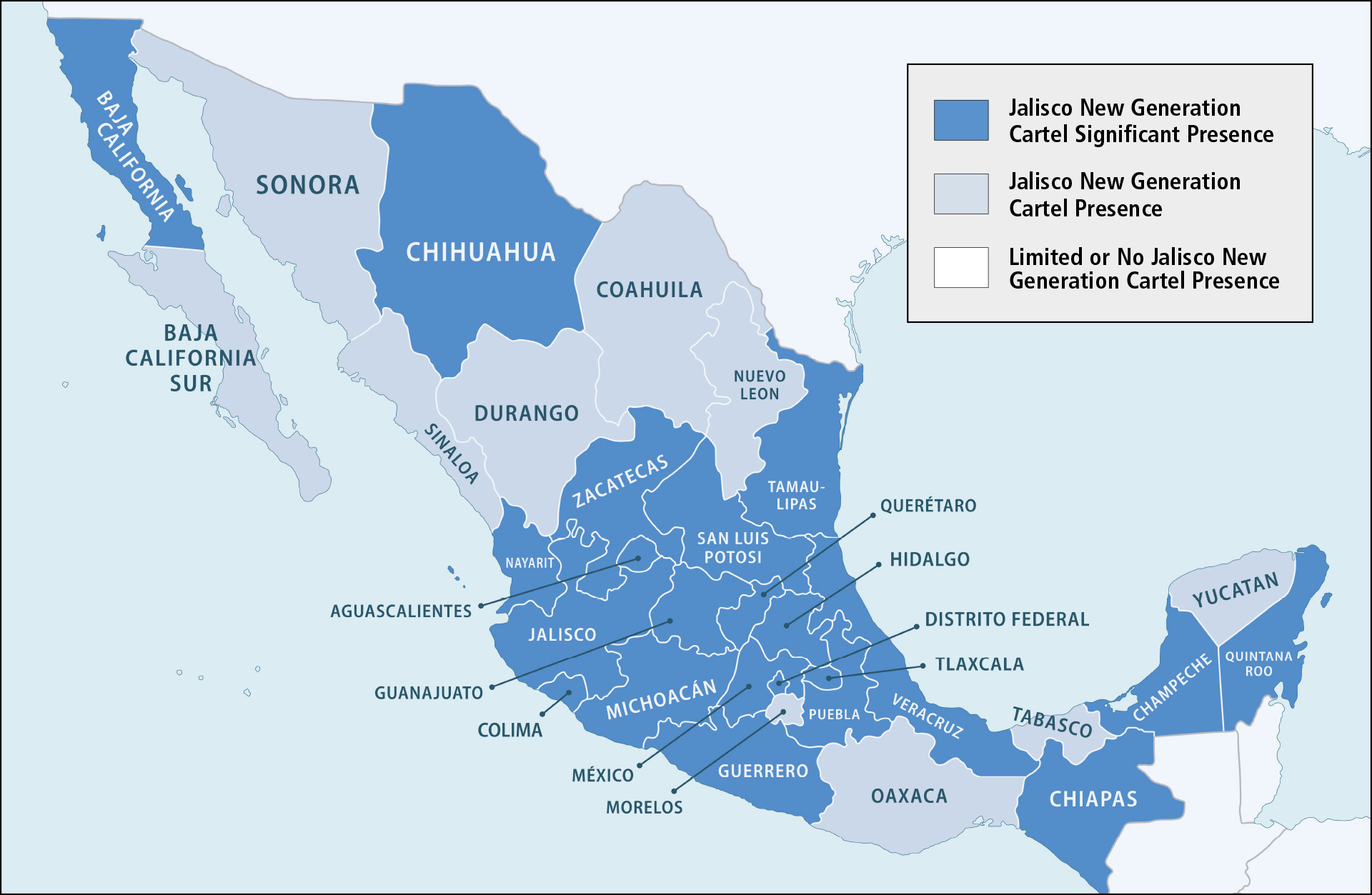
The Jalisco New Generation Cartel (CJNG) has a presence in every Mexican state. (Drug Enforcement Administration)

Organized crime in Mexican society

American law enforcement officers often encounter the end result of Mexican cartel and other criminal organization actions and influence. The impact on American law enforcement is undeniable, whether responding to an overdose; seizing drugs, guns or money; rescuing trafficked individuals; or arresting those involved in crimes tied to cartel activities stemming from operations in Mexico. The U.S. continues to adjust its methods to target cartel illicit activities. In 2025, six Mexican cartels were designated as foreign terrorist organizations, and over the past year, Mexico has transferred almost 100 cartel members to the U.S. These transfers include former leaders of the Guadalajara, Sinaloa, Los Zetas and Jalisco New Generation cartels.

The U.S. strategy[5]apbweb.com/2026/02/the-war-on-drugs-is-evolving sends a clear message to criminal organizations: first, that cartel leaders will remain a target, and second, that even if they are already in Mexican custody, the U.S. intends to bring them into its custody. However, organized crime cannot survive and prosper in Mexico without the existence of corruption and collusion among civil leaders and authorities at all levels of government. Mexico is notorious for politicians, government officials and security personnel working with organized crime groups. If not directly working with them, officials may simply ignore criminal activity.

Corruption at all levels in Mexico has created a lack of trust between the populace and national, state and municipal governments, as well as law enforcement officials. A former Mexican police officer told me that he quit his state police position and fled his home state due to coercion to work for the cartels. This is common among those who sought to serve their communities in law enforcement, only to discover the harsh reality. Organized crime groups in Mexico are so powerful that the public views them as a de facto or parallel government.

For years, reporting has linked mayors, police chiefs, governors, high-ranking officials and even presidents to Mexican criminal organizations. In 2016, Alex Cifuentes testified against El Chapo Guzmán that former Mexican President Enrique Peña Nieto received $100 million from the Sinaloa Cartel. In 2020, U.S. authorities arrested the former Mexican minister of defense, General Salvador Cienfuegos Zepeda, in Los Angeles on drug trafficking and money laundering charges.[6]apnews.com/article/mexico-obrador-military-drug-trafficking-854bba46f715fbb9211937b7e07bc0a5 In 2023, a jury in Brooklyn convicted Mexico’s former secretary of public security, Genaro García Luna, for cartel-related activities tied to the Sinaloa Cartel.

Mexico’s criminal organizations once simply paid government officials and police to look the other way, and they even invested narcotics profits into local communities. Now, criminal organizations are running rackets in almost every sector in Mexico, from legitimate industries like agriculture, mining and manufacturing to illicit activities like human trafficking, smuggling and the narcotics trade. They need politicians, security personnel and government officials to assist in these efforts. Cartels motivate Mexican officials to comply through violence, intimidation and rewards, creating a system of criminal subnational governance. There is no area of Mexico that is not influenced by criminal organizations. The U.S. is taking notice. In 2025, the U.S. revoked more than 50 visas of Mexican officials — most notably, the governor of Baja California.[7]theguardian.com/us-news/2025/oct/14/us-revokes-visas-mexican-trump-drug-cartel-crackdown

The collusion between Mexico’s criminal organizations and those responsible for civil security makes it nearly impossible for citizens to trust the criminal justice system. Mexico’s criminal impunity rate is over 95%,[8]theguadalajarareporter.net/index.php/news/news/regional/58911-impunity-in-jalisco-over-95 and crimes committed often include law enforcement participation. One of the most notable examples occurred in 2014, when Mexican police reportedly turned over 43 students to cartel members in the state of Guerrero.[9]smallwarsjournal.com/2024/01/05/social-network-analysis-guerreros-unidos-crime-syndicate To date, only the remains of three have been discovered.
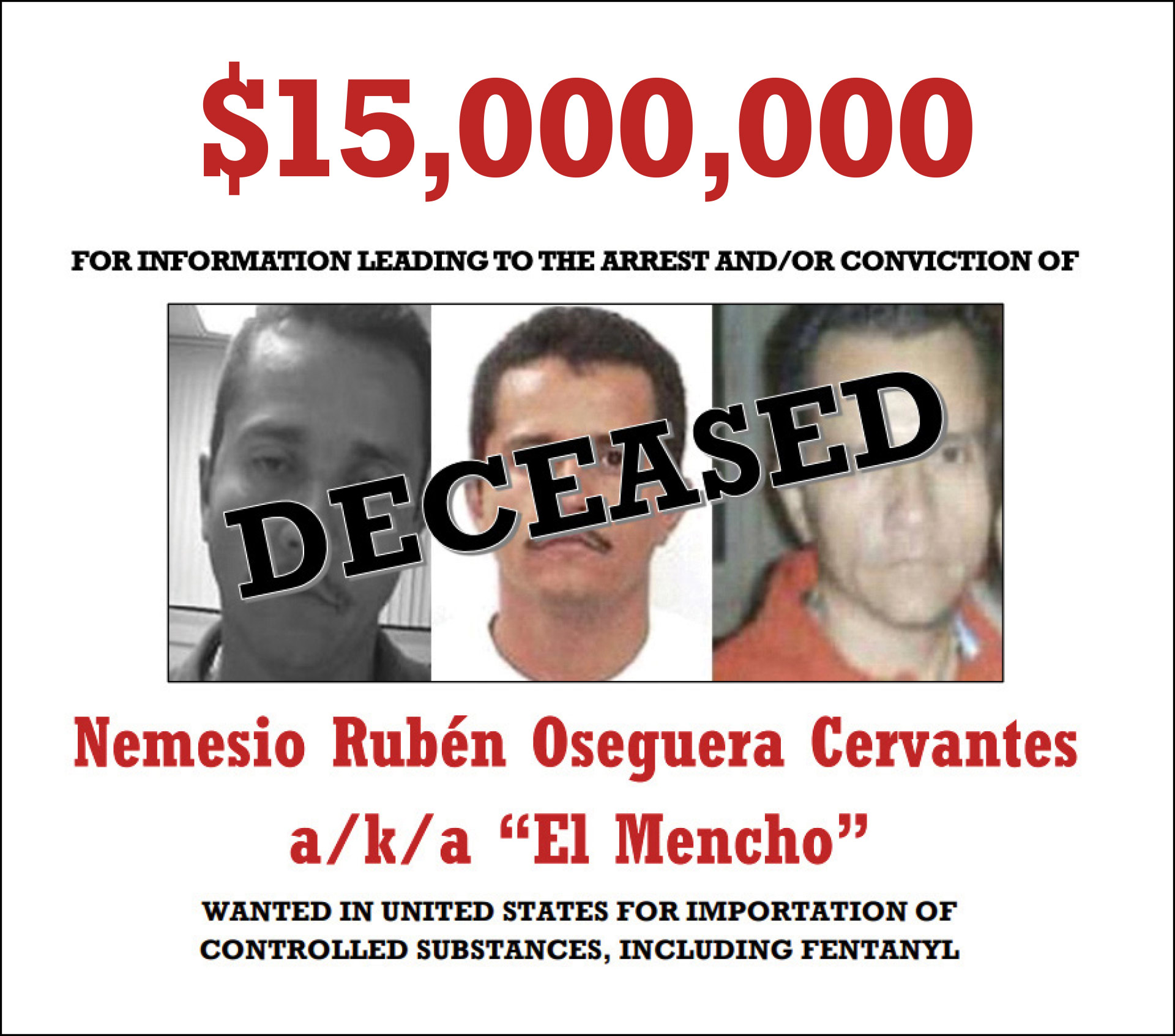
CJNG leader “El Mencho” was killed in Tapalpa, Jalisco, Mexico, on February 22, 2026, by Mexican military members. (U.S. Department of Justice)

U.S. challenges

The lack of trust in Mexico’s criminal justice and intelligence apparatus is challenging because of the deep-rooted corruption in Mexico. Often, authorities are not voluntarily working for criminal organizations, but the fear of doing so is part of the social fabric. Assassinations of politicians, law enforcement officers and journalists are common. Disappearances of Mexican citizens occur daily. Citizens and visitors are always being watched. One cartel even used a hacker to track and kill FBI informants.[10]abc7.com/post/el-chapo-guzmans-sinaloa-drug-cartel-used-hacker-track-fbi-official-killed-potential-informants-audit-says/16880340

Joint U.S.–Mexico law enforcement efforts are often viewed by U.S. law enforcement as difficult due to the lack of trust in Mexican authorities. This became apparent when Mexican authorities were left out of the plans to capture Sinaloa Cartel leader El Mayo, as well as the subsequent deal allowing Sinaloa Cartel members to legally enter the U.S.[11]cbsnews.com/news/sinaloa-cartel-leader-family-enters-us-deal-trump-administration-mexico However, since then we have seen a successful operation to remove the head of the Jalisco New Generation Cartel (CJNG), El Mencho, using American intelligence.[12]nypost.com/2026/02/26/us-news/cias-help-killing-mexican-drug-lord-el-mencho-is-far-from-the-only-us-mission-in-latin-america The CJNG is the largest and most dangerous Mexican cartel. While it is too soon to know the full extent, removing El Mencho will likely lead to the CJNG fracturing and increased violence, as has been seen when other cartel leaders have been removed.

Mexican National Guard security forces ride toward the scene of a shooting in the busy tourist area of Tulum’s hotel zone in May 2021. Five months later, two tourists, one of them American, were killed in the crossfire of a drug-gang shootout in the same area. (iStock.com/Joel Carillet)

Conclusion

Corruption, collusion and impunity are embedded in Mexican society as the accepted practice among crime groups, citizens, and government officials and law enforcement at all levels. Unfortunately, changing the status quo in Mexico remains a long way off. The entire Mexican criminal justice system is ineffective, from the political apparatus to the courts and corrections. However, the U.S. has driven more significant change over the past year than in recent decades, using both new and established methods. Unfortunately, Mexico is no safer for those living there, but the U.S. has put criminal leaders and those colluding with them on notice that policies are changing.

American law enforcement officers encounter the effects of cartel activities, and understanding the source and influence of cartels on Mexican society allows officers to be proactive during enforcement actions. Cartels demonstrate effective ways to coerce and corrupt individuals; therefore, if officers understand the environment from which those they encounter come, interactions, trust and intelligence-gathering can increase throughout agencies.

Leon Boyer

Leon Boyer

Leon Boyer is a former U.S. Border Patrol agent who served in patrol, management and intelligence roles at various locations across the U.S. During his tenure, he authored, published and approved numerous intelligence reports addressing national and regional threats, often involving transnational criminal organizations. He remains actively engaged in these issues as the director of United Voices Interpreting and Consulting, LLC and as an adjunct faculty member, lecturing in political science, homeland security, intelligence analysis and security management, and border security and transportation at two colleges.

View articles by Leon Boyer

References[+]

References
1 census.gov/foreign-trade/statistics/highlights/topcm.html
2 doi.org/10.1126/science.adh2888
3 justice.gov/opa/media/1422326/dl
4 statista.com/statistics/618857/total-federal-drug-control-spending-in-us
5 apbweb.com/2026/02/the-war-on-drugs-is-evolving
6 apnews.com/article/mexico-obrador-military-drug-trafficking-854bba46f715fbb9211937b7e07bc0a5
7 theguardian.com/us-news/2025/oct/14/us-revokes-visas-mexican-trump-drug-cartel-crackdown
8 theguadalajarareporter.net/index.php/news/news/regional/58911-impunity-in-jalisco-over-95
9 smallwarsjournal.com/2024/01/05/social-network-analysis-guerreros-unidos-crime-syndicate
10 abc7.com/post/el-chapo-guzmans-sinaloa-drug-cartel-used-hacker-track-fbi-official-killed-potential-informants-audit-says/16880340
11 cbsnews.com/news/sinaloa-cartel-leader-family-enters-us-deal-trump-administration-mexico
12 nypost.com/2026/02/26/us-news/cias-help-killing-mexican-drug-lord-el-mencho-is-far-from-the-only-us-mission-in-latin-america

Categories: Policy

Primary Sidebar

Recent Articles

  • Corruption, collusion and impunity
  • The five minutes before the ambulance
  • New Mexico license plate readers save lives, lead to “precise policing”
  • Addressing stress, vicarious trauma and burnout
  • Understanding the boundaries of professional relationships with the boss
  • E-bikes spark public safety concerns
  • Improving autism awareness
  • Cut the cops, save a dollar?
  • Villains and heroes in the Big Apple
  • NLEOMF announces February 2026 Officers of the Month

Footer

Our Mission
To serve as a trusted voice of the nation’s law enforcement community, providing informative, entertaining and inspiring content on interesting and engaging topics affecting peace officers today.

Contact us: info@apbweb.com | (800) 234-0056.

  • Facebook
  • Instagram
  • Twitter

Categories

  • Editor’s Picks
  • On the Job
  • Labor
  • Tech
  • Training
  • Policy
  • Health/Wellness
  • Community
  • Offbeat
  • We Remember
  • Jobs and Careers
  • Events

Editor’s Picks

Liability challenges in contemporary policing

Liability challenges in contemporary policing

February 27, 2026

When performance reviews are a waste of time

When performance reviews are a waste of time

February 26, 2026

Proactive wellness visits

Proactive wellness visits

February 25, 2026

Taking a page from Toyota’s playbook

Taking a page from Toyota’s playbook

February 23, 2026

Policies | Consent Preferences | Copyright © 2026 APB Media, LLC | Website design, development and maintenance by 911MEDIA

Open

Subscribe

Close

Receive the latest news and updates from American Police Beat directly to your inbox!

  • This field is for validation purposes and should be left unchanged.