
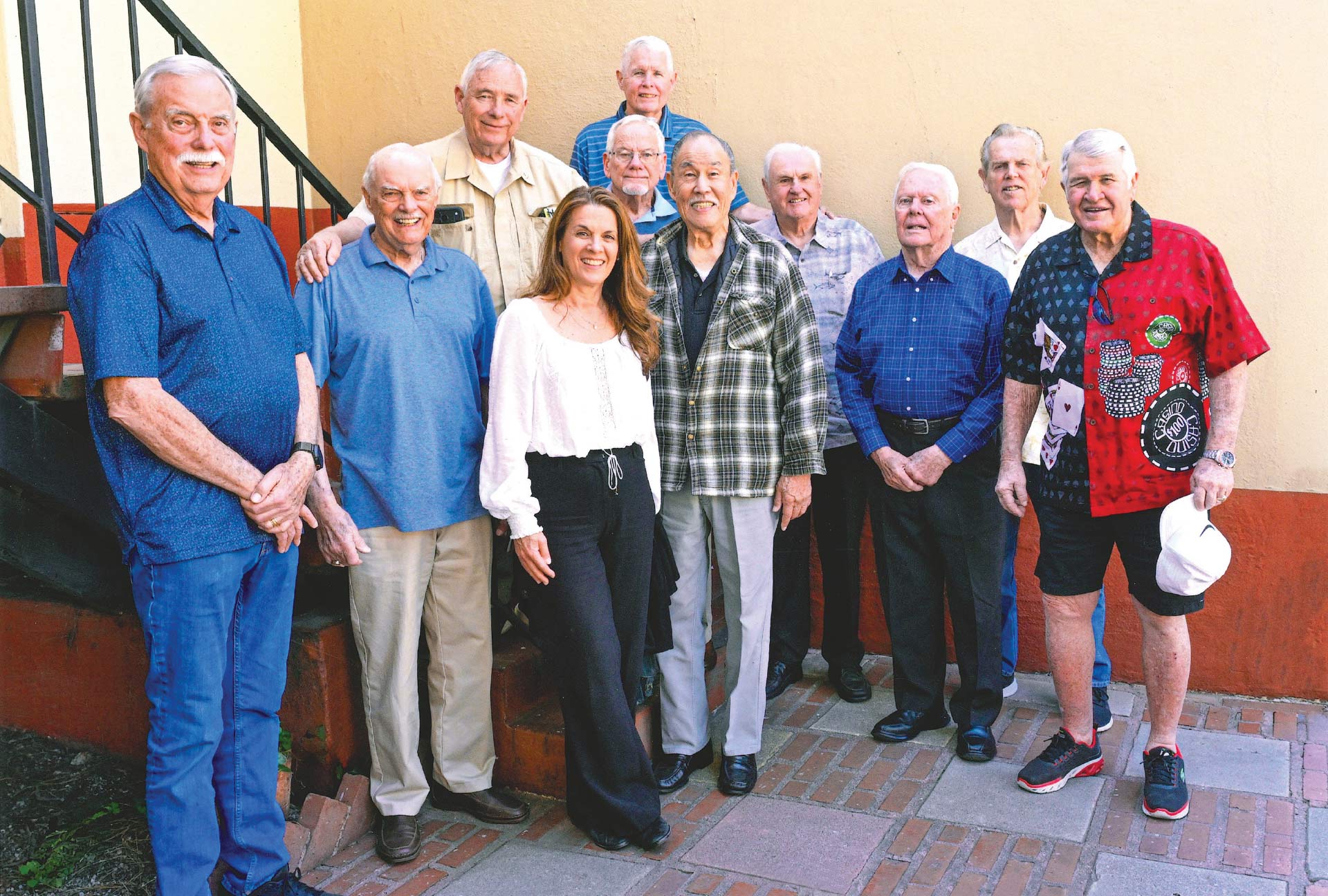
For me, the decision to dedicate this edition of APB to line-of-duty deaths (LODDs) could not have come at a more meaningful time. The remaining members of my 1966 LAPD Academy class recently marked the 60th anniversary of our graduation. Our guest of honor was the daughter of one of our classmates, who tragically lost his life in a vehicle pursuit just six months after we completed our training. Remarkably, our honored guest was born the day after her father was laid to rest. The photograph on this page shows the remaining class members of fallen officer Malcomb Beaty and his lovely daughter, Dana.
Unanimous passion for perpetual recognition
The good news is that honoring and recognizing LODDs is one of the rare topics that unites everyone — there is universal agreement on the importance of paying tribute to our fallen comrades. This is a solemn and deeply passionate commitment among officers. Just as law enforcement professionals devote themselves to preventing crime and apprehending offenders, they also demonstrate profound respect when a colleague makes the ultimate sacrifice in the line of duty.
The typical outpouring of support is both appropriate and heartwarming. Evolving customs and advancements in technology have significantly expanded the ways we honor fallen officers. Some recent traditions include processions of public safety vehicles escorting the deceased, such as from the hospital to the medical examiner’s office. Another trend is the rapid creation of fundraising accounts, such as GoFundMe pages, though these can sometimes be fraudulent. In these difficult times, there is never a shortage of good intentions.
Agencies should be proactive in seeking opportunities to include the families of fallen officers in events and ceremonies.
Good intentions are not enough
Unfortunately, good intentions alone are not sufficient to ensure ongoing remembrance. Without an established system and a dedicated individual responsible for maintaining perpetual recognition, well-meaning efforts often fade over time.
Everyone — both individually and organizationally — agrees that the memory of fallen officers must never be forgotten. However, finding someone willing to take on the responsibility of ensuring lasting recognition is challenging. Based on considerable experience, I believe the duty of tracking and maintaining perpetual recognition must be formally included in the job description of an appropriate position, such as the executive secretary or assistant to the sheriff or police chief. Assigning this responsibility at a high level increases the likelihood that remembrance for fallen personnel will be preserved and treated seriously. Establishing this expectation at the top ensures it remains a priority.
A solid perpetual system is essential
In my view, the process for perpetual recognition of LODDs needs to be institutionalized in written policies or ordinances. Systems such as “tickler files” should be used to provide advance notice of upcoming anniversaries, and the contact information for relatives of the deceased should be regularly updated to maintain ongoing connections.
My failed efforts
Sadly, I have witnessed several instances where well-intentioned efforts and processes gradually faded, and the goal of perpetual recognition for LODD personnel was not achieved. In one case, a memorial room at a Marine Corps base was abruptly converted into a storage area by a new commanding officer who prioritized storage needs. In another instance, a badge that once belonged to a fallen officer disappeared from the police department’s lobby. I have also seen artifacts — including those belonging to fallen officers — taken by a retiring police chief for personal display rather than being preserved for the department and the public.
Establishing continuous recognition
While it may seem ambitious, I recommend that agencies remain proactive in seeking opportunities to include the families of fallen officers in events and ceremonies. Appropriate occasions may include new facility dedications, street namings, monument or statue unveilings, retirements, award ceremonies and any other events where survivors of fallen officers might appreciate being present. When in doubt about whether to extend an invitation, do so — the families will always appreciate being remembered and included.

Keith Bushey
As seen in the May 2026 issue of American Police Beat magazine.
Don’t miss out on another issue today! Click below: