
• Skip to primary navigation
  • Skip to main content
  • Skip to primary sidebar
  • Skip to footer
  • Home
  • About
  • The Magazine
  • Events
  • Partners
  • Products
  • Contact
  • Jobs and Careers
  • Advertise
  • Facebook
  • Instagram
  • Twitter
  • Subscribe
American Police Beat

American Police Beat Magazine

Law Enforcement Publication

  • Home
  • Leadership
    • Understanding the boundaries of professional relationships with the...
      Why you should lead from 30,000 feet
      Public perception and trust
      When performance reviews are a waste of time
      Taking a page from Toyota’s playbook
  • Topics
    • Leadership
      • Understanding the boundaries of professional relationships with the...
        Why you should lead from 30,000 feet
        Public perception and trust
        When performance reviews are a waste of time
        Taking a page from Toyota’s playbook
    • Editor’s Picks
      • Liability challenges in contemporary policing
        When performance reviews are a waste of time
        Proactive wellness visits
        Taking a page from Toyota’s playbook
        Law enforcement’s missing weapon
    • On the Job
      • Frankpledge to forensics: A brief history of law enforcement
        Villains and heroes in the Big Apple
        Right place, right time — again
        Some good news on crime
        Mom-to-be named Cop of the Year
    • Labor
      • The Promise Gap
        Cut the cops, save a dollar?
        Labor release under fire
        Who’s watching the watchmen?
        Crime and punishment (or lack thereof) in Seattle
    • Tech
      • New Mexico license plate readers save lives, lead to “precise...
        A modern field guide to understanding research in policing
        Gear that moves with you
        A new breed of cop car
        The future of patrol is here
    • Training
      • Pushback as a training signal
        Let’s get moving!
        The five minutes before the ambulance
        Navigating danger
        Critical thinking in police training
    • Policy
      • Corruption, collusion and impunity
        E-bikes spark public safety concerns
        Try racing without wheels
        Law enforcement accreditation: Why it matters
        Liability challenges in contemporary policing
    • Health/Wellness
      • Addressing stress, vicarious trauma and burnout
        Nervous system regulation
        The nature of the job
        Promoting organizational wellness
        Telling cops to get more sleep isn’t working
    • Community
      • Improving autism awareness
        Shop with a Cop
        Community engagement: What is it moving forward?
        Contradictory crossroads
        Back-to-school season brings out police support nationwide
    • Offbeat
      • An unexpected burglar
        Police humor only a cop would understand
        Not eggzactly a perfect heist
        Pizza … with a side of alligator?
        Wisconsin man charged with impersonating Border Patrol agent twice in...
    • We Remember
      • Heroes of the World Trade Center
        Forty heroes: United Airlines Flight 93
        The Pentagon
        A nation propelled to war, lives changed forever
        A Christmas loss
    • HOT Mail
      • The War on Cops Continues Unabated
  • On the Job
    • Frankpledge to forensics: A brief history of law enforcement
      Villains and heroes in the Big Apple
      Right place, right time — again
      Some good news on crime
      Mom-to-be named Cop of the Year
  • Labor
    • The Promise Gap
      Cut the cops, save a dollar?
      Labor release under fire
      Who’s watching the watchmen?
      Crime and punishment (or lack thereof) in Seattle
  • Tech
    • New Mexico license plate readers save lives, lead to “precise...
      A modern field guide to understanding research in policing
      Gear that moves with you
      A new breed of cop car
      The future of patrol is here
  • Training
    • Pushback as a training signal
      Let’s get moving!
      The five minutes before the ambulance
      Navigating danger
      Critical thinking in police training
  • Policy
    • Corruption, collusion and impunity
      E-bikes spark public safety concerns
      Try racing without wheels
      Law enforcement accreditation: Why it matters
      Liability challenges in contemporary policing
  • Health/Wellness
    • Addressing stress, vicarious trauma and burnout
      Nervous system regulation
      The nature of the job
      Promoting organizational wellness
      Telling cops to get more sleep isn’t working
  • Community
    • Improving autism awareness
      Shop with a Cop
      Community engagement: What is it moving forward?
      Contradictory crossroads
      Back-to-school season brings out police support nationwide
  • Offbeat
    • An unexpected burglar
      Police humor only a cop would understand
      Not eggzactly a perfect heist
      Pizza … with a side of alligator?
      Wisconsin man charged with impersonating Border Patrol agent twice in...
  • We Remember
    • Heroes of the World Trade Center
      Forty heroes: United Airlines Flight 93
      The Pentagon
      A nation propelled to war, lives changed forever
      A Christmas loss
  • HOT Mail
    • The War on Cops Continues Unabated
  • About
  • The Magazine
  • Events
  • Partners
  • Products
  • Contact
  • Jobs and Careers
  • Advertise
  • Subscribe
Search

On the Job

Frankpledge to forensics: A brief history of law enforcement

Part 1 — The ancient world and Middle Ages

Jack R. Gates Published April 30, 2026 @ 6:00 am PDT

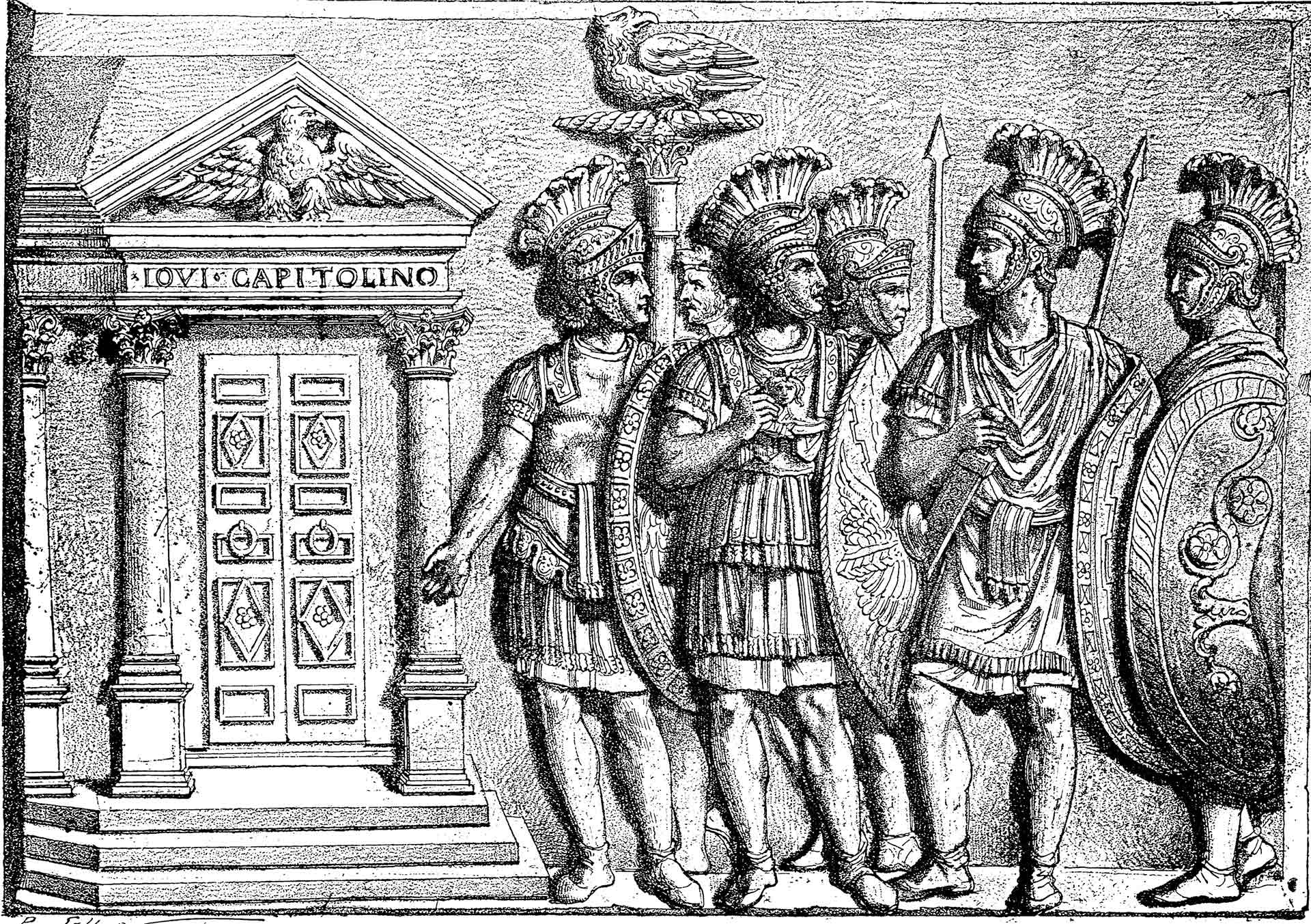
An elite military unit responsible for protecting the Roman emperor, the Praetorian Guard has parallels to the modern Secret Service, but it also engaged in espionage, riot policing and even emergency firefighting. (iStock.com/clu)

The need to maintain the peace within a group of people is not unique to modern society. Humans have placed importance on keeping order since prehistoric times. The manner in which a particular culture’s moral codes, social structure and laws have been enforced continues to be an evolving process. Within more recent historical times, law enforcement officers have fulfilled that role.

People who were utilized as enforcers of the law, in times of old, were not ordained with titles as such. The laws and decrees passed down by rulers were enforced by soldiers, not by police officers as we know them today. Often, a military detail would be exclusively responsible for maintaining law and order in any area in which it was stationed. Perhaps the primary difference between law enforcement and military duties is their respective purposes: the military exists to conquer armies and protect borders at the bequest of its leaders, while law enforcement personnel have the duty to investigate crimes, prevent breaches of the peace, arrest criminals and resolve situations in a manner that ensures safety and preserves life. In a historical context, bygone cultures drew no such distinctions.

An important part of any culture’s history is the evolution of its system of laws and those charged with the duty of enforcing them. That process by which the system of laws and law enforcers are nurtured and honed has produced a specialized professional unlike anything before.

In Anglo-Saxon England, King Alfred the Great organized the populace into groups that were responsible for maintaining their own law and order, overseen by officials who would later become known as constables and sheriffs. (iStock.com/TonyBeggett)

Law and order in the ancient world

The first approximation of enforcing laws existed at the dawning of the cave-dwellers. A tribe or clan of people were expected to maintain their social order and group mores by means of individual responsibility to the group — a system of law enforcement that would reemerge in the Dark Ages in Europe centuries later.

It was incumbent upon each member of the tribe to follow certain rules, dictated by a chief, or face such punishments as ostracization, banishment, torture or even death. The tribal chief was the maker of laws and often solely decided the proper punishment when a member of the tribe broke a law. In some ancient cultures, a crime against an individual might be adjudicated by the victim or their family.

Some of the earliest written records came from the land of Sumer, located in the area of the Tigris–Euphrates River valley. Many of these records date as far back as 2300 BC and give glimpses of the ancient people’s laws and punishments. In 2200 BC, just a hundred years later, official law would be established by King Hammurabi in his Code of Hammurabi. This codification, instructing on such things as liabilities for inadequate home construction, established the legal principle of lex talionis — “an eye for an eye” punishment.

One of the world’s first organized court systems was established in Egypt, roughly in 1500 BC. A number of courts were created and presided over by judges appointed by the Pharaoh. Officers of the court who performed law-enforcement-type duties carried wooden staffs topped with metal pommels inscribed with the Pharaoh’s name as a sign of their authority. These ornate staffs were the forerunners of the modern batons carried by law enforcement officers throughout the world today.

At about the time of Christ, the Roman Praetorian Guard — appointed by the Emperor Augustus Caesar — served a quasi-law-enforcement role in areas conquered by Rome. During Augustus’ tenure, units of vigiles were created and placed in roles as both firefighters and law enforcement personnel. Their alert watch over Rome and other cities helped maintain security and avoid catastrophic fires.

One of the world’s first organized court systems was established in Egypt, roughly in 1500 BC.

The early foundations: Tithing and frankpledge systems

As the Dark Ages were ending and Rome’s occupation of Great Britain ebbed, Germanic invaders entered England. Like any new occupiers, the Germanic people brought with them their own laws and customs. Intermarriage between native Englanders and the Germanic people produced the stalwart Anglo-Saxons. The Anglo-Saxons fostered the growth of self-governing farming communities.

During the reign of Alfred the Great (849–899), all freemen were obliged to belong to an association that bound them to other groups of people throughout the British Isles. It became law that if an individual from one particular group was convicted of a crime, the entire group was held responsible for paying the fine. This type of self-governing system encouraged group members to be watchful of each other’s activities. This would be the rudiment of what we’d come to understand as citizen’s arrest.

In the tithing system, all males over the age of 12 were placed into groups of 10 men — a tithing. The chief of a tithing was referred to as a “tithing man.” Ten groups of tithings were called a hundred. A hundred would be headed by a “hundred man,” or what would later be called a constable. Groups of hundreds were categorized as a shire. The leader of a shire, responsible for all law enforcement activities within his jurisdiction, was called a “reeve” or “shire-reeve.” That term would finally be modernized into the word “sheriff.”

The shire-reeve was both a law enforcer and a judge, traveling from hundred to hundred to conduct his business. It was within his authority to convene a posse comitatus, where he would gather men from with his shire to search for absconding lawbreakers. The idea of organizing a posse would be reintroduced in the mid-19th century in the American West, as any fan of old Westerns can attest.

After the invasion of the Norman ruler William the Conqueror in 1066, the tithing system was modified into the frankpledge system. William divided his kingdom into 55 distinct military districts, each headed by a shire-reeve who answered directly to him, ensuring absolute loyalty to the crown. One of the changes William made was to refashion the duties of the shire-reeves into strictly law enforcement activities, as judges were appointed separately to oversee judicial proceedings. This was a move toward the more modern separation of authority in the law enforcement and judicial systems used today.

In 1285, King Edward I established a night watch program, as well as his Statute of Winchester, which was the first institution of modern common law. Men were hired as night watchmen to enforce the curfew and guard the gates of the king’s castle. Edward further decreed that groups of 100 merchants would be responsible for maintaining his law and preservation of peace in their respective districts. This particular system is known as the watch and ward system, and it created a 24-hours-per-day watch in each district.

In the 14th century, the shire-reeves were replaced by justices of the peace. This newly created position was assisted by constables. Originally, justices of the peace had law enforcement responsibilities, but later those duties would be judicial in nature.

As the feudal era ended, the church took a more prominent role in the creation and enforcement of the law. Those antiquated groups of hundreds were slowly changed into parishes. Each parish represented groups of people belonging to a specific church, and a constable was appointed in each parish to oversee all law enforcement activities. This form of law enforcement would remain intact in England until the 18th century.

In my next article, I’ll discuss the foundations of law enforcement in the United States, beginning with colonial-era policing.

Jack R. Gates

Jack R. Gates

Jack R. Gates is a former law enforcement officer in Missouri, currently serving as a civilian employee with a police department in southwest Missouri. He can be contacted at numis1967@gmail.com.

View articles by Jack R. Gates

As seen in the April 2026 issue of American Police Beat magazine.
Don’t miss out on another issue today! Click below:


SUBSCRIBE TODAY!

Categories: On the Job

Primary Sidebar

Recent Articles

  • Frankpledge to forensics: A brief history of law enforcement
  • Pushback as a training signal
  • Let’s get moving!
  • Heroes of the World Trade Center
  • The Promise Gap
  • Corruption, collusion and impunity
  • The five minutes before the ambulance
  • New Mexico license plate readers save lives, lead to “precise policing”
  • Addressing stress, vicarious trauma and burnout
  • Understanding the boundaries of professional relationships with the boss

Footer

Our Mission
To serve as a trusted voice of the nation’s law enforcement community, providing informative, entertaining and inspiring content on interesting and engaging topics affecting peace officers today.

Contact us: info@apbweb.com | (800) 234-0056.

  • Facebook
  • Instagram
  • Twitter

Categories

  • Editor’s Picks
  • On the Job
  • Labor
  • Tech
  • Training
  • Policy
  • Health/Wellness
  • Community
  • Offbeat
  • We Remember
  • Jobs and Careers
  • Events

Editor’s Picks

Liability challenges in contemporary policing

Liability challenges in contemporary policing

February 27, 2026

When performance reviews are a waste of time

When performance reviews are a waste of time

February 26, 2026

Proactive wellness visits

Proactive wellness visits

February 25, 2026

Taking a page from Toyota’s playbook

Taking a page from Toyota’s playbook

February 23, 2026

Policies | Consent Preferences | Copyright © 2026 APB Media, LLC | Website design, development and maintenance by 911MEDIA


