• Skip to primary navigation
  • Skip to main content
  • Skip to primary sidebar
  • Skip to footer
  • Home
  • About
  • The Magazine
  • Events
  • Partners
  • Products
  • Contact
  • Jobs and Careers
  • Advertise
  • Facebook
  • Instagram
  • Twitter
  • Subscribe
American Police Beat

American Police Beat Magazine

Law Enforcement Publication

  • Home
  • Leadership
    • Perpetual recognition of line-of-duty deaths
      Understanding the boundaries of professional relationships with the...
      Why you should lead from 30,000 feet
      Public perception and trust
      When performance reviews are a waste of time
  • Topics
    • Leadership
      • Perpetual recognition of line-of-duty deaths
        Understanding the boundaries of professional relationships with the...
        Why you should lead from 30,000 feet
        Public perception and trust
        When performance reviews are a waste of time
    • Editor’s Picks
      • Let’s get moving!
        Heroes of the World Trade Center
        The Promise Gap
        Corruption, collusion and impunity
        Liability challenges in contemporary policing
    • On the Job
      • Testing the waters — literally
        Frankpledge to forensics: A brief history of law enforcement
        Villains and heroes in the Big Apple
        Right place, right time — again
        Some good news on crime
    • Labor
      • The Promise Gap
        Cut the cops, save a dollar?
        Labor release under fire
        Who’s watching the watchmen?
        Crime and punishment (or lack thereof) in Seattle
    • Tech
      • New Mexico license plate readers save lives, lead to “precise...
        A modern field guide to understanding research in policing
        Gear that moves with you
        A new breed of cop car
        The future of patrol is here
    • Training
      • Pushback as a training signal
        Let’s get moving!
        The five minutes before the ambulance
        Navigating danger
        Critical thinking in police training
    • Policy
      • Police pause license plate readers
        Corruption, collusion and impunity
        E-bikes spark public safety concerns
        Try racing without wheels
        Law enforcement accreditation: Why it matters
    • Health/Wellness
      • Addressing stress, vicarious trauma and burnout
        Nervous system regulation
        The nature of the job
        Promoting organizational wellness
        Telling cops to get more sleep isn’t working
    • Community
      • Improving autism awareness
        Shop with a Cop
        Community engagement: What is it moving forward?
        Contradictory crossroads
        Back-to-school season brings out police support nationwide
    • Offbeat
      • An unexpected burglar
        Police humor only a cop would understand
        Not eggzactly a perfect heist
        Pizza … with a side of alligator?
        Wisconsin man charged with impersonating Border Patrol agent twice in...
    • We Remember
      • A Tribute to Fallen Heroes
        Markers of service and remembrance
        Tragedy strikes Baker to Vegas
        Heroes of the World Trade Center
        Forty heroes: United Airlines Flight 93
    • HOT Mail
      • The War on Cops Continues Unabated
  • On the Job
    • Testing the waters — literally
      Frankpledge to forensics: A brief history of law enforcement
      Villains and heroes in the Big Apple
      Right place, right time — again
      Some good news on crime
  • Labor
    • The Promise Gap
      Cut the cops, save a dollar?
      Labor release under fire
      Who’s watching the watchmen?
      Crime and punishment (or lack thereof) in Seattle
  • Tech
    • New Mexico license plate readers save lives, lead to “precise...
      A modern field guide to understanding research in policing
      Gear that moves with you
      A new breed of cop car
      The future of patrol is here
  • Training
    • Pushback as a training signal
      Let’s get moving!
      The five minutes before the ambulance
      Navigating danger
      Critical thinking in police training
  • Policy
    • Police pause license plate readers
      Corruption, collusion and impunity
      E-bikes spark public safety concerns
      Try racing without wheels
      Law enforcement accreditation: Why it matters
  • Health/Wellness
    • Addressing stress, vicarious trauma and burnout
      Nervous system regulation
      The nature of the job
      Promoting organizational wellness
      Telling cops to get more sleep isn’t working
  • Community
    • Improving autism awareness
      Shop with a Cop
      Community engagement: What is it moving forward?
      Contradictory crossroads
      Back-to-school season brings out police support nationwide
  • Offbeat
    • An unexpected burglar
      Police humor only a cop would understand
      Not eggzactly a perfect heist
      Pizza … with a side of alligator?
      Wisconsin man charged with impersonating Border Patrol agent twice in...
  • We Remember
    • A Tribute to Fallen Heroes
      Markers of service and remembrance
      Tragedy strikes Baker to Vegas
      Heroes of the World Trade Center
      Forty heroes: United Airlines Flight 93
  • HOT Mail
    • The War on Cops Continues Unabated
  • About
  • The Magazine
  • Events
  • Partners
  • Products
  • Contact
  • Jobs and Careers
  • Advertise
  • Subscribe
Search

On the Job

Some good news on crime

Homicides fall sharply in major U.S. cities, report finds

APB Team Published March 10, 2026 @ 6:00 am PDT

iStock.com/Lacheev

A recent report from the Council on Criminal Justice (CCJ), a nonpartisan think tank for criminal justice policy and research, shows a significant decrease in homicide rates from 2024 to 2025. According to the data, homicides fell by 21%, equating to nearly 922 fewer deaths last year.

It’s important to note that the study did not cover the entire country. Instead, it focused on 35 larger municipalities, of which all but three showed substantial declines in reported homicides. The organization tracked 13 types of crime and reported declines in 11 categories, including carjackings, shoplifting and aggravated assaults. Drug offenses rose slightly, while sexual assaults remained unchanged between 2024 and 2025, according to the Associated Press.
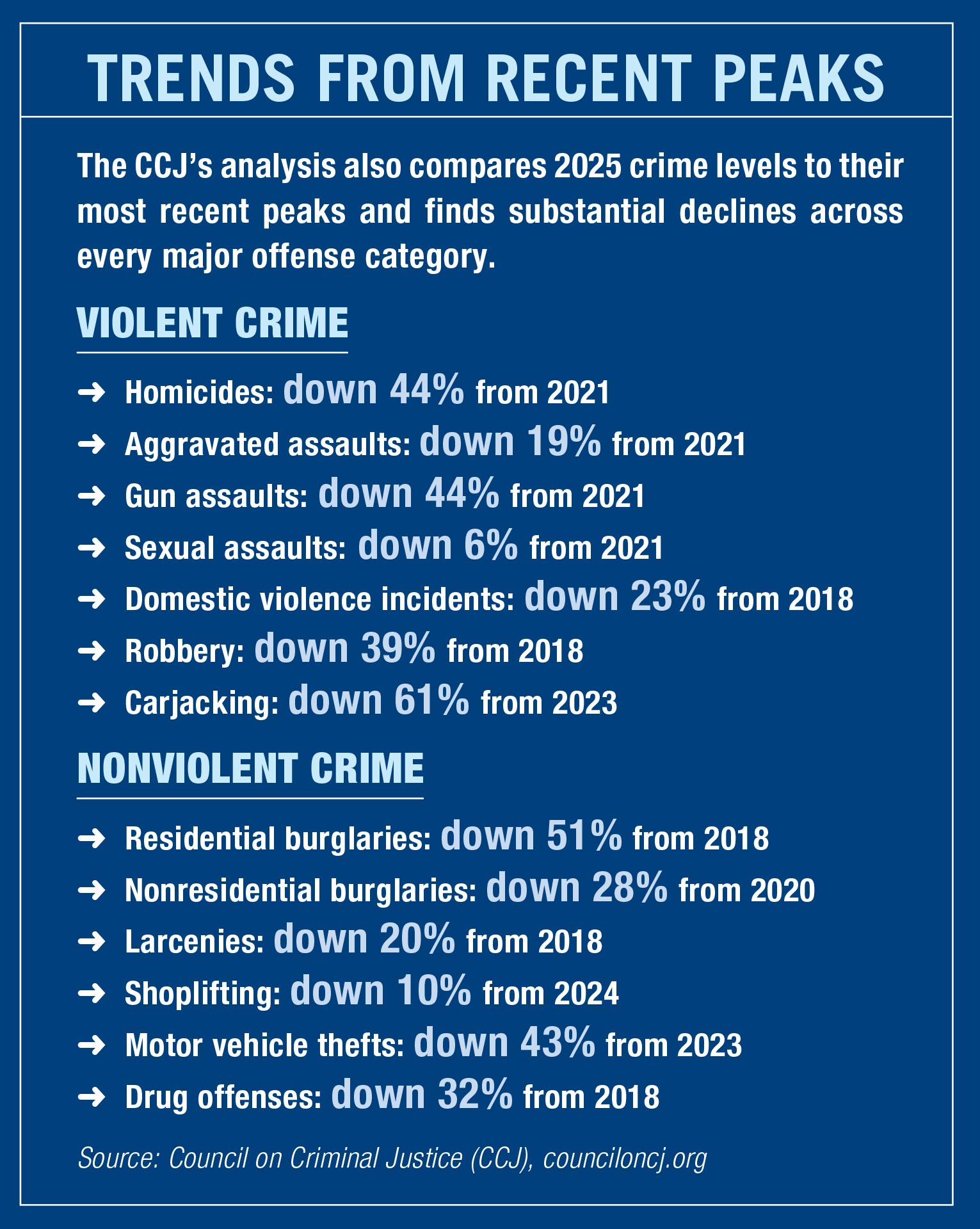
In a CCJ press release, the organization noted that when the FBI releases nationwide data for jurisdictions of all sizes later this year, homicide rates in 2025 could fall to around 4.0 per 100,000 residents. “That would be the lowest rate recorded in law enforcement or public health data going back to 1900 … and would mark the largest single-year percentage drop in the homicide rate on record,” the release stated.

“We’re seeing big swings in criminal justice policies, programs, and rhetoric, big advances in crime-fighting technologies, and big social, economic, and cultural shifts all happening at the same time,” CCJ President and CEO Adam Gelb said. “It’s extremely difficult to disentangle and pinpoint what’s actually driving the drop. As a result, we have a battle of sound bites and abundant claims of credit but scarce hard evidence to back them up.”

Lawmakers from both sides of the aisle are touting that their respective policies are responsible for the positive news. Some Republicans have attributed the drops to the Trump administration’s tough-on-crime policies, though the CCJ’s report notes that many of the cities in the study were not subject to National Guard deployments or immigration operation surges. Likewise, some Democratic mayors have claimed responsibility for the decreases.

Jens Ludwig, a public policy professor and the director of the University of Chicago Crime Lab, questioned these assertions. “The fact that in any individual city, we are seeing crime drop across so many neighborhoods and in so many categories, means it can’t be any particular pet project in a neighborhood enacted by a mayor.… It’s not like any individual mayor is a genius in figuring this out,” he told AP.

According to Ludwig, no single politician or program may rightfully take credit for the decreases. He suggested the drops may reflect a “normalization” of crime rates. Many large cities saw steep spikes in crime in 2020 amid government-mandated lockdowns, protests following George Floyd’s death and, in some cases, riots. The declines observed now may simply be a return to more typical levels.

If the decreases are indeed a normalization of crime, they may not last. “It’s too soon for anybody on either side of this to declare mission accomplished,” Ludwig said.

As seen in the March 2026 issue of American Police Beat magazine.
Don’t miss out on another issue today! Click below:


SUBSCRIBE TODAY!

Categories: On the Job

Primary Sidebar

Recent Articles

  • Perpetual recognition of line-of-duty deaths
  • A Tribute to Fallen Heroes
  • NLEOMF Fund announces March 2026 Officers of the Month
  • Markers of service and remembrance
  • Testing the waters — literally
  • Police pause license plate readers
  • Tragedy strikes Baker to Vegas
  • Frankpledge to forensics: A brief history of law enforcement
  • Pushback as a training signal
  • Let’s get moving!

Footer

Our Mission
To serve as a trusted voice of the nation’s law enforcement community, providing informative, entertaining and inspiring content on interesting and engaging topics affecting peace officers today.

Contact us: info@apbweb.com | (800) 234-0056.

  • Facebook
  • Instagram
  • Twitter

Categories

  • Editor’s Picks
  • On the Job
  • Labor
  • Tech
  • Training
  • Policy
  • Health/Wellness
  • Community
  • Offbeat
  • We Remember
  • Jobs and Careers
  • Events

Editor’s Picks

Let’s get moving!

Let’s get moving!

April 27, 2026

Heroes of the World Trade Center

Heroes of the World Trade Center

April 24, 2026

The Promise Gap

The Promise Gap

April 22, 2026

Corruption, collusion and impunity

Corruption, collusion and impunity

April 21, 2026

Policies | Consent Preferences | Copyright © 2026 APB Media, LLC | Website design, development and maintenance by 911MEDIA

Open

Subscribe

Close

Receive the latest news and updates from American Police Beat directly to your inbox!

  • This field is for validation purposes and should be left unchanged.