• Skip to primary navigation
  • Skip to main content
  • Skip to primary sidebar
  • Skip to footer
  • Home
  • About
  • The Magazine
  • Events
  • Partners
  • Products
  • Contact
  • Jobs and Careers
  • Advertise
  • Facebook
  • Instagram
  • Twitter
  • Subscribe
American Police Beat

American Police Beat Magazine

Law Enforcement Publication

  • Home
  • Leadership
    • Understanding the boundaries of professional relationships with the...
      Why you should lead from 30,000 feet
      Public perception and trust
      When performance reviews are a waste of time
      Taking a page from Toyota’s playbook
  • Topics
    • Leadership
      • Understanding the boundaries of professional relationships with the...
        Why you should lead from 30,000 feet
        Public perception and trust
        When performance reviews are a waste of time
        Taking a page from Toyota’s playbook
    • Editor’s Picks
      • Liability challenges in contemporary policing
        When performance reviews are a waste of time
        Proactive wellness visits
        Taking a page from Toyota’s playbook
        Law enforcement’s missing weapon
    • On the Job
      • Villains and heroes in the Big Apple
        Right place, right time — again
        Some good news on crime
        Mom-to-be named Cop of the Year
        Fatherly instincts save boy from icy water
    • Labor
      • The Promise Gap
        Cut the cops, save a dollar?
        Labor release under fire
        Who’s watching the watchmen?
        Crime and punishment (or lack thereof) in Seattle
    • Tech
      • New Mexico license plate readers save lives, lead to “precise...
        A modern field guide to understanding research in policing
        Gear that moves with you
        A new breed of cop car
        The future of patrol is here
    • Training
      • Let’s get moving!
        The five minutes before the ambulance
        Navigating danger
        Critical thinking in police training
        Threshold neuroscience
    • Policy
      • Corruption, collusion and impunity
        E-bikes spark public safety concerns
        Try racing without wheels
        Law enforcement accreditation: Why it matters
        Liability challenges in contemporary policing
    • Health/Wellness
      • Addressing stress, vicarious trauma and burnout
        Nervous system regulation
        The nature of the job
        Promoting organizational wellness
        Telling cops to get more sleep isn’t working
    • Community
      • Improving autism awareness
        Shop with a Cop
        Community engagement: What is it moving forward?
        Contradictory crossroads
        Back-to-school season brings out police support nationwide
    • Offbeat
      • An unexpected burglar
        Police humor only a cop would understand
        Not eggzactly a perfect heist
        Pizza … with a side of alligator?
        Wisconsin man charged with impersonating Border Patrol agent twice in...
    • We Remember
      • Heroes of the World Trade Center
        Forty heroes: United Airlines Flight 93
        The Pentagon
        A nation propelled to war, lives changed forever
        A Christmas loss
    • HOT Mail
      • The War on Cops Continues Unabated
  • On the Job
    • Villains and heroes in the Big Apple
      Right place, right time — again
      Some good news on crime
      Mom-to-be named Cop of the Year
      Fatherly instincts save boy from icy water
  • Labor
    • The Promise Gap
      Cut the cops, save a dollar?
      Labor release under fire
      Who’s watching the watchmen?
      Crime and punishment (or lack thereof) in Seattle
  • Tech
    • New Mexico license plate readers save lives, lead to “precise...
      A modern field guide to understanding research in policing
      Gear that moves with you
      A new breed of cop car
      The future of patrol is here
  • Training
    • Let’s get moving!
      The five minutes before the ambulance
      Navigating danger
      Critical thinking in police training
      Threshold neuroscience
  • Policy
    • Corruption, collusion and impunity
      E-bikes spark public safety concerns
      Try racing without wheels
      Law enforcement accreditation: Why it matters
      Liability challenges in contemporary policing
  • Health/Wellness
    • Addressing stress, vicarious trauma and burnout
      Nervous system regulation
      The nature of the job
      Promoting organizational wellness
      Telling cops to get more sleep isn’t working
  • Community
    • Improving autism awareness
      Shop with a Cop
      Community engagement: What is it moving forward?
      Contradictory crossroads
      Back-to-school season brings out police support nationwide
  • Offbeat
    • An unexpected burglar
      Police humor only a cop would understand
      Not eggzactly a perfect heist
      Pizza … with a side of alligator?
      Wisconsin man charged with impersonating Border Patrol agent twice in...
  • We Remember
    • Heroes of the World Trade Center
      Forty heroes: United Airlines Flight 93
      The Pentagon
      A nation propelled to war, lives changed forever
      A Christmas loss
  • HOT Mail
    • The War on Cops Continues Unabated
  • About
  • The Magazine
  • Events
  • Partners
  • Products
  • Contact
  • Jobs and Careers
  • Advertise
  • Subscribe
Search

Training

Let’s get moving!

Train to move at the speed of a gunfight

Todd Fletcher Published April 27, 2026 @ 6:00 am PDT

iStock.com/Leicarras

Most officers and firearm instructors agree the way we’ve trained in the past isn’t the best way to prepare officers for the reality of the street. Standing on a line with everyone planted to the ground and shooting at static targets isn’t training for a gunfight. Shooting a couple of slow shots into the middle of a wide-open target, slowly changing magazines and looking around to “scan for other threats” isn’t doing much to help officers prevail when someone is trying to kill them or someone else.

This doesn’t mean line drills don’t serve a purpose or are a waste of training time. Standing still and focusing on accuracy reinforces marksmanship fundamentals and builds dexterity for smoother, more efficient reloads. In instructor development classes, it provides a way for new instructors to work with each other to provide coaching and feedback while improving their ability to diagnose shooting errors. These are core foundational skills that we can use to build gunfighting skills.

Unless the fight starts while the officer is already behind cover, officers are moving — and moving fast.

Get real

The problem lies with training programs and instructors who fail to train officers for the realities of deadly force encounters. We have more video evidence than ever before about the realities of officer-involved shootings. Officers aren’t standing still while slowly pressing the trigger to the rear. They aren’t firing a shot, then assessing and scanning for threats. They’re shooting fast, assessing while fighting and focused on the threat who’s trying to kill them.

The vast majority of law enforcement firearms training includes movement. Unfortunately, it usually begins and ends with the introduction of the rolling Groucho Walk. Rolling heel-to-toe smoothly and slowly is an effective way to present movement to officers as a first experience, but it doesn’t mirror reality. Unless the fight starts while the officer is already behind cover, officers are moving — and moving fast.

So, let’s get real. Training to move at the speed of a gunfight means moving dynamically. If you’re going to move, you might as well get moving. Once you’ve Groucho Walked across the range, pick up the pace and move like you mean it. A progression of slow Groucho Walking, regular walking pace, fast walking, slow jog, fast jog and finally an honest running speed should all be part of firearms training.
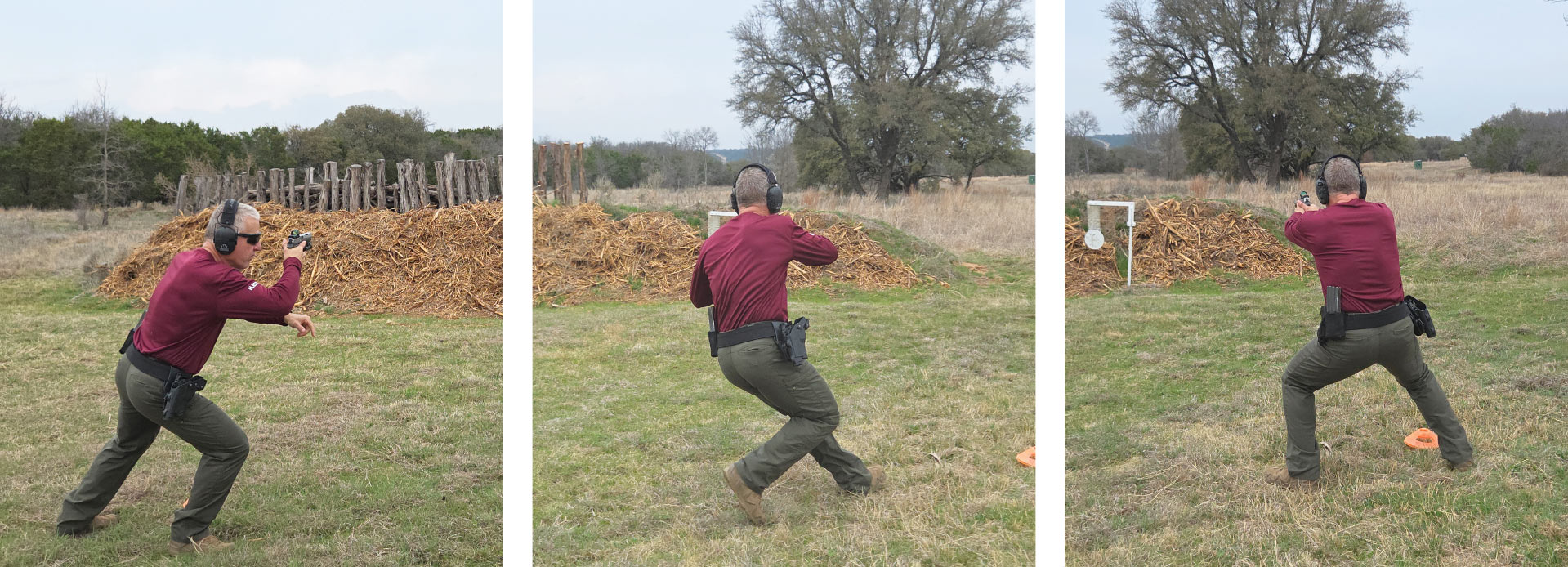
The 9×9 drill: exit, entry and landing. A balanced athletic shooting platform gets the shooter into and out of position more quickly, providing more time to shoot well. (Todd Fletcher)

Tips and tricks

Moving fast and shooting well means training time. It takes range time to shoot well while moving dynamically. As you progressively begin to move faster, there are a few things to keep in mind to make it easier to move and improve your accuracy. First, maintain an athletic position. This allows you to keep your balance over varied terrain, gives you the ability to quickly change direction and helps keep your shooting platform level, helping maintain acceptable accuracy. An athletic position means the knees are bent, your butt is lower to the ground and your weight is biased toward your toes regardless of the direction of movement.

Second, practice seeing what movement does to your sighting system. For example, if you’re using a pistol-mounted optic, the reticle will move in a predictable pattern based on your speed. Once you see that pattern, you will see a rhythm to your movement that allows you to be more accurate even while moving faster than you’ve trained in the past.

Lastly, your shooting platform from the hips up is crucial. The same factors we teach for static shooting apply, but they become critically important to minimize movement of the pistol while you’re moving fast. Keep a slight bend in your arms, elbows rotated slightly down toward the ground and hard grip pressure, especially with your support hand, and press the palms of your hands together. This will help create the predictable pattern of movement that I mentioned before.

Training for the realities of a law enforcement gunfight shouldn’t be a luxury.

Dynamic movement drills

Here are some drills to improve your accuracy while shooting on the move. But first, there are a few things to keep in mind. I do not recommend moving backward. Moving backward fast has very predictable results: we end up on our butts. Falling backward and landing on your backside during a gunfight would suck.

Start slow, but don’t stay slow. Push the pace outside your comfort zone, but stay safe doing it. The faster you move, the more uncomfortable it’s going to feel, because you haven’t been there before. The more you do it, the more comfortable you will be with fast, dynamic movement while shooting.

When you first start doing this kind of training, your marksmanship is going to suffer. This is new, so you’re not going to be a superstar right out of the gate. Start with a full-size silhouette paper target and mark your rounds after each round. Once you get better, move to steel targets such as A/C zone silhouettes, a 12-inch round target or an 8-by-12-inch rectangle target. If you use steel, make sure you’re not getting closer than 10 yards from the target before stopping.

Moving forward from the 20-yard line, start with the progression from slow Groucho Walking, regular walking pace, fast walking, slow jog, fast jog and then an honest running speed. This will help you understand the rhythm of movement and what your sights are doing in relation to your target.

Next, add quick, dynamic lateral movement and sudden stops before engaging your target. Remember to stay low and explode in the other direction. Stay low while stabilizing your shooting platform and engage your target before moving the other direction.

After some reps of those drills, try these other excellent drills I like to use to improve performance. Most of these work best using a shot timer so you have an objective way to measure performance.
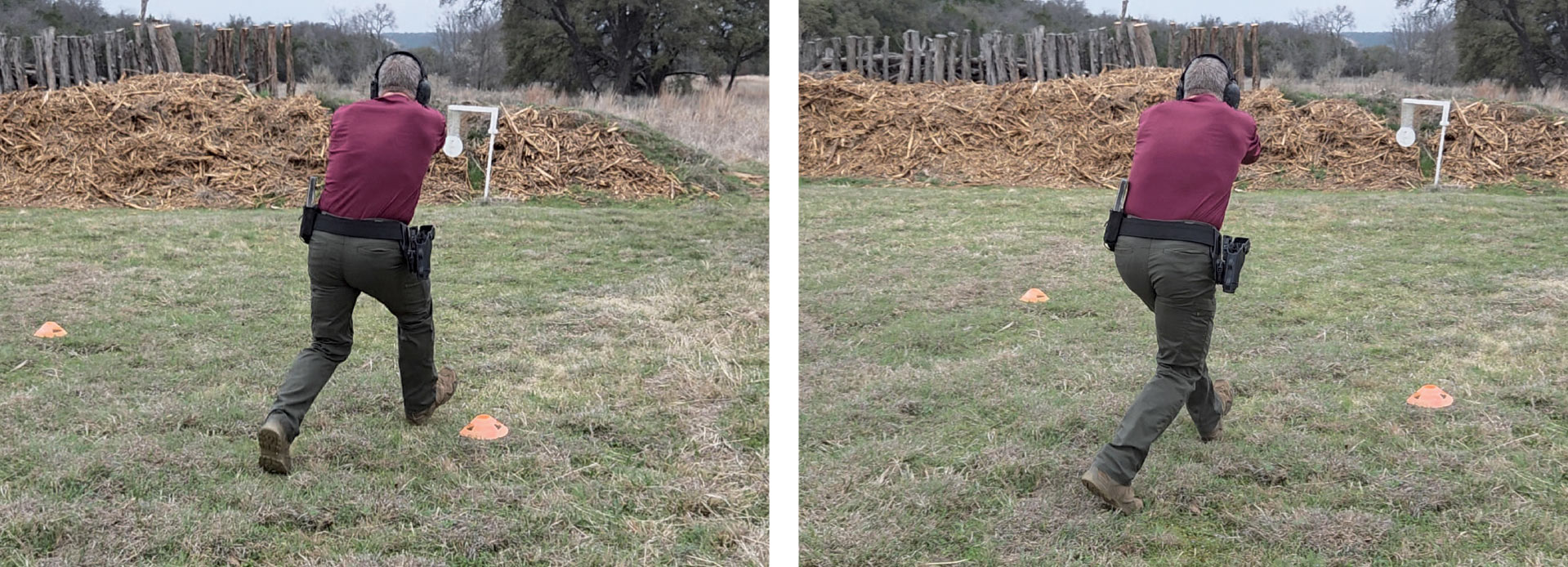
Shooting the X drill on an 8-inch steel plate while running. Note the forward weight bias, bent knees and hips square to the direction of movement. (Todd Fletcher)

9×9 drill — 9 rounds

Setup: I got this drill from one of my mentors and role models, Dave Spaulding. Using a 3-by-5-inch index card on an 8-inch paper plate as your target, place two cones about 15 feet apart at the 5-yard line.

Description: Standing behind one of the cones at the 5-yard line, on the signal, the shooter will draw and fire three shots to the index card. Move quickly to the other cone and fire three shots to the index card. Move back to the first cone and fire three shots to the index card. Time stops on the last shot fired.

Scoring: Placing all nine hits on the index cards in nine seconds or less is excellent. Hits on the plate but off the index card add a one-second penalty.

X-drill — 12 rounds

Setup: This one will get your heart rate up! Using a silhouette paper target with a realistic center mass scoring area or a steel target (no closer than 10 yards), set cones up in an X pattern with the cones about 5 yards from each other.

Description: Standing at one of the farthest corner cones, on the signal, the shooter will advance diagonally toward the opposite cones, making three hits on target. Once the shooter has made it to the opposite forward cone, they will safely and quickly move up range to the rearmost cone on that side. Once at the opposite rearmost cone from where they originally started the drill, the shooter will advance diagonally toward the opposite cone, making three hits on target before moving safely and quickly up range to the original starting point. Once at the original starting point, the shooter will repeat the drill for a total of nine rounds. Time stops on the last shot fired.

Scoring: On steel, a total of 12 hits on target must be made (three each moving forward). On paper, no penalty time for center mass hits, one-second penalty for hits outside the center mass and five-second penalty for misses.

It takes practice

Set these up and work on moving and hitting at the speed of a gunfight. Training for the realities of a law enforcement gunfight shouldn’t be a luxury. It should be something we do every time we hit the range. If you’re not getting this type of training from your department, take ownership of your own training and skill development. The life you save may be your own.

Todd Fletcher

Todd Fletcher

Todd Fletcher is a retired sergeant from central Oregon with over 30 years of law enforcement experience. He presents firearms training, instructor certification and instructor development classes nationwide. Todd has presented at multiple regional, national and international conferences, including multiple ILEETA conferences and IALEFI events. He owns Combative Firearms Training, LLC, providing firearms training, handgun and patrol rifle instructor certification, and instructor development classes to law enforcement, military and private security. He can be contacted at Todd@CombativeFirearms.com.

View articles by Todd Fletcher

As seen in the April 2026 issue of American Police Beat magazine.
Don’t miss out on another issue today! Click below:


SUBSCRIBE TODAY!

Categories: Training

Primary Sidebar

Recent Articles

  • Let’s get moving!
  • Heroes of the World Trade Center
  • The Promise Gap
  • Corruption, collusion and impunity
  • The five minutes before the ambulance
  • New Mexico license plate readers save lives, lead to “precise policing”
  • Addressing stress, vicarious trauma and burnout
  • Understanding the boundaries of professional relationships with the boss
  • E-bikes spark public safety concerns
  • Improving autism awareness

Footer

Our Mission
To serve as a trusted voice of the nation’s law enforcement community, providing informative, entertaining and inspiring content on interesting and engaging topics affecting peace officers today.

Contact us: info@apbweb.com | (800) 234-0056.

  • Facebook
  • Instagram
  • Twitter

Categories

  • Editor’s Picks
  • On the Job
  • Labor
  • Tech
  • Training
  • Policy
  • Health/Wellness
  • Community
  • Offbeat
  • We Remember
  • Jobs and Careers
  • Events

Editor’s Picks

Liability challenges in contemporary policing

Liability challenges in contemporary policing

February 27, 2026

When performance reviews are a waste of time

When performance reviews are a waste of time

February 26, 2026

Proactive wellness visits

Proactive wellness visits

February 25, 2026

Taking a page from Toyota’s playbook

Taking a page from Toyota’s playbook

February 23, 2026

Policies | Consent Preferences | Copyright © 2026 APB Media, LLC | Website design, development and maintenance by 911MEDIA

Open

Subscribe

Close

Receive the latest news and updates from American Police Beat directly to your inbox!

  • This field is for validation purposes and should be left unchanged.