• Skip to primary navigation
  • Skip to main content
  • Skip to primary sidebar
  • Skip to footer
  • Home
  • About
  • The Magazine
  • Events
  • Partners
  • Products
  • Contact
  • Jobs and Careers
  • Advertise
  • Facebook
  • Instagram
  • Twitter
  • Subscribe
American Police Beat

American Police Beat Magazine

Law Enforcement Publication

  • Home
  • Leadership
    • Understanding the boundaries of professional relationships with the...
      Why you should lead from 30,000 feet
      Public perception and trust
      When performance reviews are a waste of time
      Taking a page from Toyota’s playbook
  • Topics
    • Leadership
      • Understanding the boundaries of professional relationships with the...
        Why you should lead from 30,000 feet
        Public perception and trust
        When performance reviews are a waste of time
        Taking a page from Toyota’s playbook
    • Editor’s Picks
      • Let’s get moving!
        Heroes of the World Trade Center
        The Promise Gap
        Corruption, collusion and impunity
        Liability challenges in contemporary policing
    • On the Job
      • Testing the waters — literally
        Frankpledge to forensics: A brief history of law enforcement
        Villains and heroes in the Big Apple
        Right place, right time — again
        Some good news on crime
    • Labor
      • The Promise Gap
        Cut the cops, save a dollar?
        Labor release under fire
        Who’s watching the watchmen?
        Crime and punishment (or lack thereof) in Seattle
    • Tech
      • New Mexico license plate readers save lives, lead to “precise...
        A modern field guide to understanding research in policing
        Gear that moves with you
        A new breed of cop car
        The future of patrol is here
    • Training
      • Pushback as a training signal
        Let’s get moving!
        The five minutes before the ambulance
        Navigating danger
        Critical thinking in police training
    • Policy
      • Police pause license plate readers
        Corruption, collusion and impunity
        E-bikes spark public safety concerns
        Try racing without wheels
        Law enforcement accreditation: Why it matters
    • Health/Wellness
      • Addressing stress, vicarious trauma and burnout
        Nervous system regulation
        The nature of the job
        Promoting organizational wellness
        Telling cops to get more sleep isn’t working
    • Community
      • Improving autism awareness
        Shop with a Cop
        Community engagement: What is it moving forward?
        Contradictory crossroads
        Back-to-school season brings out police support nationwide
    • Offbeat
      • An unexpected burglar
        Police humor only a cop would understand
        Not eggzactly a perfect heist
        Pizza … with a side of alligator?
        Wisconsin man charged with impersonating Border Patrol agent twice in...
    • We Remember
      • A Tribute to Fallen Heroes
        Markers of service and remembrance
        Tragedy strikes Baker to Vegas
        Heroes of the World Trade Center
        Forty heroes: United Airlines Flight 93
    • HOT Mail
      • The War on Cops Continues Unabated
  • On the Job
    • Testing the waters — literally
      Frankpledge to forensics: A brief history of law enforcement
      Villains and heroes in the Big Apple
      Right place, right time — again
      Some good news on crime
  • Labor
    • The Promise Gap
      Cut the cops, save a dollar?
      Labor release under fire
      Who’s watching the watchmen?
      Crime and punishment (or lack thereof) in Seattle
  • Tech
    • New Mexico license plate readers save lives, lead to “precise...
      A modern field guide to understanding research in policing
      Gear that moves with you
      A new breed of cop car
      The future of patrol is here
  • Training
    • Pushback as a training signal
      Let’s get moving!
      The five minutes before the ambulance
      Navigating danger
      Critical thinking in police training
  • Policy
    • Police pause license plate readers
      Corruption, collusion and impunity
      E-bikes spark public safety concerns
      Try racing without wheels
      Law enforcement accreditation: Why it matters
  • Health/Wellness
    • Addressing stress, vicarious trauma and burnout
      Nervous system regulation
      The nature of the job
      Promoting organizational wellness
      Telling cops to get more sleep isn’t working
  • Community
    • Improving autism awareness
      Shop with a Cop
      Community engagement: What is it moving forward?
      Contradictory crossroads
      Back-to-school season brings out police support nationwide
  • Offbeat
    • An unexpected burglar
      Police humor only a cop would understand
      Not eggzactly a perfect heist
      Pizza … with a side of alligator?
      Wisconsin man charged with impersonating Border Patrol agent twice in...
  • We Remember
    • A Tribute to Fallen Heroes
      Markers of service and remembrance
      Tragedy strikes Baker to Vegas
      Heroes of the World Trade Center
      Forty heroes: United Airlines Flight 93
  • HOT Mail
    • The War on Cops Continues Unabated
  • About
  • The Magazine
  • Events
  • Partners
  • Products
  • Contact
  • Jobs and Careers
  • Advertise
  • Subscribe
Search

Community

Community engagement: What is it moving forward?

Robert Spinks Published October 28, 2025 @ 6:00 am PDT

iStock.com/Imagesbybarbara

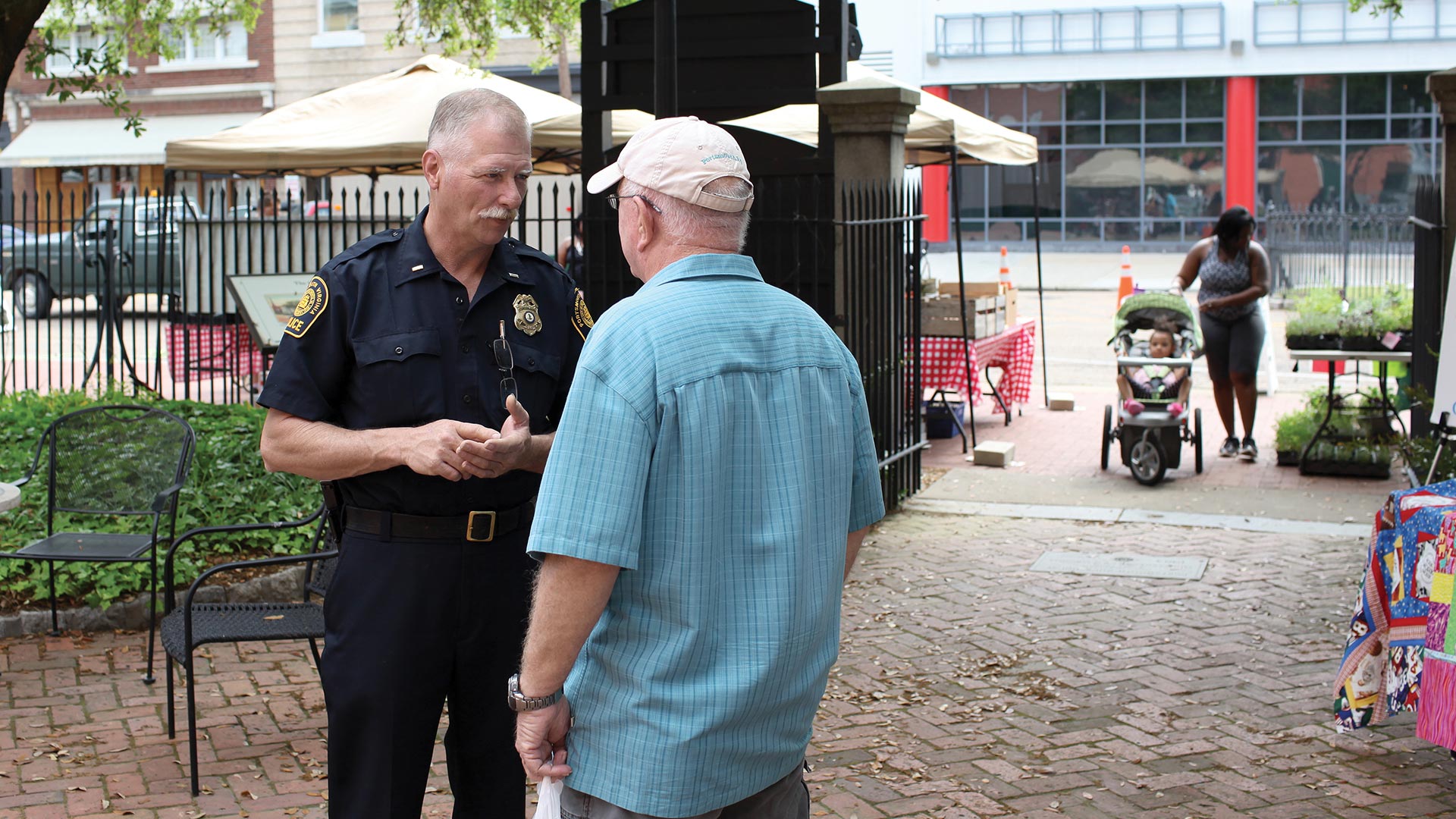
Community engagement isn’t a buzzword or a box to check — it’s the foundation of trust, legitimacy and effectiveness in modern policing. While chiefs and command staff may set policy and vision, the real face of engagement is the patrol officer or deputy on the street. Every call for service, traffic stop or casual conversation on a neighborhood corner becomes an opportunity to strengthen — or weaken — the bond between law enforcement and the people we serve.

For 50 years, engagement has been central to effective policing. It is not a “soft” alternative to enforcement, but a philosophy rooted in collaboration, trust-building and proactive problem-solving. Done well, it reinforces legitimacy, enhances public safety and addresses root causes of crime. Both officers and agencies share this responsibility.

In this climate, the frontline officer’s calm, respectful, by-the-book contact is the cooling system that keeps trust alive.

Engagement in a changing landscape

Community engagement has never been more critical, especially as federal priorities increasingly touch local policing. Programs like 287(g), Secure Communities or National Guard deployments often blur lines between federal and local roles. For residents, the uniform may symbolize “the government,” regardless of who wears it. That perception impacts local legitimacy.

Research shows that immigration enforcement partnerships can reduce cooperation, particularly in Latino communities, raising victimization risks and lowering crime reporting. If witnesses stop calling, evidence dries up and offenders remain on the street. In this climate, the frontline officer’s calm, respectful, by-the-book contact is the cooling system that keeps trust alive.

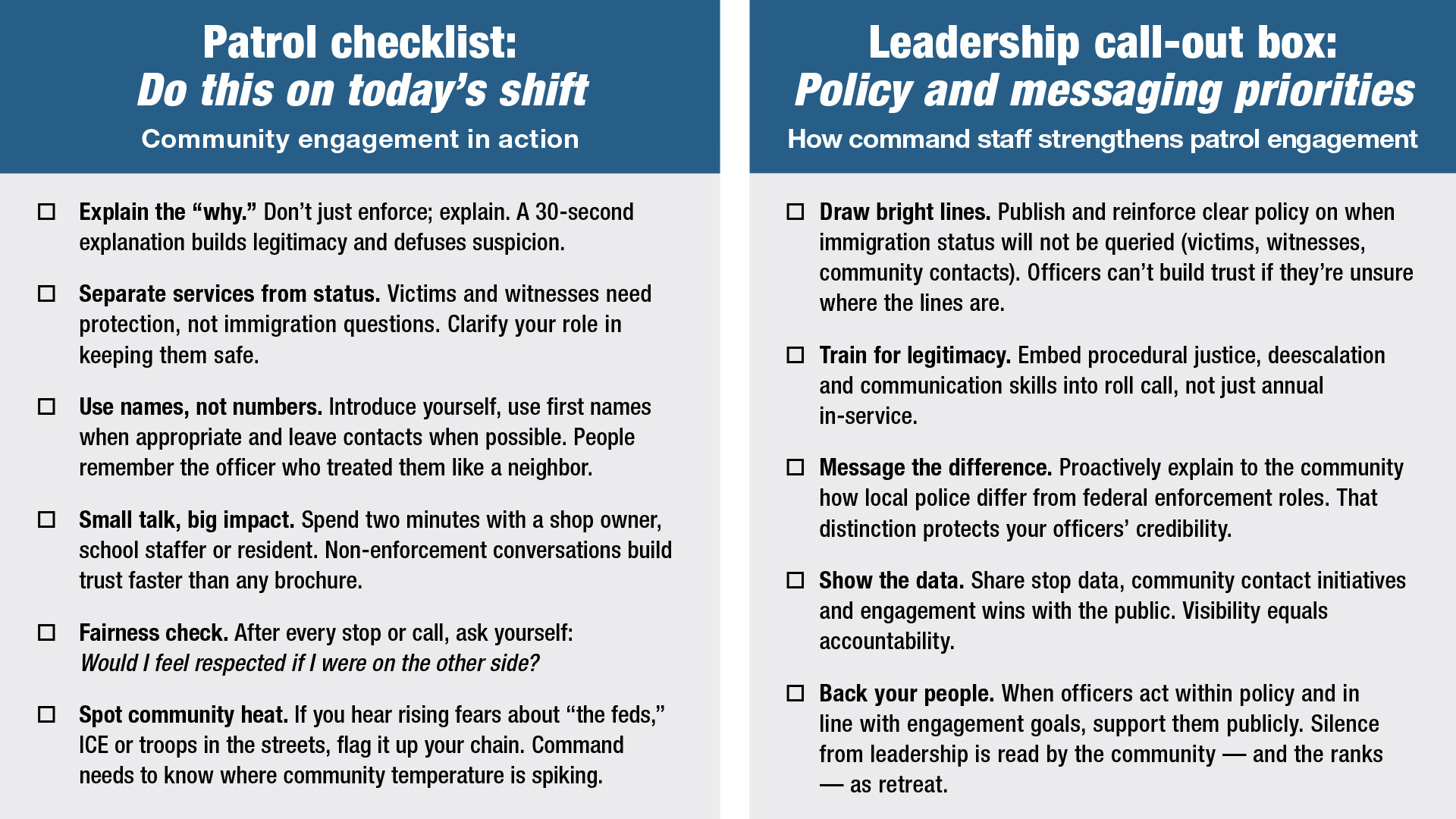
For chiefs, the challenge is to create clarity and consistency: clear policy on federal partnerships, unambiguous guidance on immigration queries (especially for victims/witnesses, consistent with law) and transparent data-sharing. When strategic alignment supports the daily work of officers, engagement
becomes a force multiplier — even amid national controversy.

Defining engagement

The American Crime Prevention Institute (ACPI) defines community engagement as “the proactive process by which law enforcement works in partnership with the community to identify and address issues of public safety, fear of crime and quality of life.” Engagement is not merely outreach — it is sustained interaction that fosters trust, communication and mutual problem-solving.

Key operational aspects of community engagement include:

  1. Two-way communication. Engagement is not just about delivering information but also about listening and incorporating public feedback into decision-making.
  2. Relationship building. Long-term relationships create the foundation for mutual trust.
  3. Transparency and accountability. Public trust requires visible commitment to fair, ethical and consistent practices.
  4. Shared problem-solving. Officers and community members collaborate to address crime and disorder at the neighborhood level.

ACPI operational guidance emphasizes the need for agencies to integrate engagement into every unit and shift, making it “the responsibility of every officer, every day.”

Organizational inertia — the “we’ve always done it this way” mindset — slows progress.

The officer’s role

While agencies design programs, the patrol officer operationalizes engagement. Research from the DOJ shows that routine encounters — traffic stops, calls for service, neighborhood patrols — shape perceptions more than community meetings ever could.

The cumulative impact of small interactions is powerful. One respectful contact can build a reservoir of trust; one dismissive encounter can erase years of progress. Officers who explain their actions, listen and treat people with fairness create lasting impressions.

Neighborhood familiarity also enhances problem-solving. Knowing the store owners, the crossing guard or the neighbor who always calls about suspicious activity builds context for what is normal. That local knowledge can prevent crime and defuse conflict before it escalates.

Every patrol officer carries the weight of the agency’s legitimacy. The badge represents authority; legitimacy is earned — one stop, one conversation, one neighborhood visit at a time.

Engagement frameworks in practice

Several complementary models guide community engagement today:

  • Community Oriented Policing and Problem Solving (COPPS) links partnerships, organizational transformation and problem-solving. Engagement is the thread that animates all three — without it, COPPS remains rhetoric rather than reality.
  • Guardian versus warrior mindsets highlight the difference between collaboration and control. Research shows that guardian-oriented officers are more likely to deescalate and are perceived more positively, while warrior cultures often reinforce “us versus them” dynamics.
  • Actively caring for people policing (ACP), developed by E. Scott Geller and Bobby Kipper, builds compassion and prosocial behavior into daily practice. ACP encourages officers to see each encounter as an opportunity to positively influence others, while strengthening internal agency culture and officer morale.
  • Police2Peace reframes police identity through the “peace officer” concept. Pilot programs report increases in trust and reductions in use-of-force incidents. Language, symbols and procedural justice all reinforce officers as facilitators of peace rather than just enforcers of law.

Together, these frameworks share a common foundation: empathy, trust and service. They give agencies practical tools to embed engagement into culture while improving officer well-being and legitimacy.

Barriers to engagement

Resistance to change remains one of the greatest obstacles. Organizational inertia — the “we’ve always done it this way” mindset — slows progress. Some officers fear engagement compromises authority, while others lack training to feel confident.

The impacts are measurable. A Bureau of Justice Assistance (BJA) study found that agencies resistant
to COPPS reforms had lower citizen satisfaction and higher complaint rates. Resistance is not just an internal hurdle; it directly undermines community partnerships and public trust.

Overcoming it requires intentional recruitment, training and leadership that consistently reinforces engagement as central to the mission.

Sustaining engagement

ACPI guidance provides practical strategies for embedding engagement into daily police operations:

  • Assign officers to consistent neighborhoods to build familiarity and accountability.
  • Hold regular forums to solicit feedback and share information.
  • Develop collaborative crime-prevention projects like neighborhood watch or youth mentoring.
  • Build partnerships with schools, businesses, and faith organizations to broaden impact.

Consistency matters most. Engagement is not a special event; it is the work itself.

Conclusion

Community engagement is both an operational necessity and a moral imperative. It is the lifeblood of COPPS, strengthened by a guardian mindset, and reinforced through frameworks like ACP and Police2Peace. Policy may set the tone, but it is the officer’s daily interactions that define policing for the public.

Trust is not built through press releases or programs — it is built on street corners, in living rooms and across front porches.

Policing will not thrive in the 21st century if engagement is treated as an add-on. It must be the foundation of how every peace officer and agency approaches the mission. Community engagement is not optional. It is policing.
Robert Spinks

Robert Spinks

Robert Spinks started his career in 1981 with the Eugene Police Department in Oregon and later served at the Port of Seattle Police Department in Washington. He has been the chief of police in Sedro-Woolley, Washington; Milton-Freewater, Oregon; Sequim, Washington; and McNeese State University. He is currently the chief in Parsons, Kansas. He is a fellow of the Future Policing Institute. He has instructed college courses for over 30 years and is currently at Labette Community College. Community policing information can be downloaded at www.parsonspdks.gov.

View articles by Robert Spinks

As seen in the October 2025 issue of American Police Beat magazine.
Don’t miss out on another issue today! Click below:


SUBSCRIBE TODAY!

Categories: Community

Primary Sidebar

Recent Articles

  • A Tribute to Fallen Heroes
  • NLEOMF Fund announces March 2026 Officers of the Month
  • Markers of service and remembrance
  • Testing the waters — literally
  • Police pause license plate readers
  • Tragedy strikes Baker to Vegas
  • Frankpledge to forensics: A brief history of law enforcement
  • Pushback as a training signal
  • Let’s get moving!
  • Heroes of the World Trade Center

Footer

Our Mission
To serve as a trusted voice of the nation’s law enforcement community, providing informative, entertaining and inspiring content on interesting and engaging topics affecting peace officers today.

Contact us: info@apbweb.com | (800) 234-0056.

  • Facebook
  • Instagram
  • Twitter

Categories

  • Editor’s Picks
  • On the Job
  • Labor
  • Tech
  • Training
  • Policy
  • Health/Wellness
  • Community
  • Offbeat
  • We Remember
  • Jobs and Careers
  • Events

Editor’s Picks

Let’s get moving!

Let’s get moving!

April 27, 2026

Heroes of the World Trade Center

Heroes of the World Trade Center

April 24, 2026

The Promise Gap

The Promise Gap

April 22, 2026

Corruption, collusion and impunity

Corruption, collusion and impunity

April 21, 2026

Policies | Consent Preferences | Copyright © 2026 APB Media, LLC | Website design, development and maintenance by 911MEDIA

Open

Subscribe

Close

Receive the latest news and updates from American Police Beat directly to your inbox!

  • This field is for validation purposes and should be left unchanged.