
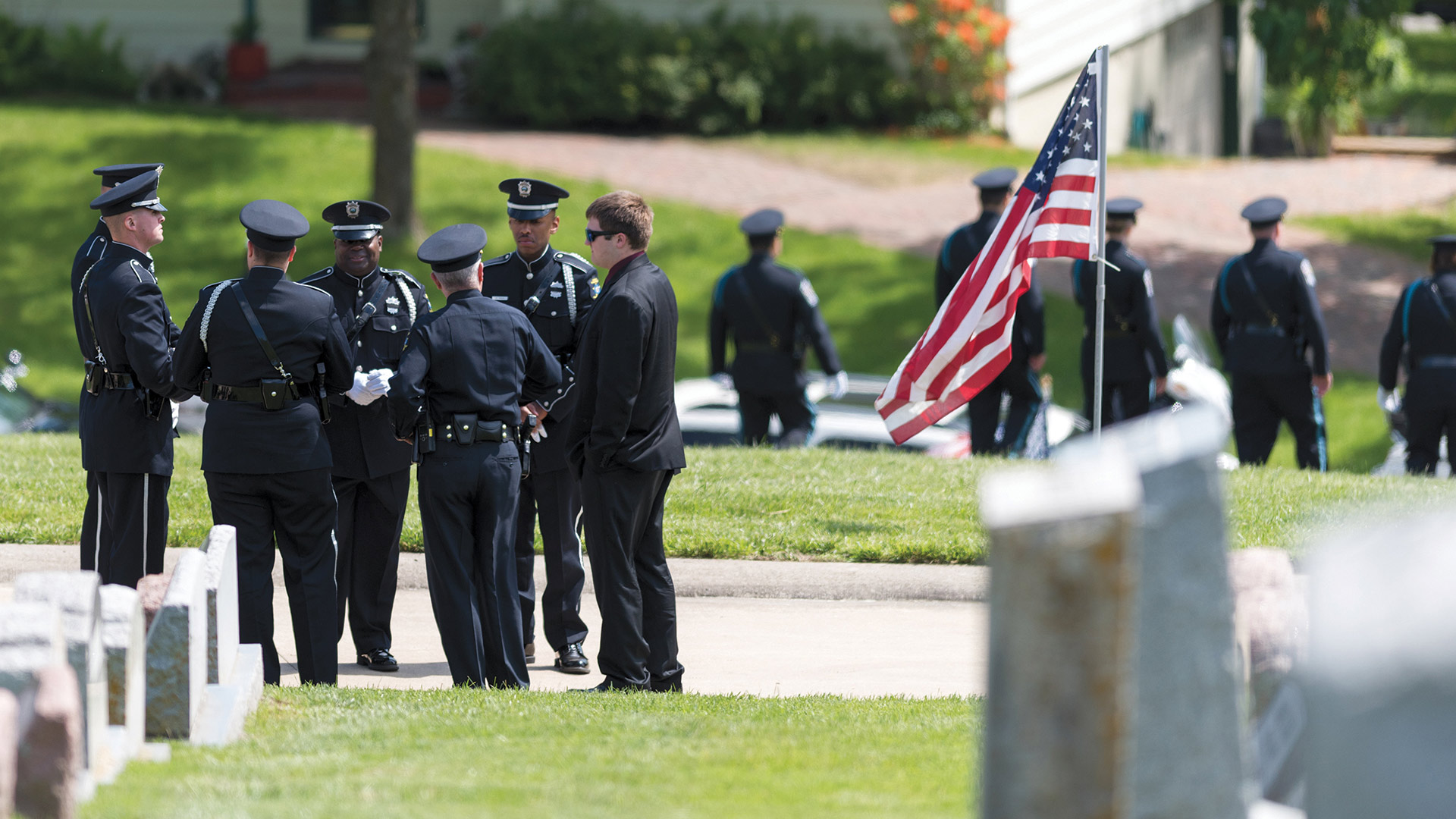
Someone once told me that when it comes to the job, you’ll remember your first, your worst and your last. When it comes to a line-of-duty death (LODD), it often becomes both your first and your worst … and, if you’re fortunate, your first is also your last.
Grieving the loss of a brother or sister who wears the same uniform is different. It’s different than a bad call, a brutal investigation or even the slow loss of who you were before this career. An LODD is heavier. It doesn’t fit on the shelf where we compartmentalize everything else. And if you try to force it there … it’s so heavy it can take the entire shelf down with it.
I was dispatched to my first LODD almost eight years ago this May. The call came in around 2300 hours. Minimal information. Two officers down. One pronounced on scene.
Another agency stepped in to handle the scene so the affected agency could gather at the station. Off-duty personnel were already arriving. The station was my first assignment.
Everyone was shaken. Crying. Hugging. Angry. Searching. Looking for something to do. That’s what we do in this profession — we move, we act, we find a task. But in that moment, there was no task. No checklist. No SOP sitting in a file room waiting to be pulled. The only job was to be present — and to grieve.
So what is grief, anyway?
It’s not a problem to solve. It’s an adaptive process — your mind and body trying to reconcile a reality that has changed.
Grief is an interesting thing. It’s intangible, but you feel it everywhere. You can’t see it, but it fills the room. You can’t always describe it, but you know it’s heavy. You can certainly hear grief — you know the difference between the scream of someone who is injured and the sound of a mother who just lost their child. Grief sounds different.
It shows up everywhere: emotionally (sadness, anger, guilt, numbness), cognitively (difficulty focusing, intrusive thoughts, disbelief), physically (fatigue, disrupted sleep, changes in appetite) and behaviorally (withdrawal, restlessness, sometimes recklessness).
At its core, grief is your system saying: “Something important is missing … and this doesn’t make sense, and nothing feels right.”
By 0400, reality started to set in. Officers couldn’t stay at the station forever. Eventually, they had to go home — back to their families, back to their thoughts, back to a reality that had already changed. And for many, that was the hardest part. Because you are being forced to acknowledge that the world is still moving. And that’s what the world does. It keeps going, even when you’re not ready. And it’s entirely unfair.
Layer on top of that the helplessness, the cumulative trauma and the moral injuries from a career in this profession — and you have a critical inflection point. This can become a breaking point, or it can become a turning point.
Before we get to that, we need to be clear about what makes an LODD different from everything else we carry. An LODD challenges the belief that training and experience keep you safe. It forces us to realize: “If it can happen to them … it can happen to me.” It’s both individual and collective. One person is lost, but the entire agency feels it — from command staff to dispatch to records. The person lost isn’t just a victim. They are a partner, a teammate, part of your identity and your mission.
And then there’s the impact on the families. For the families of the fallen, everything changes. For the families of those who survived, something changes too. They live with “the almost” — “I almost lost you.” And that realization doesn’t just go away.
While you may want to stay at the station — where people understand, where it feels contained — your family wants you home. They want proximity, reassurance and connection. And that can sometimes create tension … on top of everything else.
I wish there was a way to make this easier. There isn’t. And the truth is, not everything in life should be made easier right away. Some things need to be felt. After an LODD, what matters most is this:
- You give yourself permission to feel.
- You don’t push the thoughts away — you process them.
- You don’t judge the reaction — you try to understand it.
- You honor the fatigue — sleep when you can.
- You take care of your body — even when you don’t feel like it.
- You acknowledge the pull to isolate — but you fight it.
- You stay connected — to your people at work and your people at home.
An LODD changes you — not just in the moment, but in how you see the job, how you see each other and how you move through the world after. There’s a version of you before it … and a version of you after. And you don’t get to go back. But here’s the part we don’t say enough: that doesn’t have to be the end of the story. That weight you feel — the grief, the anger, the confusion, the helplessness — that’s not weakness. That’s evidence that something mattered. That someone mattered. And what you do with that … that’s where it starts to matter even more. You can carry it in a way that breaks you down, or you can carry it in a way that sharpens you — how you show up, how you take care of your people, how you go home at the end of the shift and actually be there. You don’t “get over” an LODD. You carry it. But over time, you learn how to carry it differently, with intention, with connection and with purpose. And maybe that’s the work. Not to make it lighter … but to make sure it means something.
Dedicated to San Luis Obispo, California, Police Detective Luca Benedetti (EOW May 10, 2021).

Dr. Cherylynn Lee
As seen in the May 2026 issue of American Police Beat magazine.
Don’t miss out on another issue today! Click below:




