“Make ready.” “Are you ready?” “Stand by …” Beep!
When I hear these words, my heart beats faster, my respiratory rate increases and the adrenaline starts to flow. Anyone who thinks competitive shooting doesn’t increase a shooter’s stress level is lying to themselves. Competitive shooting is one of the best ways to test your skills under stress and on demand.
Under stress and on demand
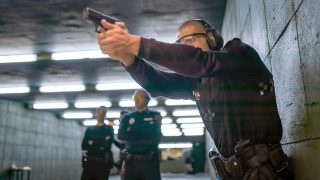
The stress of competitive shooting isn’t the same as life-threatening combat stress. There is no expectation of death or serious physical injury playing these games. However, everything is done without the benefit of warm-up drills, under time duress, with an experienced range officer watching your every move, and in front of fellow competitors and spectators. These factors combine to ramp up the pressure and really test the skills you need to prevail in a gunfight where there is the actual possibility of death or serious physical injury.
Jason Moss, a Fort Worth, Texas, Police Department Traffic Division officer assigned to Motor Team 9, recently attended his second competitive shooting match. At most clubs, new competitors are mentored through their first match and typically shoot last in the group so they are allowed the opportunity to ask questions and watch other shooters tackle the stages. This being his second match, he was part of the regular shooting rotation, giving him the opportunity to be the first shooter on a stage. I asked Moss about this, and he responded, “That was a lot more pressure than I thought it was going to be. I don’t know if I took a breath until I
was done!”
Trace McDonald, a Texas Ranger with Company B, says, “Even after 13 years and hundreds of matches, I still get nervous on the first couple stages of a club match.” He has reached the point in competitive shooting where he pushes himself to win his division, but when he first started, his only goal was to improve his department qualification scores. That goal was easily reached. Now, his goal is to become a master class shooter. As a law enforcement officer, he says, “A very nice side effect to all of this shooting and training is it helps me prepare for a deadly force situation.”

As iron sharpens iron
Competitive shooting isn’t all about performance under pressure. Shooting a match may expose deficiencies in your firearms skills and give you ideas on how to improve. Most law enforcement officers and instructors have never pushed their skills to their limits. How fast can you shoot accurately? While moving? On moving targets? From cover? At different-sized targets and at distances from 3 feet to 30-plus yards?
I’ve heard some law enforcement officers say, “Competitive shooting will get you killed!” These are the ones who have never shot a match and have no idea what they’re talking about. Competitive shooting isn’t training. It’s an opportunity to practice old skills and develop new skills in a safe environment. It’s not designed to teach tactics, but it will help you develop better firearms skills. Competitive shooting is a test that will expose any weaknesses. Those are the same weaknesses you will have on the street under the stress of a gunfight.
It will absolutely test your weapon-handling skills. A frequently overlooked part of competition shooting is drawing from the holster while moving or drawing from awkward positions. The draw and presentation must be smooth and efficient to be fast. Officer Moss has recently started the transition from a duty handgun with iron sights to a red dot. Using his new duty handgun with a Trijicon RMR optic has been an adjustment, but he feels competitive shooting is helping smooth that transition. He feels the opportunity for multiple draws and presentations is “hands down” one of the biggest skills he is improving. He told me, “If you do not have a great first presentation, then you have to account for that poor presentation.”
Reasonable expectations
When you attend your first match, set some reasonable expectations. First, do not expect to win. Don’t even expect to be one of the best shooters. I’ve been shooting competitively for 16 years and recently was the overall match winner for the first time.
Set your ego aside. A good first goal is to learn the rules and how to shoot the courses of fire safely. Far too many law enforcement officers stay away from competitive shooting because they let their ego get in the way. As Ranger McDonald says, “Most seasoned competitive shooters know that only a small percentage of cops shoot better than the average ‘B’ Class USPSA or IDPA expert. They don’t expect them to perform well, but they are happy to have us and are supportive of us on the range.” In other words, don’t let your ego prevent you from improving your skills.
McDonald suggests new shooters find a local club and bring a friend for support. You can use your normal plainclothes carry or duty gear until you get more experience and decide what is best for you. A quality holster, magazines, magazine pouches, eye and ear protection and a duty pistol are all you need to participate and maximize the benefits of competition shooting.

Where to start
Three of the most popular shooting sports for law enforcement officers are the United States Practical Shooting Association (USPSA), the International Defensive Pistol Association (IDPA) and three-gun. Each is challenging, a ton of fun and unique in their own way.
USPSA is the largest practical shooting organization in the United States. In USPSA shooting, the stages of fire are focused on speed, accuracy and solving technical problems. Competitors try to figure out the fastest way to shoot a stage accurately. It takes practice to figure out when and where to engage each target, conduct reloads and move through the stage in the most efficient manner. This kind of movement is good for officers because a lot of shooting in a USPSA match is done on the move or after dynamic movement. Does this sound similar to our working environments? Visit uspsa.org for more information.
IDPA matches are meant to simulate self-defense or real-life encounters. IDPA prides itself on the use of practical equipment to solve simulated scenarios. One advantage to IDPA matches is law enforcement officers can be competitive using duty gear. The scoring system used in IDPA rewards accurate shooting. For each shot outside the center mass scoring area, time penalties of one, three or five seconds are assessed. Speed is important just like a USPSA match, but the penalty for not making center mass hits is greater. Visit idpa.com for more information.
Three-gun, or 3-gun, is a generic name used to describe shooting competitions where participants use handguns, carbines and shotguns to engage targets from different shooting positions. A typical three-gun match includes a variety of targets — from clay pigeons and cardboard silhouettes to steel targets of multiple shapes and sizes. Each stage challenges a shooter’s ability to reload, transition between firearms and engage multiple targets. Some people have described shooting three-gun matches as a drag race with multiple firearms.
There are several sanctioning bodies and clubs running three-gun matches, including USPSA, 3-Gun Nation, the National Rifle Association (NRA), International Multi-Gun Association (IMA) and the United Multi-gun League (UML). Each of these has slightly different rules and divisions, but the nature of the events is basically the same.
In your area, local clubs may offer one match per month or multiple matches each week. Club-level matches take three to four hours from start to finish, but major matches can be two or more days. If you shoot one match each month for one year, that is 36–48 hours of additional range time each year. Even though you would be shooting for only a small portion of that time, you are watching and learning from other shooters during the entire match.
Competitive shooting is a learning process and will make your department firearms training and qualifications simple and stress free. Find a local club, take a friend and take the plunge into the competition arena. It’s a great way to improve your skills, meet new people and have a lot of fun.

Todd Fletcher
As seen in the April 2021 issue of American Police Beat magazine.
Don’t miss out on another issue today! Click below: