• Skip to primary navigation
  • Skip to main content
  • Skip to primary sidebar
  • Skip to footer
  • Home
  • About
  • The Magazine
  • Events
  • Partners
  • Products
  • Contact
  • Jobs and Careers
  • Advertise
  • Facebook
  • Instagram
  • Twitter
  • Subscribe
American Police Beat

American Police Beat Magazine

Law Enforcement Publication

  • Home
  • Leadership
    • The hidden costs of micromanagement
      Police leadership development
      Can they do it? Will they do it?
      A unique approach to salvaging a troubled employee
      The relentless pursuit of excellence
  • Topics
    • Leadership
      • The hidden costs of micromanagement
        Police leadership development
        Can they do it? Will they do it?
        A unique approach to salvaging a troubled employee
        The relentless pursuit of excellence
    • Editor’s Picks
      • No two days are ever the same
        Training dipshittery, Part 2
        Tactical medicine for cops
        Why good cops quit
        Smile and let them swing
    • On the Job
      • Frankpledge to forensics: A brief history of law enforcement
        The sixth sense in policing
        From warrior to peacekeeper
        Hats off to a new uniform look
        Overcoming climate and conditions to rescue child
    • Labor
      • The shift happens long before the resignation letter
        Facing the oral board
        Why good cops quit
        Succession planning
        Why more staff won’t fix your operational slowdowns
    • Tech
      • Accentuating safety for first responders
        Take Me Home program offers effective tool for police and families
        Get the most out of simulation training
        The virtual beat
        Training with an AI partner?
    • Training
      • More than just a red shirt and a Sharpie
        Train them to ask why
        Nobody is coming to do it for you
        Precision, adaptability and response: The need for LPVOs in equipping...
        Training dipshittery, Part 2
    • Policy
      • Out of chaos comes opportunity
        Massachusetts law establishes fund to care for retired K-9s
        Portlanders will not vote on diverting climate funds for police...
        Surviving internal affairs investigations
        Fighting human trafficking at the local level
    • Health/Wellness
      • Trauma exposure and preventing officer suicide
        Understanding why police officers think alcohol works
        Has the job quietly stolen your humanity?
        No two days are ever the same
        Changing the narrative
    • Community
      • National Night Out 2026
        Pittsburgh mounted patrol officer helps inner-city kids saddle up
        Wyoming girl on a mission to collect “hero patches”
        Texas sheriff’s office nominates 7-year-old for commendation
        Cops try to net DEA agents
    • Offbeat
      • A surprise sting operation
        Could cadaver otters help close cold cases?
        Police chief catches cat in the act
        “Teenage Mutant Ninja Deer” rescued
        An unexpected burglar
    • We Remember
      • Honoring the Fallen Heroes of 9-11
        Steel Across America
        The first officers on scene on September 11
        Protecting America with the USA PATRIOT Act
        Distant cousins connect to honor fallen family member 110 years after...
    • HOT Mail
      • The War on Cops Continues Unabated
  • On the Job
    • Frankpledge to forensics: A brief history of law enforcement
      The sixth sense in policing
      From warrior to peacekeeper
      Hats off to a new uniform look
      Overcoming climate and conditions to rescue child
  • Labor
    • The shift happens long before the resignation letter
      Facing the oral board
      Why good cops quit
      Succession planning
      Why more staff won’t fix your operational slowdowns
  • Tech
    • Accentuating safety for first responders
      Take Me Home program offers effective tool for police and families
      Get the most out of simulation training
      The virtual beat
      Training with an AI partner?
  • Training
    • More than just a red shirt and a Sharpie
      Train them to ask why
      Nobody is coming to do it for you
      Precision, adaptability and response: The need for LPVOs in equipping...
      Training dipshittery, Part 2
  • Policy
    • Out of chaos comes opportunity
      Massachusetts law establishes fund to care for retired K-9s
      Portlanders will not vote on diverting climate funds for police...
      Surviving internal affairs investigations
      Fighting human trafficking at the local level
  • Health/Wellness
    • Trauma exposure and preventing officer suicide
      Understanding why police officers think alcohol works
      Has the job quietly stolen your humanity?
      No two days are ever the same
      Changing the narrative
  • Community
    • National Night Out 2026
      Pittsburgh mounted patrol officer helps inner-city kids saddle up
      Wyoming girl on a mission to collect “hero patches”
      Texas sheriff’s office nominates 7-year-old for commendation
      Cops try to net DEA agents
  • Offbeat
    • A surprise sting operation
      Could cadaver otters help close cold cases?
      Police chief catches cat in the act
      “Teenage Mutant Ninja Deer” rescued
      An unexpected burglar
  • We Remember
    • Honoring the Fallen Heroes of 9-11
      Steel Across America
      The first officers on scene on September 11
      Protecting America with the USA PATRIOT Act
      Distant cousins connect to honor fallen family member 110 years after...
  • HOT Mail
    • The War on Cops Continues Unabated
  • About
  • The Magazine
  • Events
  • Partners
  • Products
  • Contact
  • Jobs and Careers
  • Advertise
  • Subscribe
Search

Training

Weapon retention

Choose the right holster, then train, train, train

Dan Kickert and Lauren Sheehan Published May 8, 2022 @ 6:00 am PDT

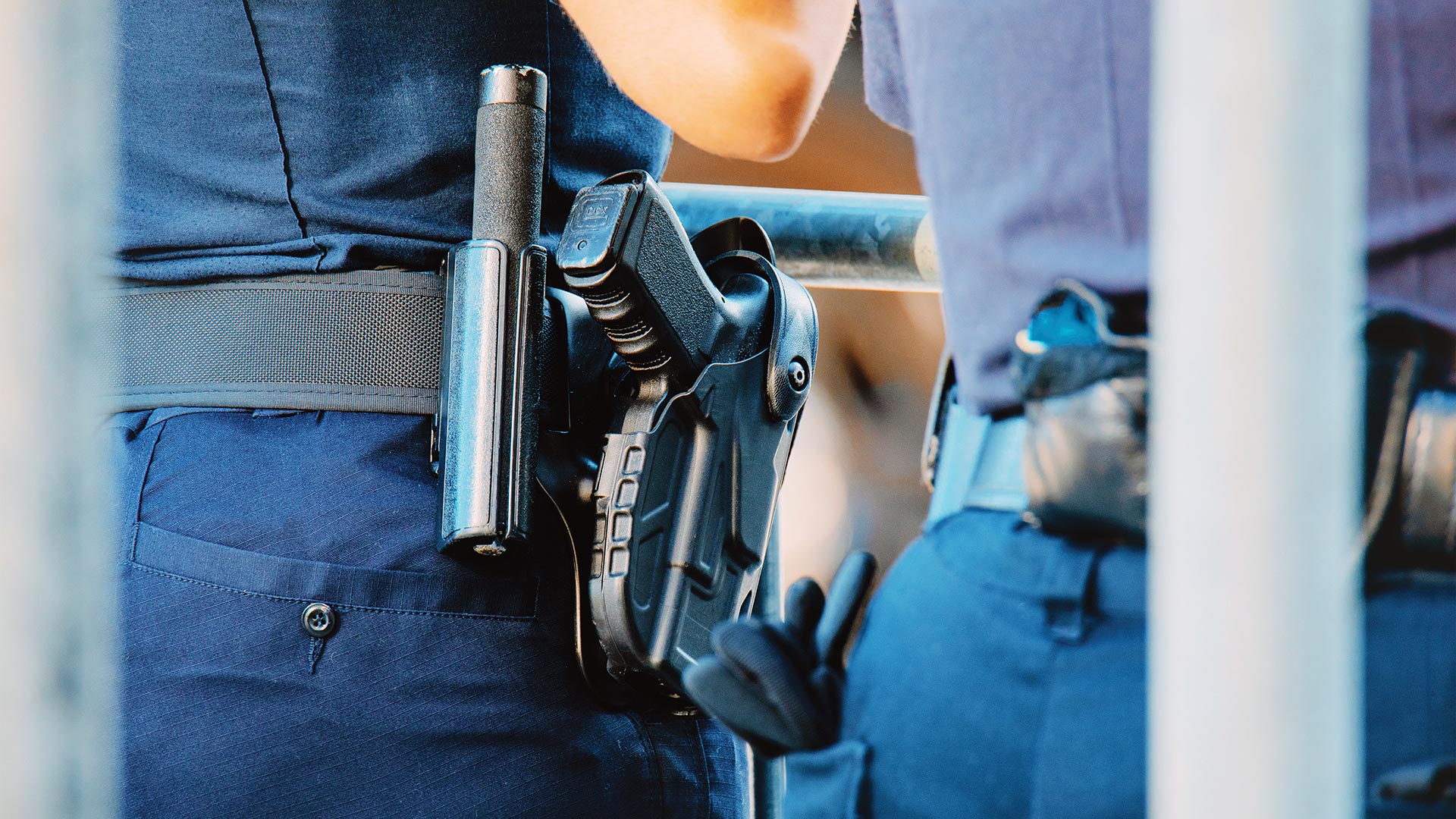
iStock.com/Glenn Highcove

Weapon retention has evolved since the standard leather thumb break holster. Most officers immediately associate the term “weapon retention” with the level of security their duty holster provides. A secure duty holster is a necessary tool in the toolbox for today’s environment. However, so is being prepared for the fight. Weapon retention ultimately starts and ends with the individual officer. The holster is a tool, and although it may prove to be an invaluable tool, it is only as good as the officer using it. When you’re fighting for your gun with a criminal or you need to draw your weapon on someone, it needs to be a quick, smooth and tactical draw from your holster. Our lives depend on tactics. And when it comes to drawing your weapon, officers need more weapon retention training with their holsters for this smooth transition. We are only as good as our training. 

Choosing a holster

First and foremost, you need to ensure that the holster is properly secured to your duty rig and the holster is a proper fit for your duty weapon. Although there are exceptions, paddle holsters should be avoided for duty use. The holster mount needs to be securely affixed to the body of the holster and securely attached to the duty belt. Safariland’s mount is extremely durable. It is a hard mount with fixed belt loops, and it mounts to the body of the holster with three hex head screws. Their mounts are available in high-ride, low-ride and mid-ride to adjust the height of the holster. Having the holster at the proper height is obviously important for an efficient draw stroke; however, it is even more important when defending your weapon.

There are career criminals and street gang members who train to defeat these holsters. Are we training as hard as the criminals to get our guns out?

The next step is to look at how the holster operates. Holsters are either a Level 1, 2 or 3. Most agencies today require officers to have a Level 3 duty holster worn by uniformed members of the department while on duty. Every holster manufacturer has its own spin on retention definitions; however, each level of retention is a level of security. Safariland has numerous holsters that operate in many different ways, but its two most popular options for duty holsters are the ALS and SLS offerings. The SLS, or Self-Locking System, utilizes a hood that rotates in and out of place to secure the weapon. The hood must be pushed down and then can be rotated forward and out of the way to draw the weapon. This is considered a Level 2 duty holster. It can be converted to a Level 3 duty holster by adding a sentry lock on the rear of the hood. This is a button that must be manually moved forward, toward the hood, to lock it in place, or away from the hood to release it. This lock prevents the hood from rotating forward when it is engaged. Although the sentry lock works and gets the job done, the demand for Level 3 duty holsters led to the rise of the ALS, or Automatic Locking System, line of holsters from Safariland. These holsters offer the SLS rotating hood with the addition of a button behind the hood that must be released to draw the weapon. These holsters, along with proper training, will release the hood and the button pressed in one smooth, precise and quick movement. The advantage to this system is that once the weapon is placed back in the holster, the SLS hood remains down until the officer manually returns it to the secured position. However, the ALS feature activates and the weapon cannot be removed from the holster unless the button is pressed.

Law enforcement administrators are often asked, what does a Level 3 mean? How do I know if my duty holster is a Level 3? The response is usually “What does it say on the website or package?” It must be understood that agency policies are often made by personnel who have been off the street for a number of years and are relatively out of touch with changes in the industry. It is important to ensure you are always operating within policy, but it is more important to ensure you are operating with duty gear you feel comfortable with. We spoke of Safariland’s offerings because in the law enforcement climate we are associated with this brand, and it is simply the gold standard. 

Training

If you have chosen a proper Level 3 duty holster, congratulations — you have covered the easiest, most basic step of weapon retention. The real work starts with weapon retention training. Why is all of this important to understand? Well, the idea of the high-level retention duty holsters is to keep our weapons on our persons and under our control. However, there are career criminals and street gang members who train to defeat these holsters. There are videos on the internet that will show anyone who is looking to know how to remove a weapon from any duty holster. Are we training as hard as the criminals to get our guns out? At what point is active retention more of a hindrance than a help? We hope the answer is train, train and train some more. Find likeminded officers in your agency or surrounding agencies. Spend the money on a red gun or any other weapon that is the same shape and size as your duty weapon and practice defending it. There are myriads of formal training classes that could save your life, but there is also a lot that can be learned by picking an officer on your shift, securing all live weapons, throwing a red gun in your holster and asking them to try and take it. 

Once you’ve trained with enough people, you are going to start to notice similarities in their methods of attack. You will be able to establish a baseline of defense and a fairly repeatable way of mounting that defense. But what about an offense? Both of the authors of this article carry a J-frame revolver in our support-side cargo pocket, a knife that is easily opened with one hand or a fixed-blade knife in our support-side pocket, and a steel-bodied pen. The idea is that no matter how the attacker wraps you up, the pen is very high on your body, the knife a little lower and the revolver even a little lower than the knife. The benefit of having a support-side secondary weapon high, medium and low on your body is hopefully being able to access and deploy one of them to fight the attacker off of your duty weapon. There are also a lot of duty design holsters that come and go for the Level 3 holsters, so you need to do your research. Your safety is of the utmost importance in this job, so making sure your weapon retention training is up to par can save your life. Law enforcement agencies need to improve training and increase weapon protection in holsters. 

The bottom line is, if you are going to do this job, it is a job worth doing the right way. Probably the only thing worse than being shot in the line of duty is being shot by your own weapon. You owe it to yourself, and to those you took an oath to serve and protect, to secure that gun. A lot of people will talk about how the Safariland holsters are more expensive than the ones they can get on Amazon. You will get what you pay for when spending the money on a good, secure holster that will contain your weapon. Then spend the most valuable currency and time on training how to properly defend that weapon. Remember, the holster is only a tool. You are the craftsman; it is on you and only you to utilize that tool. Find a tool that works well for you, practice deploying your weapon from it and train to defend it.

Dan Kickert and Lauren Sheehan

Dan Kickert and Lauren Sheehan

Dan Kickert is a police officer in the south suburbs of Chicago with 15 years of experience. He is currently assigned to patrol and training. He serves his agency as a field training officer, range master, tactics instructor and training coordinator. He was previously assigned to investigations, where he worked as a homicide investigator in a task force setting for seven years.

Lauren Sheehan spent four years with the Olympia Fields Police Department before going to work as a deputy sheriff in a collar county of Chicago. She has an M.S. in criminal social justice from Lewis University. She has served as a crisis intervention team officer, accident reconstructionist, juvenile specialist and firearms trainer, as well as volunteering to coordinate events such as the National Night Out Against Crime and Cop on Top fundraisers for the Special Olympics of Illinois.

View articles by Dan Kickert and Lauren Sheehan

As seen in the May 2022 issue of American Police Beat magazine.
Don’t miss out on another issue today! Click below:


SUBSCRIBE TODAY!

Categories: Training

Primary Sidebar

Recent Articles

  • NLEOMF to hold Online Silent Auction during Police Weekend
  • Trauma exposure and preventing officer suicide
  • The hidden costs of micromanagement
  • Honoring the Fallen Heroes of 9-11
  • Serving every survivor, every sacrifice
  • Steel Across America
  • The first officers on scene on September 11
  • National Night Out 2026
  • Accentuating safety for first responders
  • A surprise sting operation

Footer

Our Mission
To serve as a trusted voice of the nation’s law enforcement community, providing informative, entertaining and inspiring content on interesting and engaging topics affecting peace officers today.

Contact us: info@apbweb.com | (800) 234-0056.

  • Facebook
  • Instagram
  • Twitter

Categories

  • Editor’s Picks
  • On the Job
  • Labor
  • Tech
  • Training
  • Policy
  • Health/Wellness
  • Community
  • Offbeat
  • We Remember
  • Jobs and Careers
  • Events

Editor’s Picks

No two days are ever the same

No two days are ever the same

July 24, 2026

Training dipshittery, Part 2

Training dipshittery, Part 2

July 23, 2026

Tactical medicine for cops

Tactical medicine for cops

July 18, 2026

Why good cops quit

Why good cops quit

July 14, 2026

Policies | Consent Preferences | Copyright © 2026 APB Media, LLC | Website design, development and maintenance by 911MEDIA

Open

Subscribe

Close

Receive the latest news and updates from American Police Beat directly to your inbox!

  • This field is for validation purposes and should be left unchanged.