
In 2017, the Department of Justice (DOJ) and the City of Albuquerque entered a contract, which became known as the Court Assigned Settlement Agreement (CASA). The Albuquerque Police Department (APD) was identified as having a practice and pattern of using excessive force, particularly involving people with mental health issues. APD was mandated to operate under this consent decree. Independent monitors were assigned to oversee the progress toward compliance with this decree. The cost for this endeavor was $1.2 million annually.
APD was under this decree for almost 10 years, and it took its toll on the department. Crime was high, and many officers were either terminated, resigned or retired. Morale went down, and this affected response times and the ability to be proactive. While this was a department-wide case of liability that cost the city millions of dollars, it wasn’t the only source of liability matters that APD faced.
Several other lawsuits were also filed against the police during that time. In addition, the governor of New Mexico tried to take away the concept of qualified immunity, which would have left officers open to being personally sued for incidents that occurred while they were on duty doing their job. The goal of this article is to make police leaders aware of how officers, supervisors, chiefs, departments and municipalities can be open to lawsuits resulting in big-dollar settlements and other liability concerns. Fortunately, President Trump has put an end to the DOJ oversight of recent years, but other liability concerns still exist that can cost a municipality millions of dollars.
Police liability refers to the legal and financial responsibility of police officers or departments for their actions, typically addressed through civil lawsuits and can arise from various incidents like excessive force, false arrest or negligence. While officers are often protected by doctrines like qualified immunity for actions that don’t violate clearly established rights, they can be held liable for civil rights violations or if they act unreasonably or negligently.
The primary reasons for litigation against police officers, their departments and municipalities are:
- Excessive force
- Patterns and trends of misconduct being ignored or not being addressed effectively
- Ineffective internal affairs systems
- Lack of ongoing policy review and development
- Supervision
- Training
- Disciplinary issues
The Supreme Court made a ruling in the 1978 case of Monell v. The Department of Social Services (436 U.S. 658), which held that under Title 42, Section 1983
applies to municipalities and local governmental units when policies or official procedures are responsible for the violation of federally protected rights. This section outlines violations where supervisors and administrators may be held liable.
These violations cover a broad range of actions, including their own and those of their subordinates. These include the following:
- Direct liability: Their own actions (active participation)
- Vicarious or indirect liability (the actions of their subordinates)
- They authorize the act
- They are present for an act for which liability occurs
- They ratified the act. Once the act is completed, they fail to admonish or take corrective action.
The most common litigated area of liability is negligence. There are two types of negligence. There is simple negligence, where officers or their supervisors fail to provide the degree of care and vigilance required for the situation. Gross negligence consists of deliberate indifference to life or property. The court generally requires the finding of gross negligence to hold a supervisor accountable. There are five areas where supervisors have been held liable:
- Negligent assignment: Supervisor assigns subordinate tasks without first determining whether he or she is properly trained or capable of performing required work. This also applies where the supervisor is aware that the subordinate is not qualified but fails to remove the employee from the position. A good example of this would be firearm qualifications.
- Negligent failure to supervise: Supervisor fails to oversee subordinate’s actions. An example would be an ongoing pattern of excessive force.
- Negligent failure to direct: Supervisor fails to advise subordinates on specific requirements or limits of the job. (Example: Officers not trained on policy regarding deadly force. Note: If a department does not have a policy and the officers react inappropriately, then the department will be held liable under this area.)
- Negligent entrustment: A supervisor entrusts equipment and facilities and fails to oversee the officers’ care and use, resulting in an act in violation of a citizen’s federally protected rights. (Examples: firearms, less lethal weapons, hobble device, holding cells, handcuffs, etc.)
- Failure to investigate or discipline: Supervisor is inattentive or covers up complaints of misconduct, or attempts to stall, discourage or disregard complaints brought to their attention. The department can also be held liable in these circumstances.
One particularly negative concept that sometimes is determined to exist in a particular situation is that of deliberate indifference. Deliberate indifference is demonstrated “when the inadequacy is so obvious and so likely to result in a violation of constitutional rights that the policy makers can reasonably be said to have been deliberately indifferent. (i.e., a choice made from among various alternatives; a knowing choice, usually made with some state of mind and a choice made with some knowledge or appreciation of what the consequences of the choice will or might be). We only have to look back at how deliberate indifference affected the LAPD, the sergeant and officers involved in the infamous Rodney King incident. The actions of any police officer, in an instant, can impact an individual for life and even a community for generations.
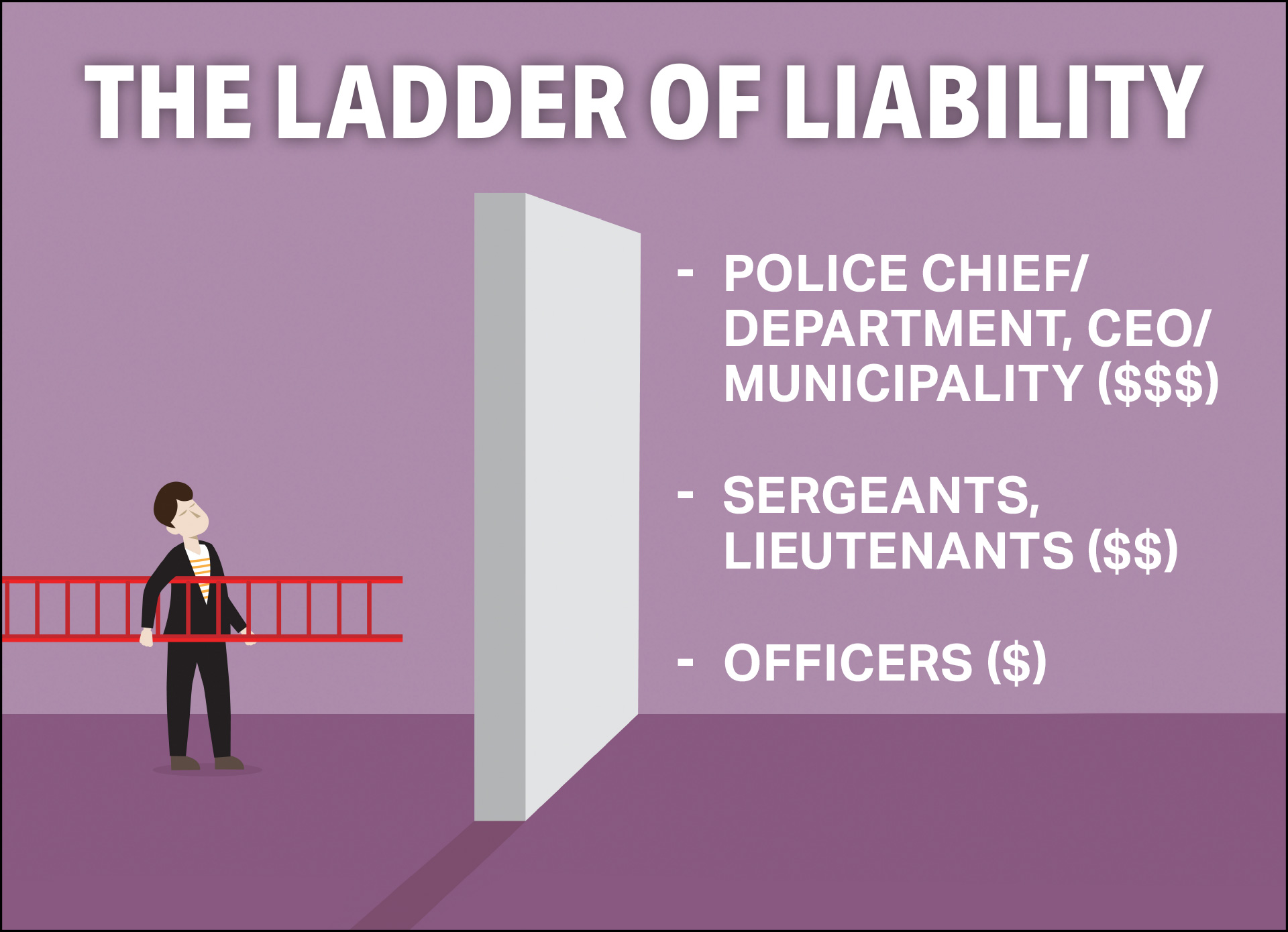
The essence of deliberate indifference
Police liability refers to the legal and financial responsibility of police officers or departments for their actions, typically addressed through civil lawsuits and can arise from various incidents like excessive force, false arrest or negligence.
There are some key aspects of police liability:
Civil liability. This involves lawsuits seeking monetary damages or court orders, with a lower standard of proof than criminal cases.
Sources of claims:
- Intentional torts. Assault, battery, false imprisonment and intentional infliction of emotional distress.
- Negligence. Actions where an officer breaches a duty of care, causing damage. Examples include reckless driving during a chase or negligently discharging a weapon.
- Civil rights violations: Actions that infringe on an individual’s constitutional or federal rights, often brought under 42 U.S. Code § 1983.
Defenses:
- Official immunity. Protects officers from liability for state law torts unless they acted in an “unreasonable” way.
- Qualified immunity. Protects officers from civil liability in civil rights cases unless their conduct violated a “clearly established” constitutional right. This means the officer must have known the conduct was unlawful.
Duty of care:
- Officers have a duty to provide reasonable assistance if they choose to help and can be liable if they perform the task unreasonably.
- An officer may assume a higher duty to an individual, such as when they promise to provide protection, and could be liable for damages if they fail to follow through.
Insurance:
- Police departments and officers may have specialized insurance to cover liability claims from incidents like accidents, wrongful acts, or civil rights violations.
Although all police officers are expected to perform competently and in good faith, occasionally, an officer will owe a higher obligation to an individual citizen. Accidents or mistakes that occur due to an officer’s negligence or failure to adequately fulfill a higher obligation can result in a civil suit against their department. An obligation to an individual citizen may occur when an officer makes an explicit promise to provide adequate protection to that individual, such as when an officer assures a battered wife that he will notify her if her husband is released on bail. The wife’s reliance on such a promise could prevent her from taking precautions that she would have made if she never received the promise of protection. Subsequent injury caused by a lack of warning and protection from the officer could subject the department to a lawsuit.
It is recommended that great caution be exercised in making specific promises to individuals. An officer also owes a high standard of care to injured or disabled persons taken into custody. An officer who arrests a person suffering from diabetic shock could file a civil suit if the victim’s condition deteriorates because of the officer’s actions. Harm resulting from compliance with an officer’s instructions, such as a pedestrian struck by a moving car while standing in an unsafe location because of police directions, could also cause a suit. Police officers should use special care in assessing medical and safety situations.
Police administrators should consistently review policy and procedures and make sure these are current and up to date. The department should also ensure that the officers receive training in these regulations and are held accountable. A policy may exist, but if it is not enforced, it can lead to lawsuits against the department. Abraham Lincoln once noted, “You can’t escape the responsibility of tomorrow by evading it today.” One way or another, sooner or later, failing to meet these leadership obligations will have costly consequences.

Mike Geier
As seen in the February 2026 issue of American Police Beat magazine.
Don’t miss out on another issue today! Click below: