
A recent report from the Council on Criminal Justice (CCJ), a nonpartisan think tank for criminal justice policy and research, shows a significant decrease in homicide rates from 2024 to 2025. According to the data, homicides fell by 21%, equating to nearly 922 fewer deaths last year.
It’s important to note that the study did not cover the entire country. Instead, it focused on 35 larger municipalities, of which all but three showed substantial declines in reported homicides. The organization tracked 13 types of crime and reported declines in 11 categories, including carjackings, shoplifting and aggravated assaults. Drug offenses rose slightly, while sexual assaults remained unchanged between 2024 and 2025, according to the Associated Press.
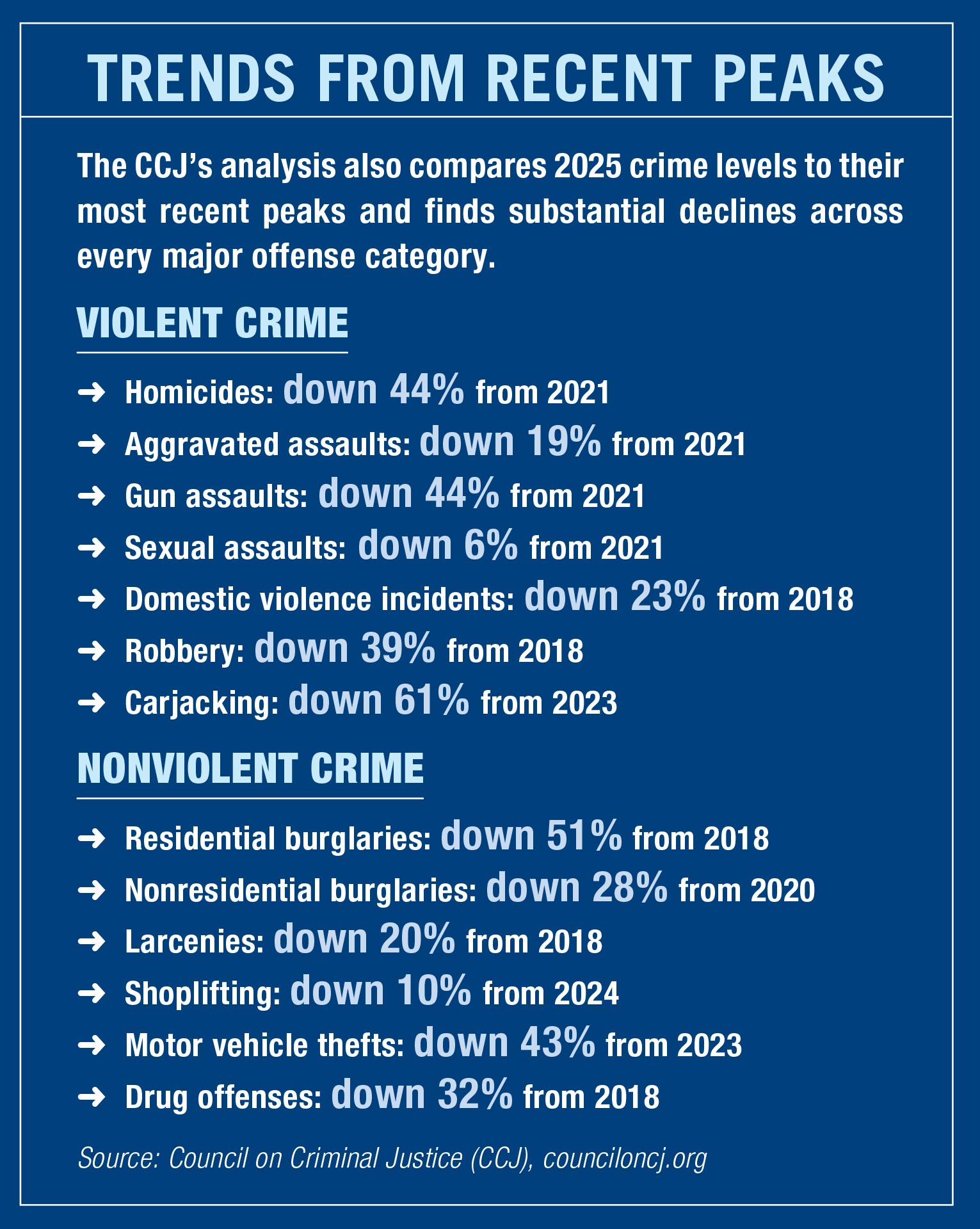 In a CCJ press release, the organization noted that when the FBI releases nationwide data for jurisdictions of all sizes later this year, homicide rates in 2025 could fall to around 4.0 per 100,000 residents. “That would be the lowest rate recorded in law enforcement or public health data going back to 1900 … and would mark the largest single-year percentage drop in the homicide rate on record,” the release stated.
“We’re seeing big swings in criminal justice policies, programs, and rhetoric, big advances in crime-fighting technologies, and big social, economic, and cultural shifts all happening at the same time,” CCJ President and CEO Adam Gelb said. “It’s extremely difficult to disentangle and pinpoint what’s actually driving the drop. As a result, we have a battle of sound bites and abundant claims of credit but scarce hard evidence to back them up.”
Lawmakers from both sides of the aisle are touting that their respective policies are responsible for the positive news. Some Republicans have attributed the drops to the Trump administration’s tough-on-crime policies, though the CCJ’s report notes that many of the cities in the study were not subject to National Guard deployments or immigration operation surges. Likewise, some Democratic mayors have claimed responsibility for the decreases.
Jens Ludwig, a public policy professor and the director of the University of Chicago Crime Lab, questioned these assertions. “The fact that in any individual city, we are seeing crime drop across so many neighborhoods and in so many categories, means it can’t be any particular pet project in a neighborhood enacted by a mayor.… It’s not like any individual mayor is a genius in figuring this out,” he told AP.
According to Ludwig, no single politician or program may rightfully take credit for the decreases. He suggested the drops may reflect a “normalization” of crime rates. Many large cities saw steep spikes in crime in 2020 amid government-mandated lockdowns, protests following George Floyd’s death and, in some cases, riots. The declines observed now may simply be a return to more typical levels.
If the decreases are indeed a normalization of crime, they may not last. “It’s too soon for anybody on either side of this to declare mission accomplished,” Ludwig said.
As seen in the March 2026 issue of American Police Beat magazine.
Don’t miss out on another issue today! Click below: