• Skip to primary navigation
  • Skip to main content
  • Skip to primary sidebar
  • Skip to footer
  • Home
  • About
  • The Magazine
  • Events
  • Partners
  • Products
  • Contact
  • Jobs and Careers
  • Advertise
  • Facebook
  • Instagram
  • Twitter
  • Subscribe
American Police Beat

American Police Beat Magazine

Law Enforcement Publication

  • Home
  • Leadership
    • Why you should lead from 30,000 feet
      Public perception and trust
      When performance reviews are a waste of time
      Taking a page from Toyota’s playbook
      Tattoos can be self-inflicted handicaps
  • Topics
    • Leadership
      • Why you should lead from 30,000 feet
        Public perception and trust
        When performance reviews are a waste of time
        Taking a page from Toyota’s playbook
        Tattoos can be self-inflicted handicaps
    • Editor’s Picks
      • Liability challenges in contemporary policing
        When performance reviews are a waste of time
        Proactive wellness visits
        Taking a page from Toyota’s playbook
        Law enforcement’s missing weapon
    • On the Job
      • Villains and heroes in the Big Apple
        Right place, right time — again
        Some good news on crime
        Mom-to-be named Cop of the Year
        Fatherly instincts save boy from icy water
    • Labor
      • Cut the cops, save a dollar?
        Labor release under fire
        Who’s watching the watchmen?
        Crime and punishment (or lack thereof) in Seattle
        Labor leadership out in the field
    • Tech
      • A modern field guide to understanding research in policing
        Gear that moves with you
        A new breed of cop car
        The future of patrol is here
        New York governor highlights $24 million investment to modernize law...
    • Training
      • Navigating danger
        Critical thinking in police training
        Threshold neuroscience
        Integrated virtual reality training
        Hit the pause button
    • Policy
      • E-bikes spark public safety concerns
        Try racing without wheels
        Law enforcement accreditation: Why it matters
        Liability challenges in contemporary policing
        The war on drugs is evolving
    • Health/Wellness
      • Nervous system regulation
        The nature of the job
        Promoting organizational wellness
        Telling cops to get more sleep isn’t working
        Proactive wellness visits
    • Community
      • Improving autism awareness
        Shop with a Cop
        Community engagement: What is it moving forward?
        Contradictory crossroads
        Back-to-school season brings out police support nationwide
    • Offbeat
      • An unexpected burglar
        Police humor only a cop would understand
        Not eggzactly a perfect heist
        Pizza … with a side of alligator?
        Wisconsin man charged with impersonating Border Patrol agent twice in...
    • We Remember
      • Forty heroes: United Airlines Flight 93
        The Pentagon
        A nation propelled to war, lives changed forever
        A Christmas loss
        York County ambush leaves three officers dead, others critically...
    • HOT Mail
      • The War on Cops Continues Unabated
  • On the Job
    • Villains and heroes in the Big Apple
      Right place, right time — again
      Some good news on crime
      Mom-to-be named Cop of the Year
      Fatherly instincts save boy from icy water
  • Labor
    • Cut the cops, save a dollar?
      Labor release under fire
      Who’s watching the watchmen?
      Crime and punishment (or lack thereof) in Seattle
      Labor leadership out in the field
  • Tech
    • A modern field guide to understanding research in policing
      Gear that moves with you
      A new breed of cop car
      The future of patrol is here
      New York governor highlights $24 million investment to modernize law...
  • Training
    • Navigating danger
      Critical thinking in police training
      Threshold neuroscience
      Integrated virtual reality training
      Hit the pause button
  • Policy
    • E-bikes spark public safety concerns
      Try racing without wheels
      Law enforcement accreditation: Why it matters
      Liability challenges in contemporary policing
      The war on drugs is evolving
  • Health/Wellness
    • Nervous system regulation
      The nature of the job
      Promoting organizational wellness
      Telling cops to get more sleep isn’t working
      Proactive wellness visits
  • Community
    • Improving autism awareness
      Shop with a Cop
      Community engagement: What is it moving forward?
      Contradictory crossroads
      Back-to-school season brings out police support nationwide
  • Offbeat
    • An unexpected burglar
      Police humor only a cop would understand
      Not eggzactly a perfect heist
      Pizza … with a side of alligator?
      Wisconsin man charged with impersonating Border Patrol agent twice in...
  • We Remember
    • Forty heroes: United Airlines Flight 93
      The Pentagon
      A nation propelled to war, lives changed forever
      A Christmas loss
      York County ambush leaves three officers dead, others critically...
  • HOT Mail
    • The War on Cops Continues Unabated
  • About
  • The Magazine
  • Events
  • Partners
  • Products
  • Contact
  • Jobs and Careers
  • Advertise
  • Subscribe
Search

Policy

E-bikes spark public safety concerns

Law enforcement and legislators work to regulate dangerous micromobility devices

APB Team Published April 13, 2026 @ 6:00 am PDT

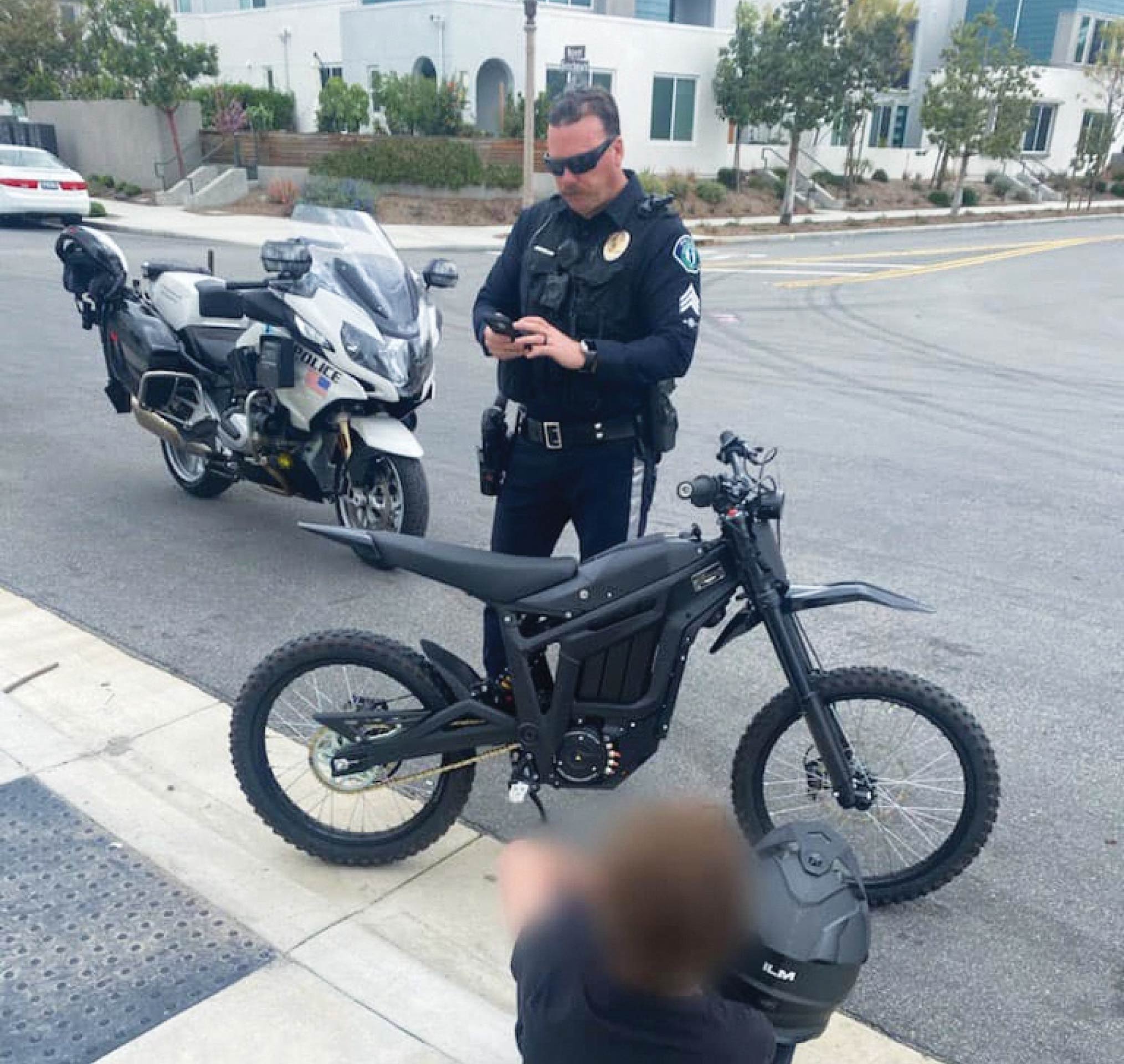
An Irvine, California, police officer stopping a rider for illegally driving an e-moto on a public roadway. Irvine is one of a growing number of cities cracking down on reckless riding by tightening ordinances and increasing enforcement, including allowing police to impound e-bikes and holding parents accountable with fines and citations when minors violate the law. (Irvine P.D.)

In case you’ve never ridden one (or had to jump out of its path), e-bikes are essentially motorized bicycles. They’re convenient, fun and fast, but they can be dangerous, too — and they’ve given rise to higher-powered versions that are wreaking havoc on sidewalks, bike paths and streets.

Traditional low-speed e-bikes are bicycles with fully operable pedals and an electric motor that is usually under 750 watts. In a system that’s been adopted by 40 states, they’re divided into three categories: Class 1 provides pedal assistance up to 20 mph, Class 2 adds a throttle that allows the bike to be powered up to 20 mph without pedaling and Class 3 has a throttle but increases the top speed to 28 mph. However, there are also electric mopeds, electric motorcycles and electric dirt bikes (often categorized as “e-motos”) that are much more powerful and faster, reaching speeds of 30 to 65 mph. Technically, these are legally classified as “motor-driven cycles,” subject to federal motor vehicle safety standards and governed by laws requiring a license, registration and insurance. But manufacturers and consumers often attempt to skirt these regulations by adding pedals to disguise these e-motos as e-bikes, or by making modifications to increase the speed and power of traditional e-bikes. This confusion, combined with reckless use, is prompting law enforcement and legislators to take action.

A recent presentation by the Las Vegas Metro Police Department to Clark County leaders reported that last year alone, Southern Nevada saw a 400% increase in injuries resulting from electric mobility device crashes. Lieutenant Cody Fulwiler of the LVMPD Traffic Bureau told
KTNV news that the rapid rise in e-devices has created operational challenges for law enforcement, in part because different jurisdictions have different definitions and regulations. Due to the proliferation of devices and incidents, the department recently updated its weekly traffic action report to treat electric bicycles, electric scooters and electric skateboards as separate categories to better track trends and identify patterns. LVMPD is also working on a public safety outreach campaign.

California is one state working to revise its legal code to regulate this nascent form of transportation. Several recent incidents have underscored the public safety risks of e-bikes and related devices, most notably the death of a bicyclist in Davis following a March 2 collision with a teen riding an e-bike on a bike path. Police Chief Todd Henry told the Davis Enterprise that faster, heavier e-bikes sharing spaces with slower-moving bicycles and pedestrians is a safety concern. While the device ridden by the teen appeared to be a traditional Class 2 e-bike, the investigation was exploring whether any modifications had been made to increase its speed. “I think a lot of times parents are getting these bikes thinking, this is a great way to address some transportation issues,” he said. “But they’re not completely aware as to, has my child potentially changed this device to make it go faster?”

“In no way, shape or form do you need to be out racing cars in this thing.”

Henry, a board member for the California Police Chiefs Association who is working with the state Legislature to identify possible e-bike regulations, added that such powerful electric vehicles in the hands of young riders is a widespread law enforcement concern. “Talking to police chiefs throughout the state, I would say this is one of the top issues that jurisdictions are dealing with,” he said.

Just a few days after the Davis collision, police officers in the city of Rancho Cordova saw a 14-year-old on an e-moto run a stop sign. They tried to stop the rider, who fled, reaching speeds up to 55 mph, including going 35 mph on a bike trail. “While it may seem like a minor incident of ‘kids being kids’ and a ‘waste of police resources,’ the fact remains that failure to properly operate an e-bike on a public roadway constitutes not only a hazard to the operator of the e-bike, but to any other motorist who may become inadvertently involved in an accident with the e-bike due to a negligent or dangerous action taken on the roadway by the operator of the e-bike,” the department said in a statement. The rider’s parent was cited for allowing an unlicensed minor to operate an e-motorcycle.

Also in early March, a 39-year-old man in Orange County was charged with child endangerment and is facing up to six years in prison for allowing his 12-year-old son to ride an e-bike he’d gifted him for Christmas. The man had helped his son make modifications to the bike, including replacing the original pedals with motorcycle pegs, increasing the power of the motor to 5,000 watts and disabling the speed-limiting mechanism. The boy, who ran a stop sign, was hit by a car and seriously injured.

“There is absolutely no reason that an unlicensed, untrained child with no concept of the rules of the road should be riding a motorcycle that can go up to 60 miles per hour next to cars on a public street and think that by some miracle they are going to be safe,” District Attorney Todd Spitzer said in a release. “This 12-year-old boy is lucky to be alive, and the driver who hit him will have to live with that horror of seriously injuring a child through no fault of his own.”

Law enforcement in Colorado have been seeing similar incidents involving modified e-bikes. “These are extremely dangerous,” Boulder County Sheriff Patrol Sergeant David Salaman told CBS News. “We actually pulled over an electric motorcycle the other day, and it was 59 mph on an electric motorcycle, and it was a 14-year-old riding it.” Body and dash-cam footage from local departments show teens doing tricks in the roadways or riding the motorized bikes in places they shouldn’t, like skate parks. ERs have seen a rise in traumatic brain injuries, cervical spine injuries and rib fractures related to e-bike accidents. Agencies are cracking down while working to educate both riders and their parents — many of whom may be unaware that their modified bikes are illegal for road use without a license, registration or insurance.

Faced with incidents such as these, many states are tightening regulations around e-devices. In Florida, CS/SB 382 would bar riders from exceeding 10 mph on a sidewalk or pedestrian area if a pedestrian is within 50 feet. The measure, which unanimously passed the Legislature and awaits the governor’s signature, would also create a micromobility device task force and require law enforcement agencies to collect data on traffic crashes involving such devices.

Meanwhile, agencies like the Sarasota Sheriff’s Office are running safety campaigns about the distinctions between e-bikes and e-motos. The agency recently shared a video of a deputy pulling over a 14-year-old for illegally driving an e-moto on the road. “What is wrong with you? Do you think for one second you would look like a good hood ornament?” the deputy asks the teen before explaining the law requiring a license and registration for the vehicle, adding, “In no way, shape or form do you need to be out racing cars in this thing.”


Categories: Policy

Primary Sidebar

Recent Articles

  • E-bikes spark public safety concerns
  • Improving autism awareness
  • Cut the cops, save a dollar?
  • Villains and heroes in the Big Apple
  • NLEOMF announces February 2026 Officers of the Month
  • Fallen law enforcement officers from across the country to be honored during 38th Annual Candlelight Vigil on May 13 in Washington, D.C.
  • Nervous system regulation
  • Navigating danger
  • The nature of the job
  • Forty heroes: United Airlines Flight 93

Footer

Our Mission
To serve as a trusted voice of the nation’s law enforcement community, providing informative, entertaining and inspiring content on interesting and engaging topics affecting peace officers today.

Contact us: info@apbweb.com | (800) 234-0056.

  • Facebook
  • Instagram
  • Twitter

Categories

  • Editor’s Picks
  • On the Job
  • Labor
  • Tech
  • Training
  • Policy
  • Health/Wellness
  • Community
  • Offbeat
  • We Remember
  • Jobs and Careers
  • Events

Editor’s Picks

Liability challenges in contemporary policing

Liability challenges in contemporary policing

February 27, 2026

When performance reviews are a waste of time

When performance reviews are a waste of time

February 26, 2026

Proactive wellness visits

Proactive wellness visits

February 25, 2026

Taking a page from Toyota’s playbook

Taking a page from Toyota’s playbook

February 23, 2026

Policies | Consent Preferences | Copyright © 2026 APB Media, LLC | Website design, development and maintenance by 911MEDIA

Open

Subscribe

Close

Receive the latest news and updates from American Police Beat directly to your inbox!

  • This field is for validation purposes and should be left unchanged.