• Skip to primary navigation
  • Skip to main content
  • Skip to primary sidebar
  • Skip to footer
  • Home
  • About
  • The Magazine
  • Events
  • Partners
  • Products
  • Contact
  • Jobs and Careers
  • Advertise
  • Facebook
  • Instagram
  • Twitter
  • Subscribe
American Police Beat

American Police Beat Magazine

Law Enforcement Publication

  • Home
  • Leadership
    • Perpetual recognition of line-of-duty deaths
      Understanding the boundaries of professional relationships with the...
      Why you should lead from 30,000 feet
      Public perception and trust
      When performance reviews are a waste of time
  • Topics
    • Leadership
      • Perpetual recognition of line-of-duty deaths
        Understanding the boundaries of professional relationships with the...
        Why you should lead from 30,000 feet
        Public perception and trust
        When performance reviews are a waste of time
    • Editor’s Picks
      • Let’s get moving!
        Heroes of the World Trade Center
        The Promise Gap
        Corruption, collusion and impunity
        Liability challenges in contemporary policing
    • On the Job
      • Testing the waters — literally
        Frankpledge to forensics: A brief history of law enforcement
        Villains and heroes in the Big Apple
        Right place, right time — again
        Some good news on crime
    • Labor
      • The Promise Gap
        Cut the cops, save a dollar?
        Labor release under fire
        Who’s watching the watchmen?
        Crime and punishment (or lack thereof) in Seattle
    • Tech
      • New Mexico license plate readers save lives, lead to “precise...
        A modern field guide to understanding research in policing
        Gear that moves with you
        A new breed of cop car
        The future of patrol is here
    • Training
      • Pushback as a training signal
        Let’s get moving!
        The five minutes before the ambulance
        Navigating danger
        Critical thinking in police training
    • Policy
      • Police pause license plate readers
        Corruption, collusion and impunity
        E-bikes spark public safety concerns
        Try racing without wheels
        Law enforcement accreditation: Why it matters
    • Health/Wellness
      • Addressing stress, vicarious trauma and burnout
        Nervous system regulation
        The nature of the job
        Promoting organizational wellness
        Telling cops to get more sleep isn’t working
    • Community
      • Improving autism awareness
        Shop with a Cop
        Community engagement: What is it moving forward?
        Contradictory crossroads
        Back-to-school season brings out police support nationwide
    • Offbeat
      • An unexpected burglar
        Police humor only a cop would understand
        Not eggzactly a perfect heist
        Pizza … with a side of alligator?
        Wisconsin man charged with impersonating Border Patrol agent twice in...
    • We Remember
      • A Tribute to Fallen Heroes
        Markers of service and remembrance
        Tragedy strikes Baker to Vegas
        Heroes of the World Trade Center
        Forty heroes: United Airlines Flight 93
    • HOT Mail
      • The War on Cops Continues Unabated
  • On the Job
    • Testing the waters — literally
      Frankpledge to forensics: A brief history of law enforcement
      Villains and heroes in the Big Apple
      Right place, right time — again
      Some good news on crime
  • Labor
    • The Promise Gap
      Cut the cops, save a dollar?
      Labor release under fire
      Who’s watching the watchmen?
      Crime and punishment (or lack thereof) in Seattle
  • Tech
    • New Mexico license plate readers save lives, lead to “precise...
      A modern field guide to understanding research in policing
      Gear that moves with you
      A new breed of cop car
      The future of patrol is here
  • Training
    • Pushback as a training signal
      Let’s get moving!
      The five minutes before the ambulance
      Navigating danger
      Critical thinking in police training
  • Policy
    • Police pause license plate readers
      Corruption, collusion and impunity
      E-bikes spark public safety concerns
      Try racing without wheels
      Law enforcement accreditation: Why it matters
  • Health/Wellness
    • Addressing stress, vicarious trauma and burnout
      Nervous system regulation
      The nature of the job
      Promoting organizational wellness
      Telling cops to get more sleep isn’t working
  • Community
    • Improving autism awareness
      Shop with a Cop
      Community engagement: What is it moving forward?
      Contradictory crossroads
      Back-to-school season brings out police support nationwide
  • Offbeat
    • An unexpected burglar
      Police humor only a cop would understand
      Not eggzactly a perfect heist
      Pizza … with a side of alligator?
      Wisconsin man charged with impersonating Border Patrol agent twice in...
  • We Remember
    • A Tribute to Fallen Heroes
      Markers of service and remembrance
      Tragedy strikes Baker to Vegas
      Heroes of the World Trade Center
      Forty heroes: United Airlines Flight 93
  • HOT Mail
    • The War on Cops Continues Unabated
  • About
  • The Magazine
  • Events
  • Partners
  • Products
  • Contact
  • Jobs and Careers
  • Advertise
  • Subscribe
Search

Tech

Choosing the best duty light

The right flashlight will vary from cop to cop

Dan Kickert Published October 29, 2021 @ 7:00 am PDT

iStock.com/Cavan Images

When I first started in law enforcement, everyone on my department carried a Maglite, which was the standard at the time and needed three D-cell batteries to power it. They were awesome for breaking out windows and using as a baton, but at a meek 80 lumens, they really were awful lights. Eventually, some of us began to switch to the new LED versions, which were far better and — providing around double the lumens of light output — actually almost functioned as a flashlight. Although these lights were not the brightest, they were seemingly indestructible and the batteries lasted forever (around 80 hours).

Technology has come a long way. Today, the choices are more varied. With more options for lighter and brighter versus durable with a long runtime, you can decide on the best tool for you based on your patrol or tactical needs. Based on runtime, lumens and size, you have several great options when it comes to selecting the right light for your belt.

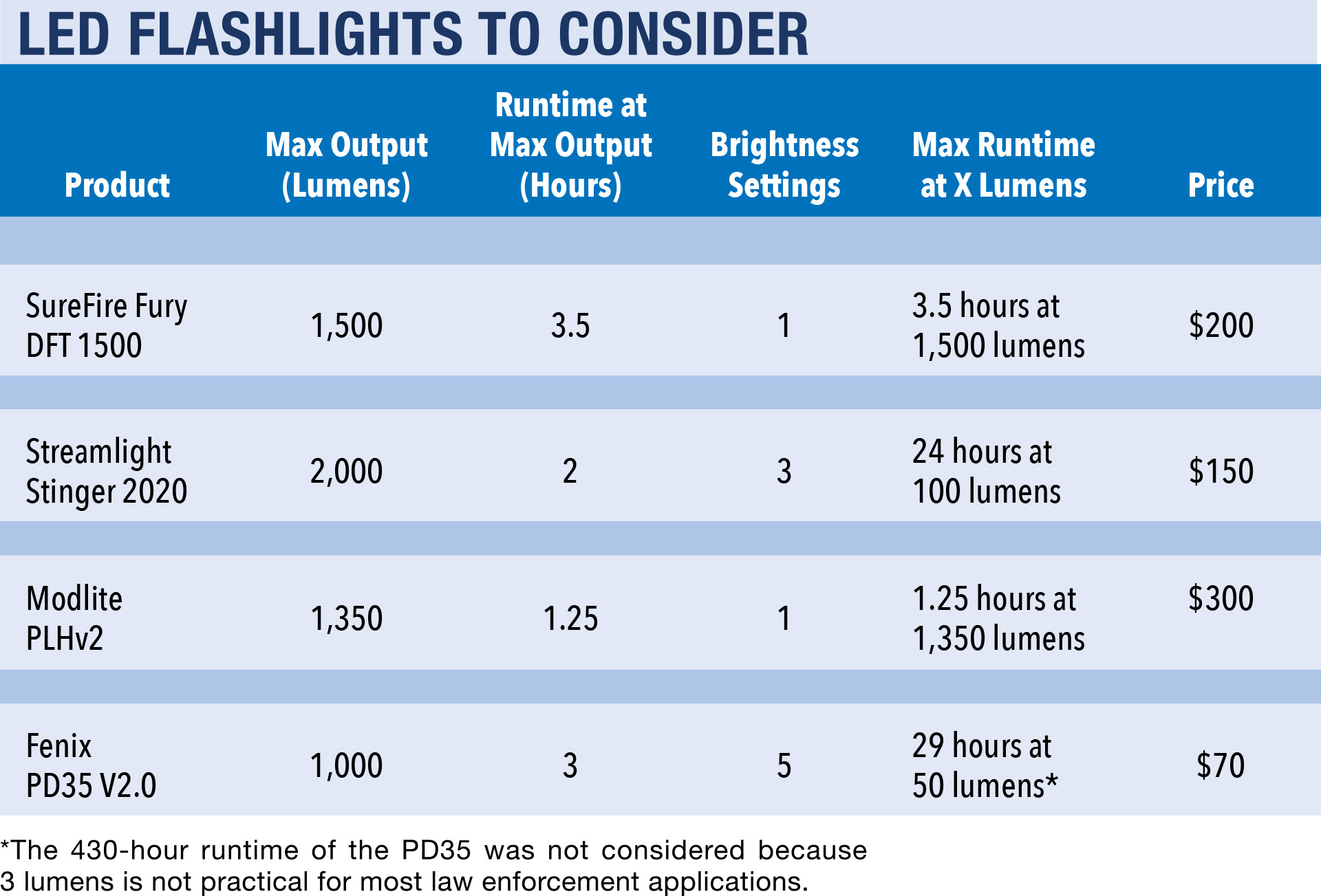
LED flashlights today have different modes ranging from two to three hours of runtime up to 24 hours of runtime. You can pay a little more and get a device that really packs a punch with 1,500 lumens for three and a half hours — you can even opt for a rechargeable battery! Of course, the runtime will vary on the lumens you get, but the options are still out there. Size matters, too. Some of these powerful lights are as small as 5.6 inches, though you might pay a little more for that compactness. Streamlight, SureFire, Modlite and Fenix are all reliable brands that have great selections for law enforcement needs.

Here, I’ve listed the standout from each company so you can select a great option for yourself based on your needs.

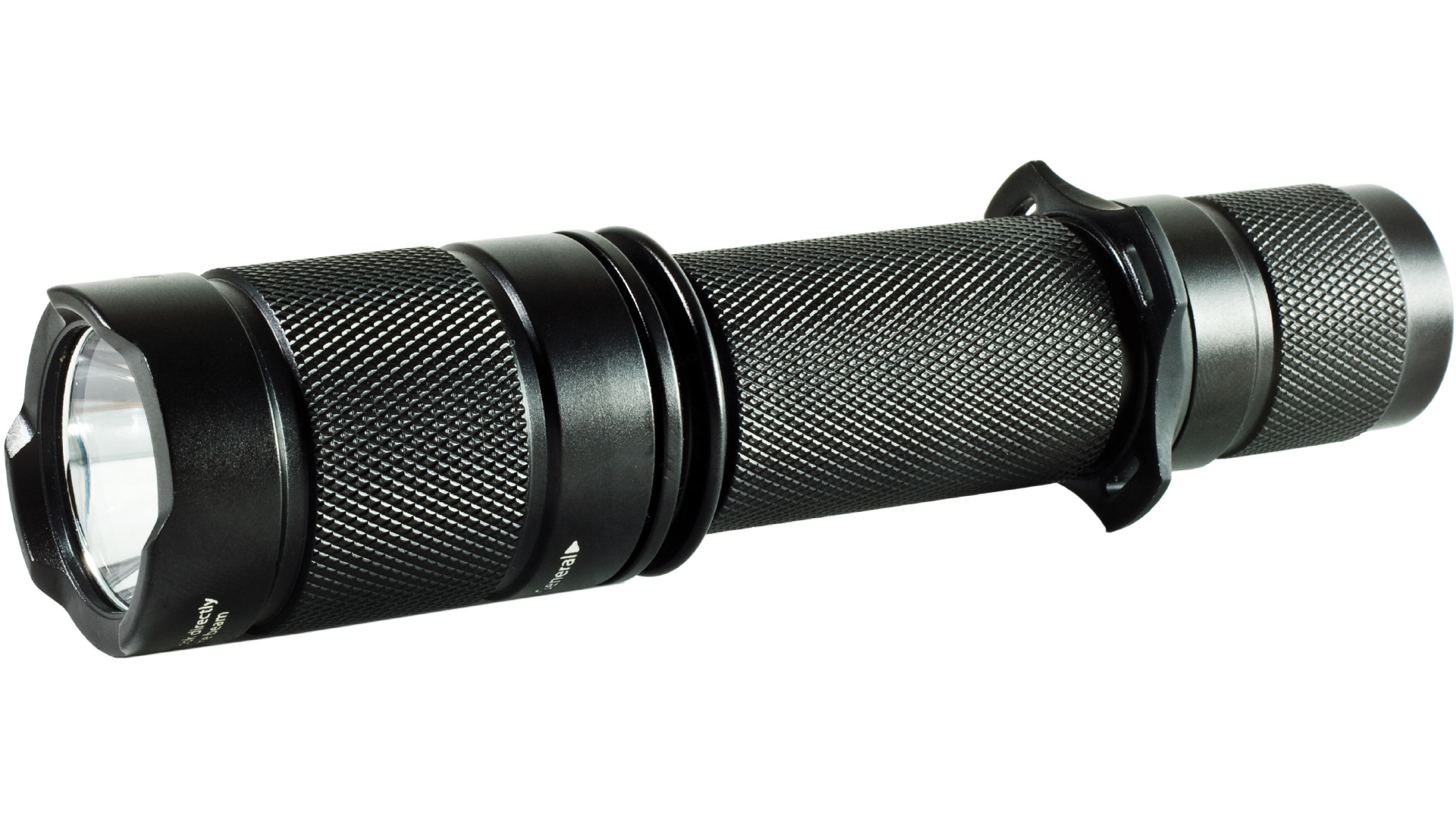
SureFire has a popular offering in the Fury DFT 1500. It runs on a single 18650 rechargeable battery or two CR123 batteries and produces an impressive 1,500 lumens for three and a half hours. It is much smaller than other lights, measuring at only 5.6 inches. Although SureFire has a solid reputation of offering outstanding products, the biggest downside to this product is the price tag at $200.

Streamlight has a great option in the Stinger 2020. It is slightly longer at 7.67 inches; however, it is brighter at an impressive 2,000 lumens. Even while blazing that out, the Stinger 2020 still boasts a two-hour runtime. The Stinger 2020 also has two additional modes of operation that offer 850 lumens, which is plenty bright for the vast majority of law enforcement applications, with a runtime of four hours and a 100-lumen mode for administrative tasks, which allows for an unbelievable 24-hour runtime. The Stinger 2020 also has a strobe function that runs for three and a quarter hours. These runtimes are achieved by a USB rechargeable battery pack. Although the battery pack is new, it is still compatible with Stinger chargers, or it may be charged outside of the light with a USB cable.

There are a couple newcomers to the game of law enforcement gear coming in at both the high and low ends of the pricing scale. At the high end is Modlite. Their most popular handheld light is currently the PLHv2. It is similar in size to the SureFire and Streamlight offerings at 5.37 inches long and weighing only 5.4 ounces. This light produces approximately 1,350 lumens for a runtime of one hour and 15 minutes. It runs on a single 18650 cell and is not capable of accepting CR123 batteries. This light will cost you around $300. That’s a lot to a guy like me … you decide if it’s worth it.

Another manufacturer is Fenix, which has gained popularity in the law enforcement community over the course of the last few years. They have the PD35 V2.0. This light is similar in size and weight to all three of the above-mentioned lights, at 5.43 inches long and 4.9 ounces. On its highest setting, it is capable of producing 1,000 lumens for three hours. Like the Streamlight, it has other modes of operation including 350 lumens for five hours, 150 lumens for 12 hours, 50 lumens for 29 hours and a ridiculously low map-reading setting of just 3 lumens for 430 hours. It runs on either a single 18650 battery or two CR123 batteries. This is the cheapest included and can be found for around $70.

All of these make great lights for any law enforcement officer. There are many different roles within our job and certain lights may be better for certain roles. For my particular use as a patrol officer on the 4 p.m. to midnight shift, I am primarily concerned with output and runtime. Although, I have always been a proponent of the saying, “You get what you pay for.” Do your due diligence and get the right tool for the job.

Dan Kickert

Dan Kickert

Dan Kickert is police officer in the south suburbs of Chicago with 15 years of experience. He is currently assigned to patrol and training. He serves his agency as a field training officer, range master, tactics instructor and training coordinator. He was previously assigned to investigations, where he worked as a homicide investigator in a task force setting for seven years.

View articles by Dan Kickert

As seen in the October 2021 issue of American Police Beat magazine.
Don’t miss out on another issue today! Click below:


SUBSCRIBE TODAY!

Categories: Tech

Primary Sidebar

Recent Articles

  • Perpetual recognition of line-of-duty deaths
  • A Tribute to Fallen Heroes
  • NLEOMF Fund announces March 2026 Officers of the Month
  • Markers of service and remembrance
  • Testing the waters — literally
  • Police pause license plate readers
  • Tragedy strikes Baker to Vegas
  • Frankpledge to forensics: A brief history of law enforcement
  • Pushback as a training signal
  • Let’s get moving!

Footer

Our Mission
To serve as a trusted voice of the nation’s law enforcement community, providing informative, entertaining and inspiring content on interesting and engaging topics affecting peace officers today.

Contact us: info@apbweb.com | (800) 234-0056.

  • Facebook
  • Instagram
  • Twitter

Categories

  • Editor’s Picks
  • On the Job
  • Labor
  • Tech
  • Training
  • Policy
  • Health/Wellness
  • Community
  • Offbeat
  • We Remember
  • Jobs and Careers
  • Events

Editor’s Picks

Let’s get moving!

Let’s get moving!

April 27, 2026

Heroes of the World Trade Center

Heroes of the World Trade Center

April 24, 2026

The Promise Gap

The Promise Gap

April 22, 2026

Corruption, collusion and impunity

Corruption, collusion and impunity

April 21, 2026

Policies | Consent Preferences | Copyright © 2026 APB Media, LLC | Website design, development and maintenance by 911MEDIA

Open

Subscribe

Close

Receive the latest news and updates from American Police Beat directly to your inbox!

  • This field is for validation purposes and should be left unchanged.