We are now on the fourth installment of a pseudo-series of articles that address an officer’s pistol shooting platform. Although I did not write all four articles specifically as a series, if you start with the first (“Reset in recoil”) and read them in succession (“Call your shots,” “Stabilize your shooting: upper body platform” and “Stabilize your shooting: lower body platform”), you will notice that all the pieces fit together to create a fully foundational shooting platform. And if you train each of the techniques the way they are laid out (with the corresponding assessment tests) and then execute exactly as prescribed, I can guarantee that you will be a better shooter as a result. I know that is a very bold and potentially arrogant statement. However, after training thousands of officers with these techniques, I can confidently give you that guarantee. Now, if you already shoot as well as you want to shoot, then these techniques will not help you much. But, if you are an officer who is not shooting as well as you think you should, then these training techniques were specifically made and tailored for you.
I teach a Pistol Skill Builder for Law Enforcement course that was created to redesign a shooter’s platform from the ground up. This class really helps officers increase their qualification scores and assists them in walking into each range day at their agency with confidence. It is not necessarily because of all the techniques they have learned, rather, it is because they go into the range day knowing how to fix the issues when they arise. The confidence lies in the knowledge of the “why” as well as the “how-to.” Not how to identify the problem, because most everyone can easily do that. But rather, it is in the knowledge of how to fix the underlying problem to their specific shooting issue. That may sound elementary, but it is truly the answer to consistent hits on target, even under stressful conditions. For example, see if you can answer these questions below.
Why are your rounds hitting low or left or right of center?
I am sure you answered that question quickly. You probably said something like “anticipation” and “slapping the trigger.” But now try to answer this next question.
Do you know how to continually fix these shooting errors with 100% confidence?
This answer may not have come so quickly. If it did, then you are already on your way to becoming the best shooter you can be. If you still do not have a solid answer, then read on because you are the officer to whom I am writing.
If you notice, in the last question, I added the word “continually.” This is because those shooting errors are inherent, meaning they cannot be rectified in one fix. It is impossible to avoid these inherent errors all the time. They will keep showing up unexpectedly and can only be mitigated for a certain period before they return. That is why shooters must understand the “why” and the “how-to” behind the problem. Once you know how to fix the underlying issue (not just identify it), you will be on your way to becoming a consistent shooter. You may never win any world’s best shooting competitions, but you will be able to undeniably manage your weapon when the situation requires consistency and confidence. The more you train on why the error happens and how to specifically fix it, the longer period of success you will have between each time you commit the error. Again, inherent errors do not go away. You will have to solve and re-solve these problems on a continuous basis for your whole shooting career. But once the fix is understood, the problem will no longer affect your confidence. And that is what changes the game.
OK, if you would not mind moving over just a little bit, I am going to step down from the soapbox that I have been standing on for the last few minutes. And I know I have not actually started writing about today’s training topic. However, I am so obsessed with making sure officers know the “why” and “how-to” principles of their training, that I get a little overzealous at times. But I have now stepped off my high horse, and I am ready to begin.
In this final addition to your shooting platform, we are going to focus on the lower body. Even though this portion may seem less important for shooting a pistol, it remarkably increases stability during successive fire. The following technique comes from 1st Special Forces Operational Detachment-Delta (1st SOFD-D). This lower body platform technique was originally developed for long guns; however, it works just as well for pistols. One of my instructors had the opportunity to privately train with a training director from the Operator Training Course (OTC). During the session, this is one of the techniques he learned. Once he brought it back, it was immediately placed into all our firearm curriculums. This technique makes the lower body stance much more stable (without much effort), and there is a noticeable difference to the overall shooting platform.
Before we get into the technique, we are going to conduct a lower body platform stability test. You will need a partner to assist. Our goal is to simulate the recoil of a 9mm semi-auto pistol. This equates to approximately 4.5–5.5-foot pounds of force that will need to be generated during the test.
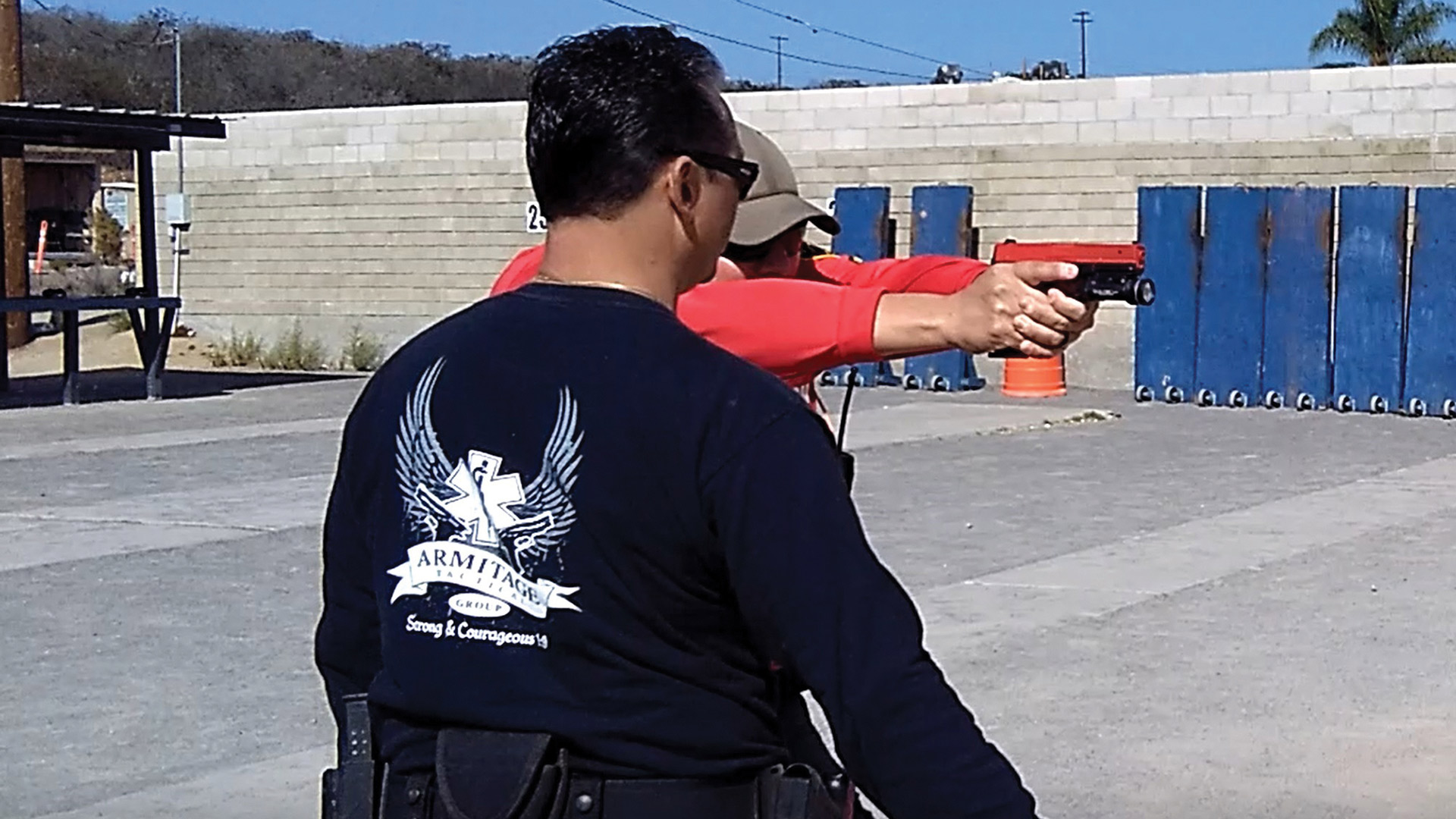
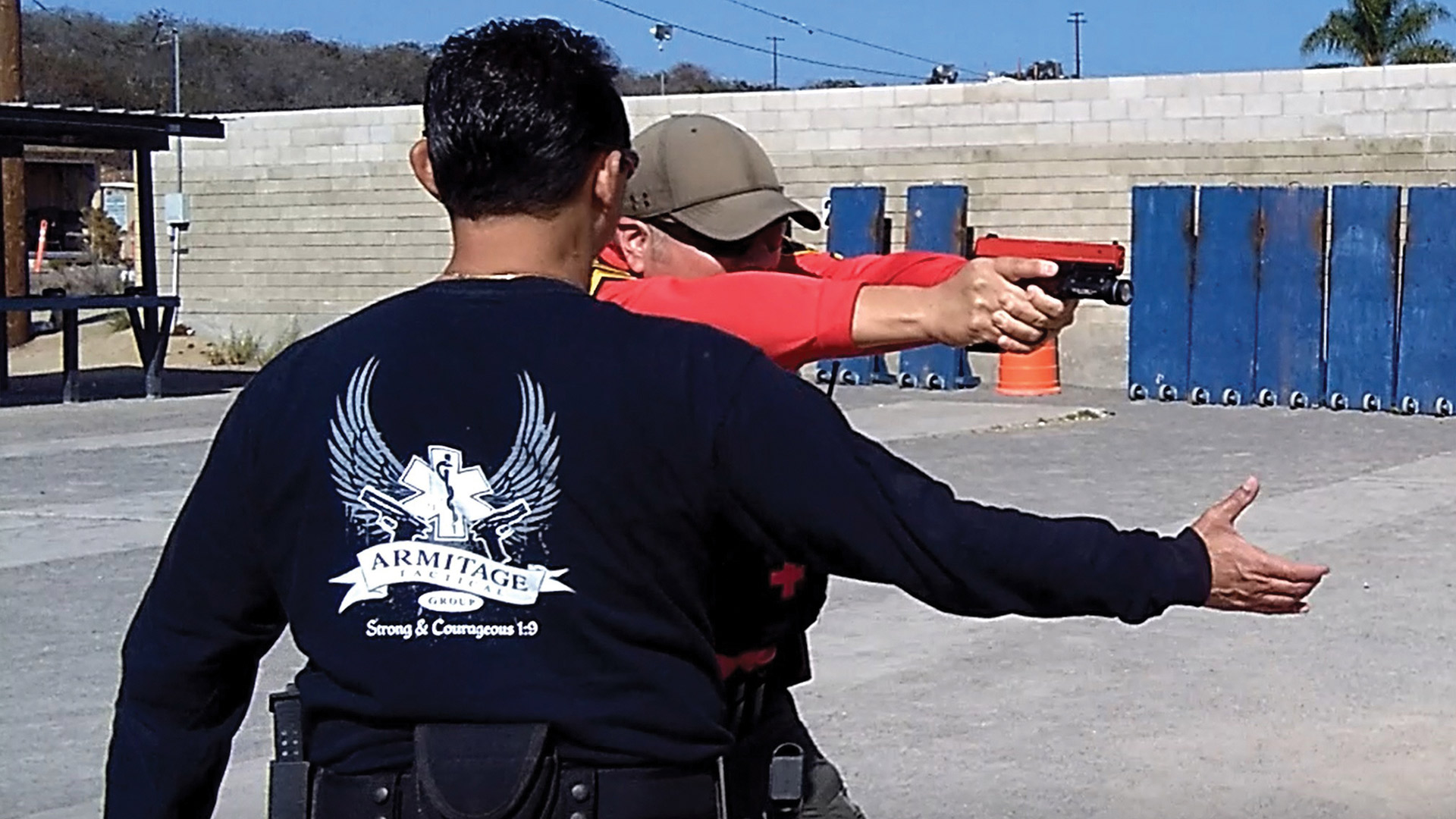
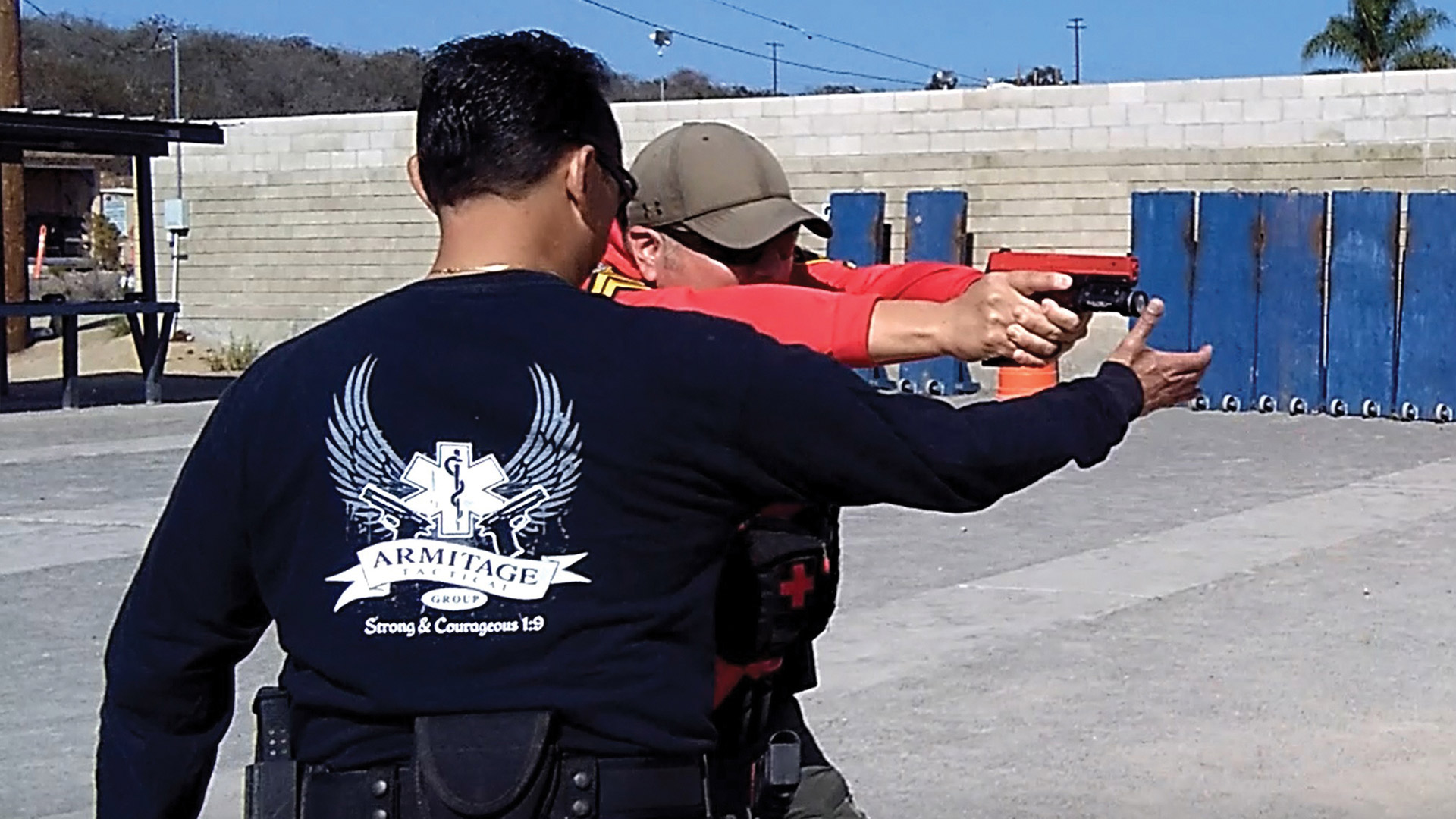
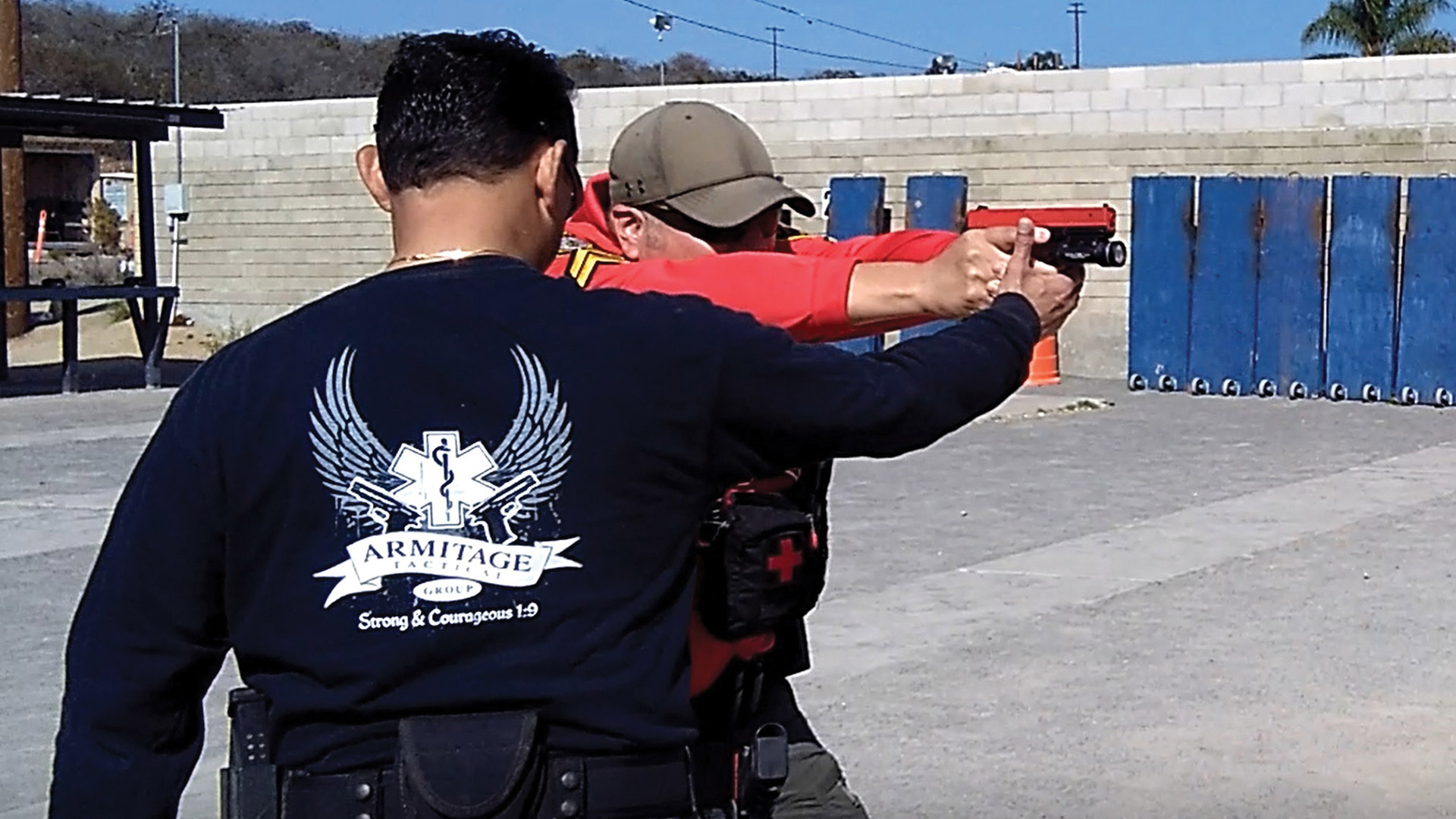
Once your partner is ready, get into your normal shooting stance (whichever stance you currently use) and extend your inert or cleared duty pistol to full extension with a proper two-handed grip. After you are set, have your partner stand at your 11 o’clock or 1 o’clock position placing their strong side nearest to the pistol. Then, with their strong hand at their side, have them throw an open-handed strike hitting their palm squarely on your knuckles. (See Figures 1–4.)
In order to create the necessary foot pounds of force to simulate the desired recoil, they will have to hit your knuckles with a force that is similar to a strong high-five slap. Have them do this at least three times in a row without you attempting to counter the force (by bearing down or shifting your weight forward). This will give you the most realistic operating condition of your current lower body platform. And try your best not to “game it.” This test can easily be manipulated by bearing down in anticipation of the strike. So, if you stand normally as if you were shooting a regular department qualification, you should be fine.
Each time they strike your knuckles, I want you to notice at least one of two things. The first is that your toes may be lifting off the floor. The second is that you may be having to fight to keep your toes grounded. Either way, if at least one of these two things are occurring, your platform is not stable enough to handle standard recoil during successive pistol fire. If there was zero movement at your toes, then your stance is stable. However, nearly all officers that conduct this test fight to keep their toes from lifting off the ground.
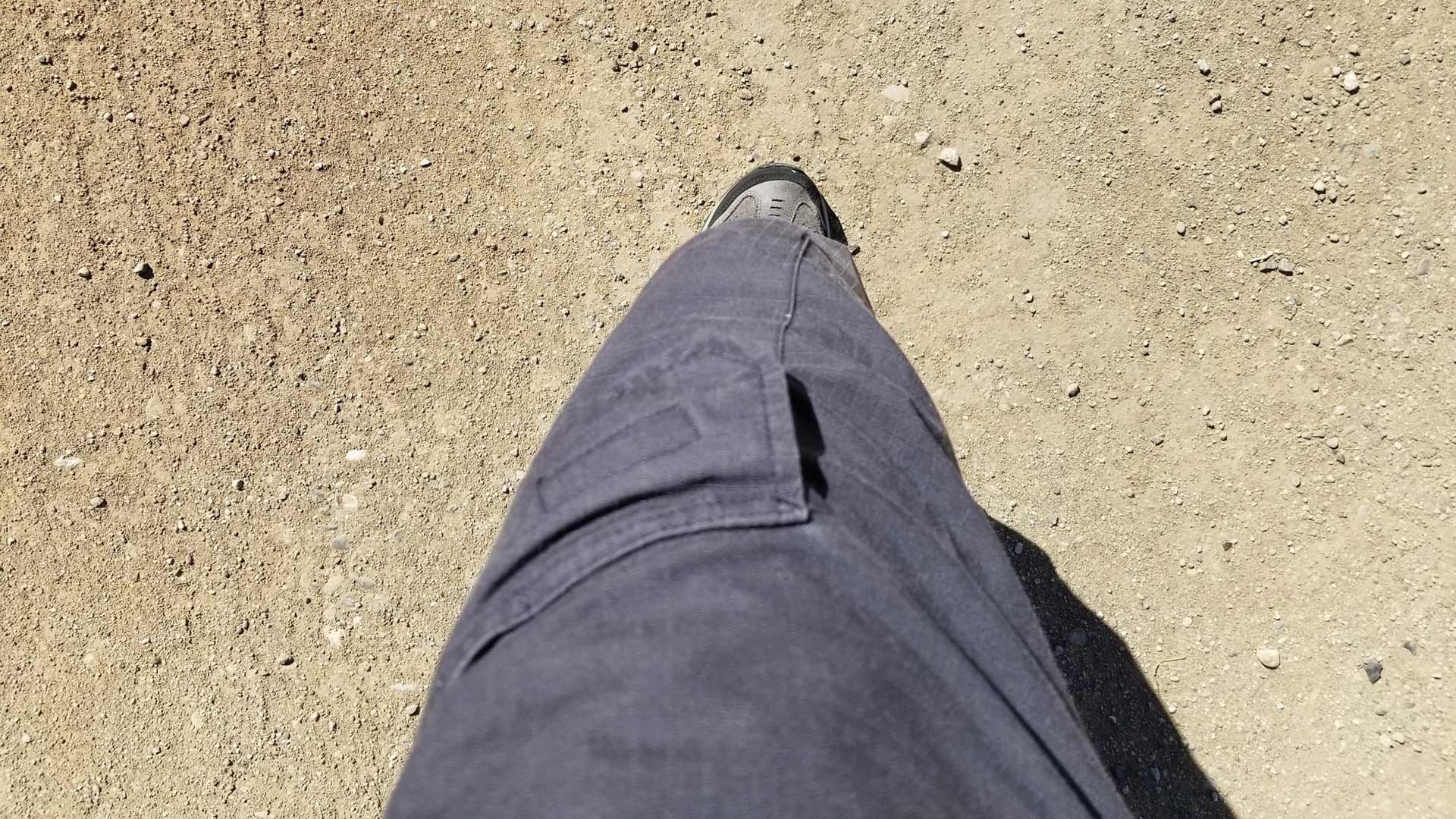
Now that we have completed the assessment, we are ready to try out the new lower body stance. First, get into a standard A-frame or isosceles stance with your feet about shoulder-width apart. Next, take a half step to the rear with your strong-side leg (like you are going to throw a punch). Now, this is the crucial part, drop your support-side knee to the point it sits directly above your support-side toes. Stop when you can only see the tip of your toes. (See Figure 5.)
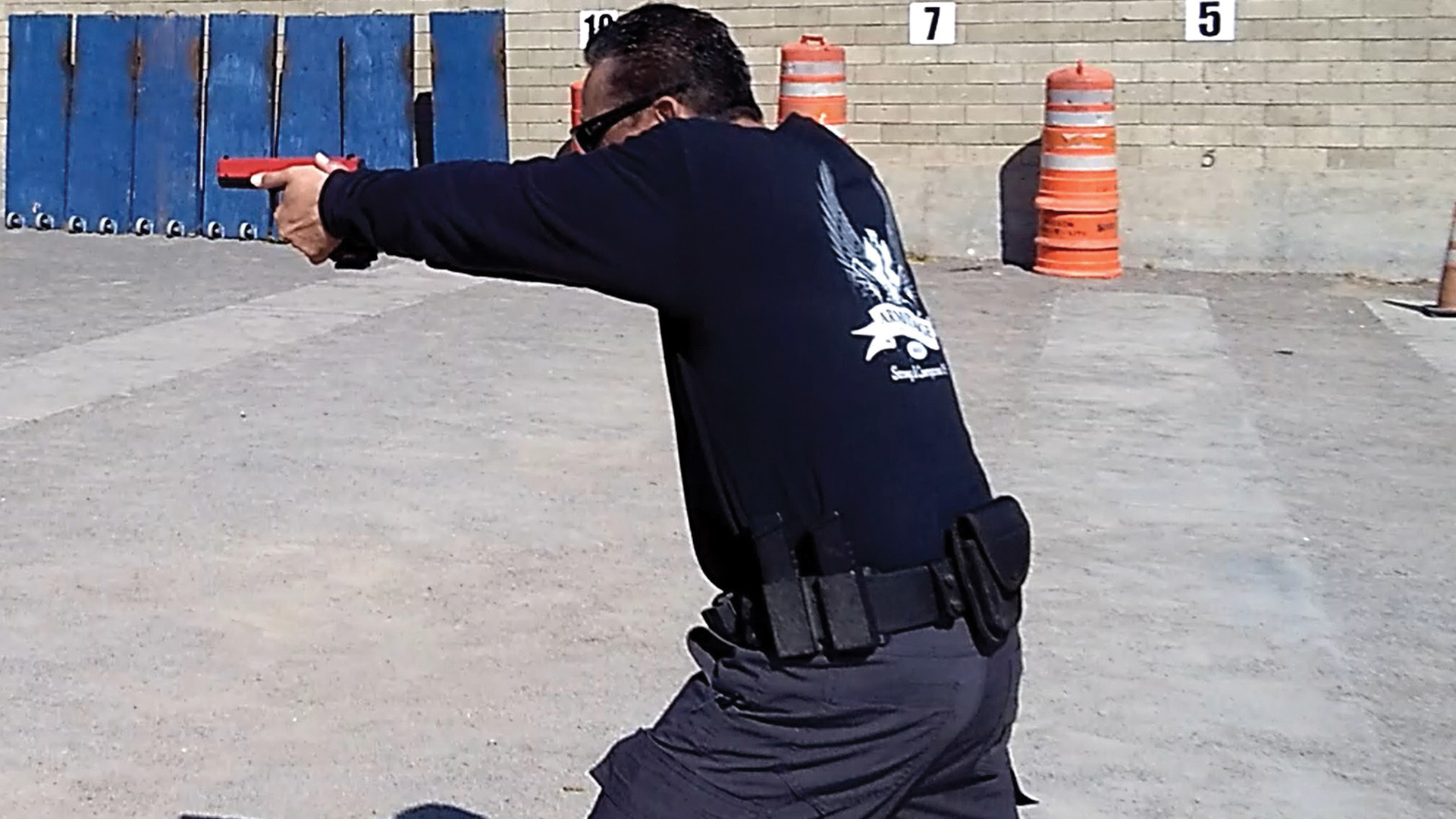
If you have the correct placement, you should also start to feel pressure above your knee near the lower end of your quadriceps muscles. Finally, drop your body weight back into your rear leg just a little bit as if you are settling into position. Make sure you are comfortable. If you are not, settle in until you are comfortable. (See Figure 6.) Most officers must remind themselves more than once to drop their front-side knee over their toes because they have unwittingly raised up during this process. So, double-check your knee-over-toes placement.
Once you are all set and comfortable in the new stance, it is time for a re-test. So again, have your partner get into position and strike your knuckles with an open palm. But first, check your knee-over-toes placement one last time. During the re-test, you will notice a marked difference in lift. It becomes abundantly clear that your stance is much more stable now. If there is still some slight toe lift, drop your support-side knee little by little until the issue resolves itself. Continuing to practice and make this stance a regular addition to your lower body platform will tremendously help to stabilize your overall shooting.
In conclusion, by putting all these techniques (from all four training articles) into practice and executing them properly, you will achieve more consistency in your shooting, thus increasing confidence in your abilities to perform when it matters.
If you have any questions, please get in touch. Otherwise, #staysafe and #stayready.

Clint Armitage
As seen in the April 2022 issue of American Police Beat magazine.
Don’t miss out on another issue today! Click below: