
Officers, first-line supervisors and trainers often lament the lack of leadership in law enforcement. They look at their department’s command staff and point toward the top of the rank structure as the area with the leadership void. They look at their department’s top management positions and complain about the lack of leadership at the highest ranks. And guess what? They’re not wrong.
Nationwide, there is a tremendous lack of leadership in law enforcement command staff personnel. But that lack of leadership and the resulting problems started at the officer, trainer and first-line supervisor level. Very few, if any, chiefs of police, sheriffs, chief deputies, undersheriffs, majors or captains came into this career with the intent to be a poor leader. It started early in their careers.
Ineffective leaders at the top
All too frequently, when we talk about leadership, we focus on the top of the chain-of-command pyramid. Many people think about the chiefs, sheriffs, captains, majors and other high-ranking officials. This is the group that trots out on stage in front of the cameras after something goes terribly wrong. They play the role of politician perfectly — filled with righteous indignation and demands to get to the bottom of things. This same group is also highly visible before elections when voters decide on funding measures or candidates. When these folks are on television, I guarantee it’s bad news. When was the last time you saw a chief of police calling a press conference to praise officers for all the positive contacts they had with the community? I have all day. I’ll wait….
It’s easy to point the finger at this group, because they occupy the top positions in our departments. Since there’s only one chief of police or sheriff, they stand out. Everything they do is magnified by the media, the community and the people of their department. They say it’s lonely at the top, and I’m sure it is a very difficult position. No one should believe for a minute that leading a law enforcement agency is a simple task.
While it’s true those in these positions hold the ultimate positions of authority within a law enforcement agency, their failings are symptomatic of a much deeper problem. Even the worst chief I ever worked for never made it his career goal to be a bad chief. As a matter of fact, when he was a sergeant, those who worked for him spoke about how he supported his officers, sought training opportunities for his team and was an active member on patrol. However, when he became a captain, his hunger for promotion was obvious as he chose politics over people. He was nice to your face but would stab you in the back if you voiced an opinion that differed from his. In hindsight, his failings didn’t start when he became a captain. They started much earlier in his career, when there were few, if any, leadership expectations at lower ranks.
An institutional problem
As a profession, we should have leadership expectations and training at the entry-level positions. Most sergeants and lieutenants in law enforcement don’t attend formal leadership training until after they are selected as supervisors. How is this even possible? Why do we select new supervisors, and expect them to be some of the most influential leaders within our departments, without providing leadership training and opportunities before promotion? How do we know what we’ll get once they’re promoted? This is a problem with a simple solution. We should have leadership training opportunities and leadership expectations for every rank in our agencies from day one.
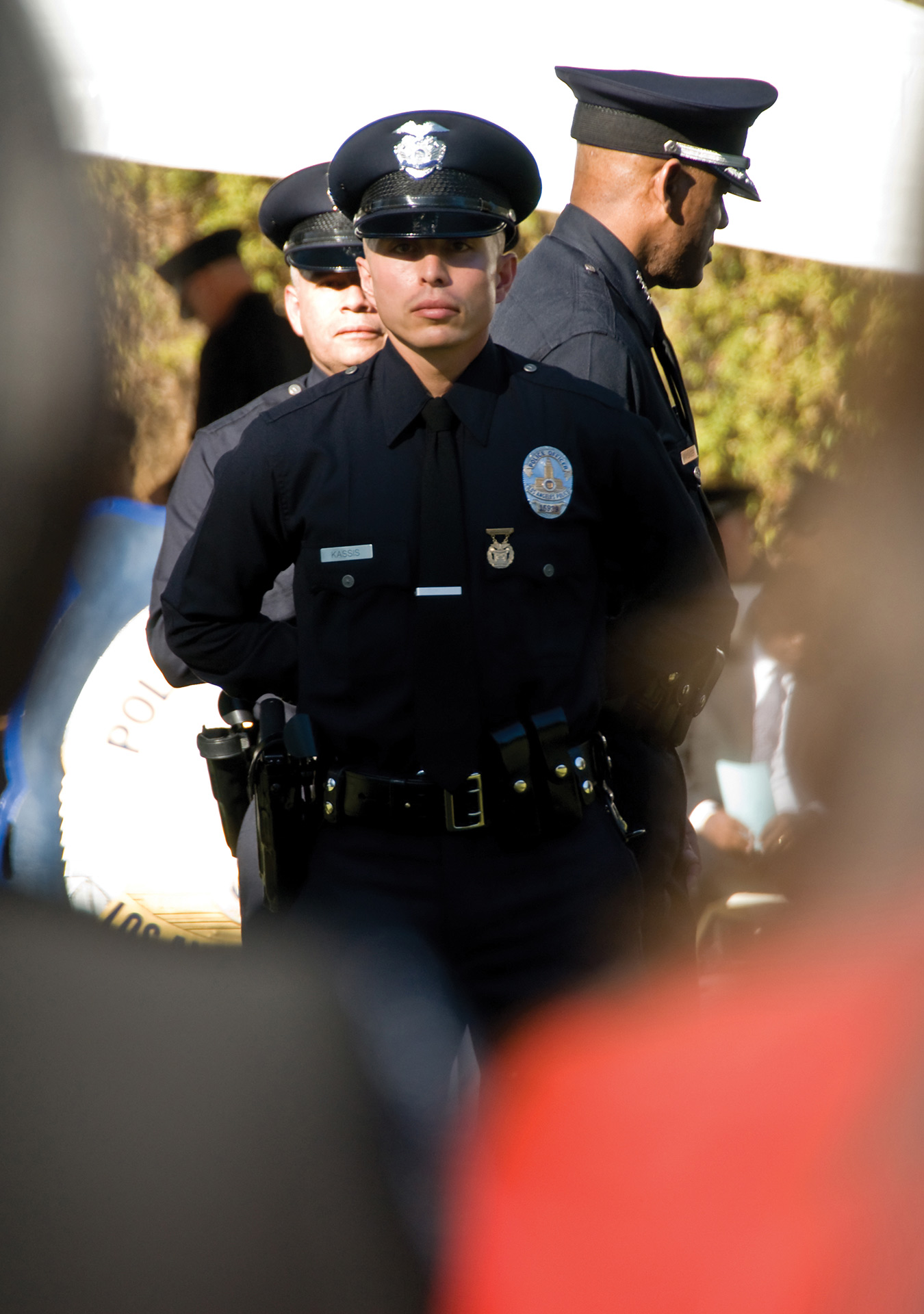
Every police academy should include leadership opportunities and expectations for all cadets. Even if someone doesn’t hold a formal position of rank, we need to have leadership expectations of every single cadet. When they pin on the badge and fasten the duty belt around their waist for their first day on patrol, our communities expect them to present themselves and perform as leaders. At a minimum, we should have the same expectations.
Once they graduate from the academy and hit the streets, field training officers and supervisors need to have leadership expectations of those new officers. Even in field training, they look like police officers, dress like police officers and have the same responsibilities as every other law enforcement officer in the department. They have the authority and responsibility to use reasonable force to take people into custody without their consent, and the ability to change people’s conduct by just being present. This is a heavy responsibility for anyone, let alone a young adult between 21 and 29 years of age.
When we demand leadership in our hiring processes, our basic academy training and our field training programs, we can set the tone and expectations for an officer’s entire career. Without demanding leadership traits, establishing leadership expectations and promoting leadership values, we shouldn’t be surprised when cops do things because they become badge-heavy. However, strong leadership and leadership expectations can help prevent bad behavior from occurring within our ranks. Bad behavior from one casts a stain on us all.
Own the problem
I know a lot of officers are still pointing fingers at the top and thinking, “But if we had a chief who was a good leader, then we wouldn’t have these problems.” True or not, that’s a weak excuse for failing to take action where you have the most influence. During an interview, Brian Willis from Winning Mind Training put it very plainly: “The majority of law enforcement officers are sergeants on down. When officers, deputies, agents, constables, troopers, corporals and sergeants become the leaders and change agents of the department, it makes bad leadership at the command staff level nearly irrelevant.”
We may not want to admit it, but once again, if we have leadership training opportunities and expectations at the bottom of the chain-of-command pyramid, we can overcome bad leadership at the top. Ask yourself this: how many chiefs or sheriffs have influence over patrol briefings? In the 16 years I served as a sergeant, I can count on one hand the number of times the chief attended a patrol briefing — and when he did, it was a quick appearance rather than being an active participant. However, the sergeant, corporals and officers have tremendous influence on every single briefing. Strong leadership from those positions influences the quality of information, shift goals and overall attitude of the team.
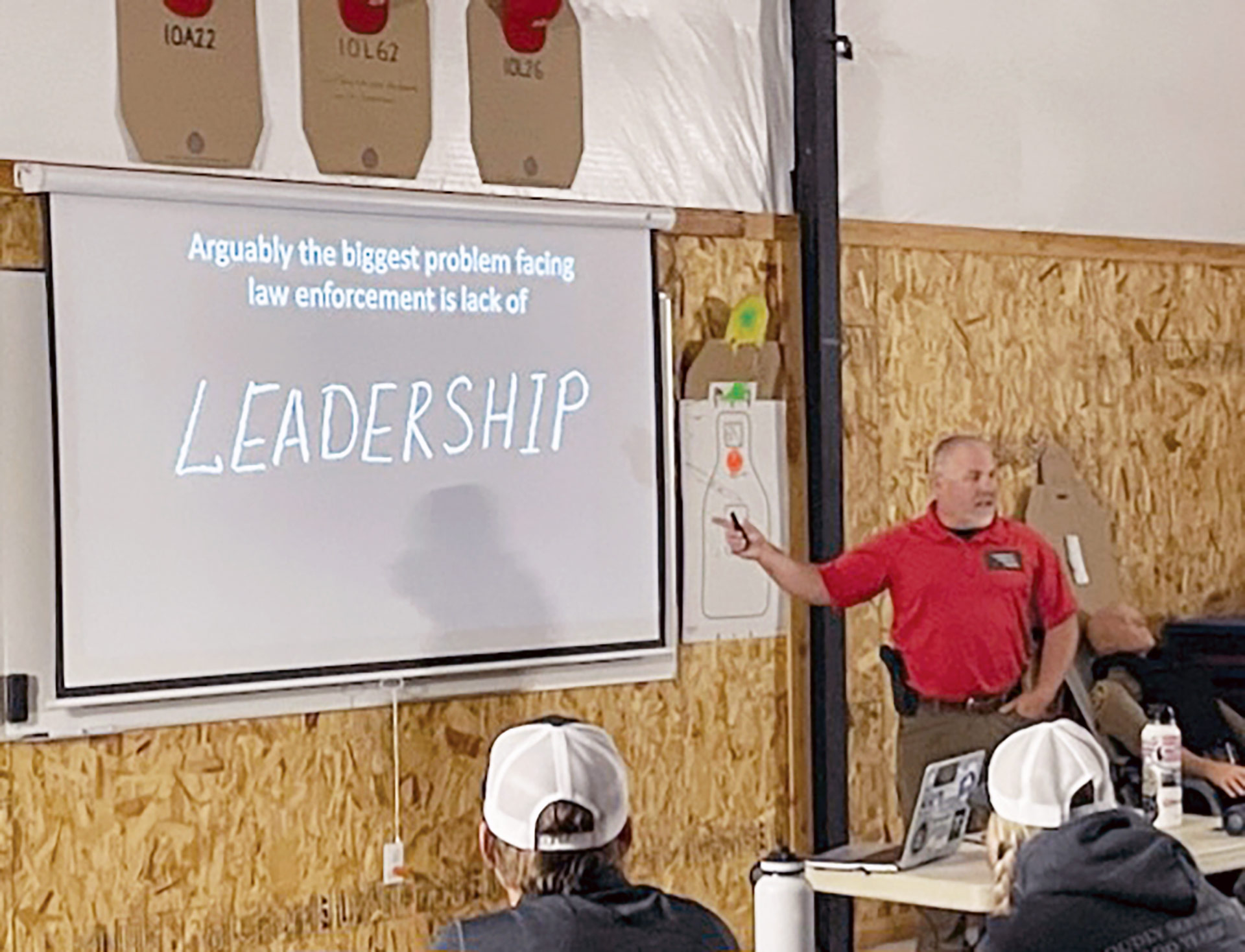
I started my firearms training company in 2011 with a focus on law enforcement, private security and military instructors. The classroom session of every class on day one includes a PowerPoint slide that states, “Arguably the biggest problem facing law enforcement is lack of leadership.” Unfortunately, 12 years later, that slide is still as relevant as ever. One could even argue that it’s more relevant than ever, considering recent incidents that shine a light on the problems that can arise when a department lacks leadership. On the other hand, good leadership can improve a department and help prevent those types of serious problems. As anyone who has attended our classes can attest, I believe the best firearm instructors are also great leaders. There’s no getting around this simple fact: a good teacher, coach, mentor and instructor possesses good leadership skills.
Last year, I experienced a prime example of this concept during one of our Pistol-Mounted Optics Instructor classes. The class started in the classroom and included a presentation on instructional leadership. Unbeknownst to me, one of the students later complained to another student about the leadership portion, saying he was there to learn about teaching the transition to optics from iron sights and not for a lecture about leadership. If he had the courage to say this during class, I would have pointed out that adding an optic to a pistol doubles the cost of the handgun and requires additional time and money for training. There are also some officers who are resistant to the change. Dealing with these issues requires leadership. And, if he still didn’t understand the connection between being an instructor and being a leader, I would have pointed out that he was the reason those slides are included, because he was an example of the problem. Leadership is an issue in our profession long before someone is promoted to the upper command ranks.
The chief I mentioned earlier did not have leadership training or expectations early in his career. If he had, maybe he would have been a good leader. Maybe not. As a profession, we can’t continue down the path of terrible leadership. We are in the lifesaving business. Law enforcement is too important to our communities, our states and our nation to put the political drones in front of the camera when things go bad. Let’s lead from the bottom up to save our noble profession.

Todd Fletcher
As seen in the July 2023 issue of American Police Beat magazine.
Don’t miss out on another issue today! Click below:




