The 1997 North Hollywood Bank of America incident proved to law enforcement leaders and trainers that uniformed officers needed patrol rifles and ballistic shields. In 1999, this once again became readily apparent following the Columbine High School shooting.
Twenty years later, a rapid mass murder suspect armed with multiple rifles killed 61 people in Las Vegas. Rapid deployment of ballistic shields may have been useful to the initial officers on scene by providing cover during approach and while rendering aid and evacuating the wounded. It is now a widely recognized fact that patrol officers will be the first officers on scene, and additional ballistic protection will help patrol officers save lives.
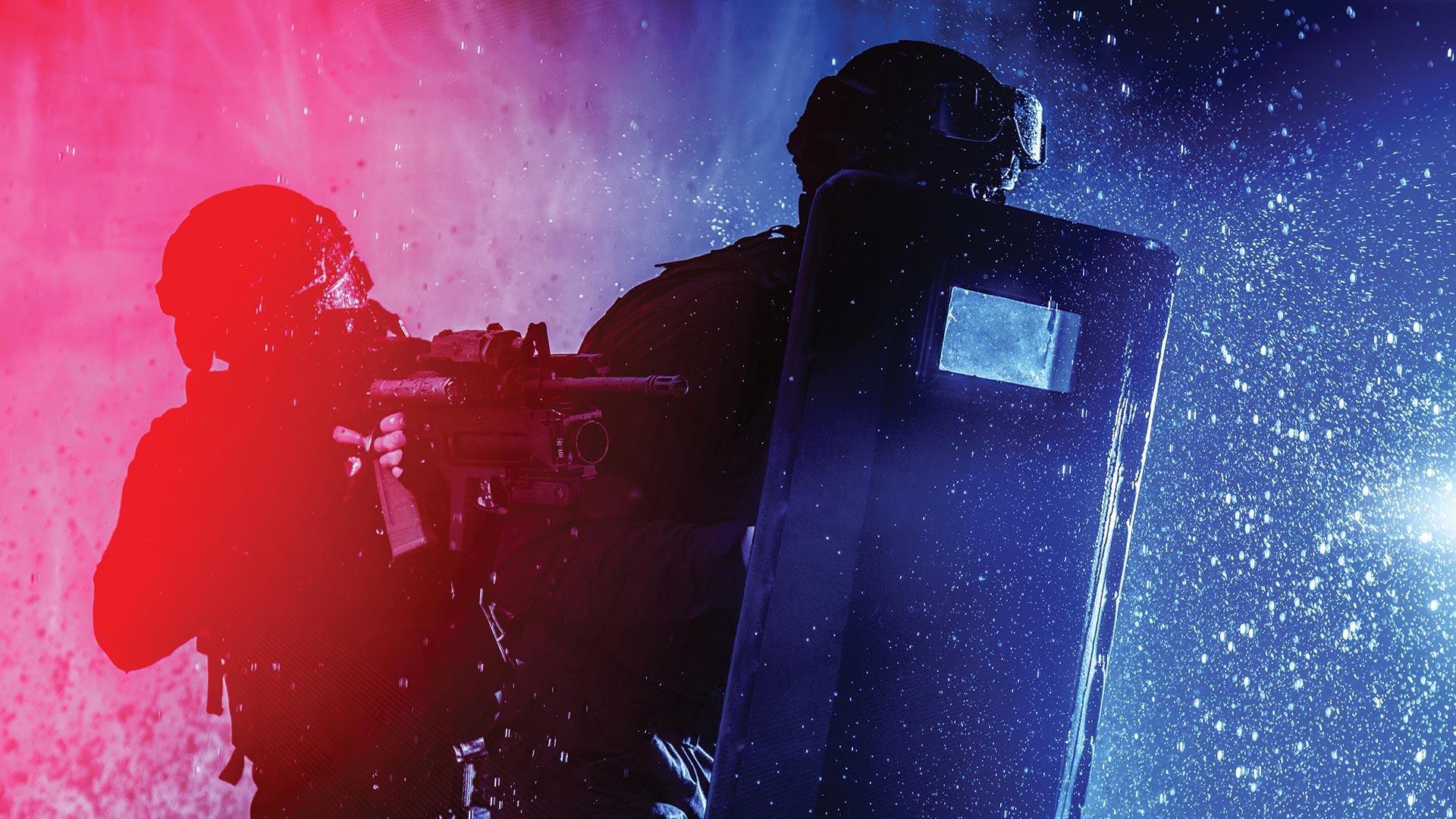
Ballistic shields are most frequently deployed on calls like building searches, shots fired investigations, armed subjects, and other patrol calls.
Bank robberies and active killer incidents aren’t the only time patrol officers could benefit from having ballistic shields available. Ballistic shields are most frequently deployed on calls like building searches, shots fired investigations, armed subjects, and other patrol calls. Making ballistic shields available to patrol officers creates a much safer working environment for those officers and our communities.
Unfortunately, most law enforcement agencies place ballistic shields in supervisor vehicles. Some administrators are more concerned with keeping equipment clean and unused instead of in the hands of the people who would make it useful. This seems counterintuitive since most would agree that it’s more likely an officer will arrive on scene before a supervisor.
Choosing a shield
If all your department can afford is a few SWAT “hand-me-downs,” then by all means, make the best use of those ballistic shields. Unfortunately, most of those shields are going to be old, heavy and bulky compared to modern armor. These shields will be left in the back of patrol vehicles instead of being deployed on calls where they are needed, but at least they’ll be on scene and used for the occasional high-risk approach or take-down team.
When it comes to selecting a modern ballistic shield for patrol officers, some of the primary things to consider are weight, the level of ballistic protection and an ergonomic carry system to make managing the shield simple. There’s really no reason to limit patrol officers to handgun-rated shields. Rifle-rated ballistic protection is needed today more than ever. Some easily deployed, individual-sized shields offer rifle-rated protection for 10 pounds or less. It baffles me that these aren’t issued with every single patrol vehicle in our fleets.
Weight is a crucial factor and should be taken seriously. Today’s ballistic shields are lighter than even a few years ago, resulting in greater ballistic protection from a comparable-sized shield. A lighter shield is safer and easier to use. Heavy shields are harder to carry and more difficult to stabilize while moving. Heavy shields are also difficult to deploy from vehicles, making it more likely that the shield or patrol vehicle will be damaged during deployment.
If weight, ballistic protection and deployment capability are key factors when selecting a shield, it’s hard not to be impressed by the lightweight individual officer shields available today. These shields should be the choice of administrators, trainers and officers alike since they can be stored inside the passenger compartment of patrol vehicles and quickly put into service on a wide variety of calls. What’s not to like about grabbing and going with 10 pounds of rifle-rated ballistic protection instead of having to get into the back of a patrol vehicle to lug out a 30-pound shield?
Operator comfort is another important consideration. An ergonomic carry system means the shield can be deployed with less effort over longer periods of time. On long searches or calls for service, a carry system that provides a comfortable way to hold the shield is crucial to proper use. Ergonomic handles, padding and forearm straps can make extended deployments more comfortable, resulting in more frequent use.
The fun stuff: Training
The next step is to train users on how to deploy this valuable piece of equipment. Training shouldn’t be restricted to SWAT, supervisors or other specialized units. Patrol officers should be trained to deploy and use ballistic shields. Training should cover calls for service and circumstances where a ballistic shield could be useful. Once context has been covered, training can move on to the basics of how the shield is stored and deployed.
The fun training comes next. When it comes to carrying and using a ballistic shield, you want to hold it away from your body, directly in front of your torso while minimizing any cant. Move your head and face behind the shield, and take quick peeks to see what you need to see. Another option for smaller shields is to hold the shield slightly lower with the shield around nose level and your eyes above the shield for visibility. This protects your torso, neck and most of your head.
To maintain your balance, stay tall with a slight forward weight bias with your feet in an athletic stance, like how you would stand while shooting. This position should allow you to comfortably support the weight of the shield while being able to move in any direction.
When it comes to the practical use of ballistic shields, training should cover basic building-search and room-clearing deployment. Building-search training should specifically cover one and two officer shield teams and stairway tactics. Stacking ballistic shields to create a larger coverage area should be taught, providing options to patrol officers during rescue operations.
Another tactic that should be covered includes “lipping” the shield around corners. To do this, simply press the edge of the shield against the wall or door frame. When moving around the corner or entering the room, the shield becomes your pivot point during entry, keeping the shield between the officer and potential threats.
Some of the most common situations where patrol officers would deploy ballistic shields include CQB and perimeter operations. Arrest team strategies and techniques should be covered to ensure officers understand how to use the shield as cover while communicating and detaining suspects.
When it comes to the live-fire range, officers should be trained on a variety of topics, including one- and two-hand shooting with the shield. When running a handgun with a ballistic shield, remember to give the slide room to run so you don’t induce a failure-to-eject malfunction. Reload and malfunction drills should be performed so officers get the opportunity to perform these skills under controlled training conditions before the uncontrolled environment of a fight. These skills are going to be performed one-handed, so practicing these skills is critical. Once these skills have been trained using handguns, it’s time to add patrol rifles to the mix.
Ultimately, these skills should be combined in scenario-based training so that officers — and teams of officers — can deploy ballistic shields while working through a variety of scenarios. These scenarios could include a wide variety of situations, including injured-officer rescues, approaches to doorways, take-down and arrest teams, threshold evaluation and port-and-cover window tactics.
Ballistic shields should be a regular part of the equipment provided to patrol officers. It’s no longer acceptable to wait for a ballistic shield to be delivered by a supervisor or SWAT. It is time to properly equip the first officers to arrive at every call for service. Portable, lightweight, ballistic protection has become a necessity for our patrol officers and communities.

Todd Fletcher
As seen in the November 2023 issue of American Police Beat magazine.
Don’t miss out on another issue today! Click below: