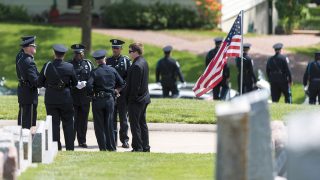
November is National Veterans and Military Families Month. This is the time to publicly acknowledge the military personnel — veterans and reserves — in your law enforcement agency and their tremendous sacrifices, their families’ shared sacrifices of service and the difference that such families make in your department. This is precisely the time to increase department awareness and understanding of resilience and courage. This is also an opportune time to convey relevant resources and family activities this month.
Tremendous sacrifices
Ultimate sacrifice. The U.S. armed forces personnel make extraordinary sacrifices, sometimes heroic sacrifices, sometimes even the ultimate sacrifice. Service in any profession may be done, of course, without sacrifice, but when the individual’s own health, well-being, happiness or future is put on the line for a higher cause (such as life, liberty and the American way), that is sacrifice. When an individual lays down his life for a friend, neighbor or another human being, that is the ultimate sacrifice of love.
Daily sacrifices. It is the daily sacrifices, however, that tend to be less noticed by others. These may be physical, psychological and/or spiritual sacrifices that most Americans never have to experience in their lives.
When an individual lays down his life for a friend, neighbor or another human being, that is the ultimate sacrifice of love.
Consider some of the daily physical sacrifices. Do you work outside all day long, standing or squatting, rain or shine, sleet or snow? Do you eat MREs morning, noon and night in less than 10 minutes? Are you interrupted by (real or simulated) gas attacks, ambushes or sniper fire? Do you sleep in a tent?
Consider some of the ongoing psychological sacrifices. Are you separated from your spouse, little ones and other family members? Do you have to power through Thanksgiving, Christmas, birthdays and special occasions like it is just another workday? Did you miss part of your newlywed time period, your child’s birth or graduation, or your favorite football team playing last Monday night?
Consider some of the regular spiritual sacrifices. Are you able to attend your faith-based services and activities regularly at the appointed places and times? Are you expected to endure all things for the good of people who do not know or even like you? Are you a living sacrifice for others?
Shared sacrifices of service
Law enforcement military families make tremendous sacrifices that are not for the faint of heart. Family separations, greater mental and emotional demands, and giving of one’s life for a cause — the families themselves share these sacrifices of service.
Military spouses. The spouses provide critical love and support to keep our troops motivated, engaged and enduring all. They volunteer to support the military simply by virtue of their spouse role; in essence, they are enlisted in the military without the financial compensation or ability to rise in the ranks.
Military spouses hold down the home fort during deployments. They regularly sacrifice their jobs and careers, their income and the “me time” they would have had if they married a teacher, accountant or some 9-to-5-type worker. Sometimes, even self-esteem and mental health are sacrificed.
Military children. The sacrifices of military children are easily overlooked despite them never volunteering for the job. They, too, experience family separations. They, too, can experience a sense of great pride and respect while simultaneously feeling sadness, worry and fear over real-life “what ifs.” They, too, sacrifice the stability of a long-term home and school district; they change schools an average of six to eight times over the course of their parent’s military career.
Other military family members. It is easy to forget about the extended family members who serve our country by supporting their uniformed relative. Grandparents have been known to help take the kids to and from school, have them over for sleepovers, cook Sunday dinners and otherwise provide a stable and secure home environment for respite. Sisters have been known to send care packages and provide significant additional emotional support to the children by calling, emailing, visiting and offering fun alternatives. It really takes a village. Aunts, uncles and cousins have been known to offer strong respect and admiration for the uniformed relative, even holding them on a pedestal as a positive role model for other family members. And so the value of service and the blessings of uniformed personnel sacrifices are held in esteem and become a core family value that helps sustain the entire community now and for generations to come.
The difference in law enforcement departments
Veteran and military families make a difference in the lives of the department. They may stand taller, look sharper, be more patriotic and committed to the mission, know better how to survive community discontent, be more steadfast in a storm, give it their all and really know what it feels like for the world to shrink to the person on their right and the person on their left.
Leadership. Veteran and military personnel tend to demonstrate leadership regardless of whether the soldiers are in a supervisory rank in the department. They accept the department mission, execute the tasks, inspire and motivate others, and expect the best of everyone. Likewise, the families tend to demonstrate leadership in their respective departments. Is the department hosting an annual walk to honor those who have died in the line of duty or by suicide? The families will most likely be there without fanfare or recognition. Did the department call for volunteers for their wellness day, fundraisers or other activities? These families will most likely have their hands up first.
Work ethic. Veteran and military personnel tend to demonstrate strong work ethic. They seem to exude a take-charge mentality with can-do efforts and minimal supervision. Likewise, the families tend to demonstrate a strong work ethic. They get things done because they know they must. They take care of all the family needs with or without a deployed spouse. They support other families routinely and in times of crisis; they tend to be the backbone of the department spouse support group. If employed outside the home, it is precisely the military spouses who tend to demonstrate the highest productivity rates at their places of employment.
Core values. Veteran and military personnel talk the talk and walk the walk. They don’t just give lip service to commitment, integrity, accountability, loyalty, service and diversity. Likewise, the families are the ones waving the flag, wearing department T-shirts, speaking to other spouses about marital commitment and fidelity, shipping packages off to disaster survivors and more.
Resilience and courage
Military families tend to embody strength, resilience, and courage. Resilience is the ability to bounce back quickly when tough times come (and they always come in every life). Psychological resilience is the ability to effectively cope and positively adapt at those times. That is why some officers actually grow as a result of trauma (aka post-traumatic growth) whereas other officers may struggle or even develop post-traumatic stress. Consult with the department police psychologist regarding how to strengthen individual and organizational resilience.
Courage is about executing the task even in the face of fear or grief. It is the mental or moral strength to resist opposition to the rule of law, face danger when performing one’s job duties, endure hardship when faced with injury recovery or the death of another officer. Courage is the mettle to do the right thing in the right way at the right time.
Resources
Department military liaison. They provide training days, symposiums and observances for veteran and military personnel in the department. They assist with department recruiting efforts within the military, work in partnership with the police union and other entities that might benefit vets in the department and inform newly hired department military veteran recruits of the benefits afforded to them (e.g., GI Bill, veterans’ preference for hiring, VA clothing allowance). Training supervisors, assembling and sending care packages to deployed employees and supporting return-to-work needs (e.g., return-to-work procedures, reintegration training, information sessions with the police psychologist) may be offered.
Department police psychologist. The docs offer military return information sessions, deployment debriefings, critical incident support, couples therapy, executive coaching, referrals and more.
Peer support. These personnel offer support by virtue of already having gone through what you are currently experiencing. Some departments even have a peer support military cadre — a select group of veterans and military personnel in the department who are also trained in peer support.
All law enforcement personnel are called into service to defend the weak and vulnerable, to uphold the law of the land for the poor and oppressed and to open their hearts wide and hold nothing back. All law enforcement families are called into the shared sacrifice of service.

Dr. Stephanie Barone McKenny
As seen in the November 2023 issue of American Police Beat magazine.
Don’t miss out on another issue today! Click below: