• Skip to primary navigation
  • Skip to main content
  • Skip to primary sidebar
  • Skip to footer
  • Home
  • About
  • The Magazine
  • Events
  • Partners
  • Products
  • Contact
  • Jobs and Careers
  • Advertise
  • Facebook
  • Instagram
  • Twitter
  • Subscribe
American Police Beat

American Police Beat Magazine

Law Enforcement Publication

  • Home
  • Leadership
    • The relentless pursuit of excellence
      An effective strategy for difficult discussions
      Developing and enhancing assertiveness
      Clarifying your “true north”
      The job has changed — have you?
  • Topics
    • Leadership
      • The relentless pursuit of excellence
        An effective strategy for difficult discussions
        Developing and enhancing assertiveness
        Clarifying your “true north”
        The job has changed — have you?
    • Editor’s Picks
      • No two days are ever the same
        Training dipshittery, Part 2
        Tactical medicine for cops
        Why good cops quit
        Smile and let them swing
    • On the Job
      • From warrior to peacekeeper
        Hats off to a new uniform look
        Overcoming climate and conditions to rescue child
        Father and son mark career milestones together
        Officer’s determination closes case and surprises cancer patient
    • Labor
      • The shift happens long before the resignation letter
        Facing the oral board
        Why good cops quit
        Succession planning
        Why more staff won’t fix your operational slowdowns
    • Tech
      • Take Me Home program offers effective tool for police and families
        Get the most out of simulation training
        The virtual beat
        Training with an AI partner?
        NYC’s electric vehicle fleet for LE passes milestone
    • Training
      • Train them to ask why
        Nobody is coming to do it for you
        Precision, adaptability and response: The need for LPVOs in equipping...
        Training dipshittery, Part 2
        Tactical medicine for cops
    • Policy
      • Out of chaos comes opportunity
        Massachusetts law establishes fund to care for retired K-9s
        Portlanders will not vote on diverting climate funds for police...
        Surviving internal affairs investigations
        Fighting human trafficking at the local level
    • Health/Wellness
      • Understanding why police officers think alcohol works
        Has the job quietly stolen your humanity?
        No two days are ever the same
        Changing the narrative
        Supporting your peer support team
    • Community
      • Pittsburgh mounted patrol officer helps inner-city kids saddle up
        Wyoming girl on a mission to collect “hero patches”
        Texas sheriff’s office nominates 7-year-old for commendation
        Cops try to net DEA agents
        A different type of teen takeover
    • Offbeat
      • Could cadaver otters help close cold cases?
        Police chief catches cat in the act
        “Teenage Mutant Ninja Deer” rescued
        An unexpected burglar
        Police humor only a cop would understand
    • We Remember
      • Protecting America with the USA PATRIOT Act
        Distant cousins connect to honor fallen family member 110 years after...
        9/11 Victim Compensation Fund: A journey to coverage
        Driver charged with murder after striking LAPD sergeant at 112 mph
        Unsung heroes: New York City correction officers
    • HOT Mail
      • The War on Cops Continues Unabated
  • On the Job
    • From warrior to peacekeeper
      Hats off to a new uniform look
      Overcoming climate and conditions to rescue child
      Father and son mark career milestones together
      Officer’s determination closes case and surprises cancer patient
  • Labor
    • The shift happens long before the resignation letter
      Facing the oral board
      Why good cops quit
      Succession planning
      Why more staff won’t fix your operational slowdowns
  • Tech
    • Take Me Home program offers effective tool for police and families
      Get the most out of simulation training
      The virtual beat
      Training with an AI partner?
      NYC’s electric vehicle fleet for LE passes milestone
  • Training
    • Train them to ask why
      Nobody is coming to do it for you
      Precision, adaptability and response: The need for LPVOs in equipping...
      Training dipshittery, Part 2
      Tactical medicine for cops
  • Policy
    • Out of chaos comes opportunity
      Massachusetts law establishes fund to care for retired K-9s
      Portlanders will not vote on diverting climate funds for police...
      Surviving internal affairs investigations
      Fighting human trafficking at the local level
  • Health/Wellness
    • Understanding why police officers think alcohol works
      Has the job quietly stolen your humanity?
      No two days are ever the same
      Changing the narrative
      Supporting your peer support team
  • Community
    • Pittsburgh mounted patrol officer helps inner-city kids saddle up
      Wyoming girl on a mission to collect “hero patches”
      Texas sheriff’s office nominates 7-year-old for commendation
      Cops try to net DEA agents
      A different type of teen takeover
  • Offbeat
    • Could cadaver otters help close cold cases?
      Police chief catches cat in the act
      “Teenage Mutant Ninja Deer” rescued
      An unexpected burglar
      Police humor only a cop would understand
  • We Remember
    • Protecting America with the USA PATRIOT Act
      Distant cousins connect to honor fallen family member 110 years after...
      9/11 Victim Compensation Fund: A journey to coverage
      Driver charged with murder after striking LAPD sergeant at 112 mph
      Unsung heroes: New York City correction officers
  • HOT Mail
    • The War on Cops Continues Unabated
  • About
  • The Magazine
  • Events
  • Partners
  • Products
  • Contact
  • Jobs and Careers
  • Advertise
  • Subscribe
Search

Community

How to improve police–community relations

Law enforcement leaders weigh in

Dr. Gene Ira Katz, DMCJ Published May 15, 2024 @ 6:00 am PDT

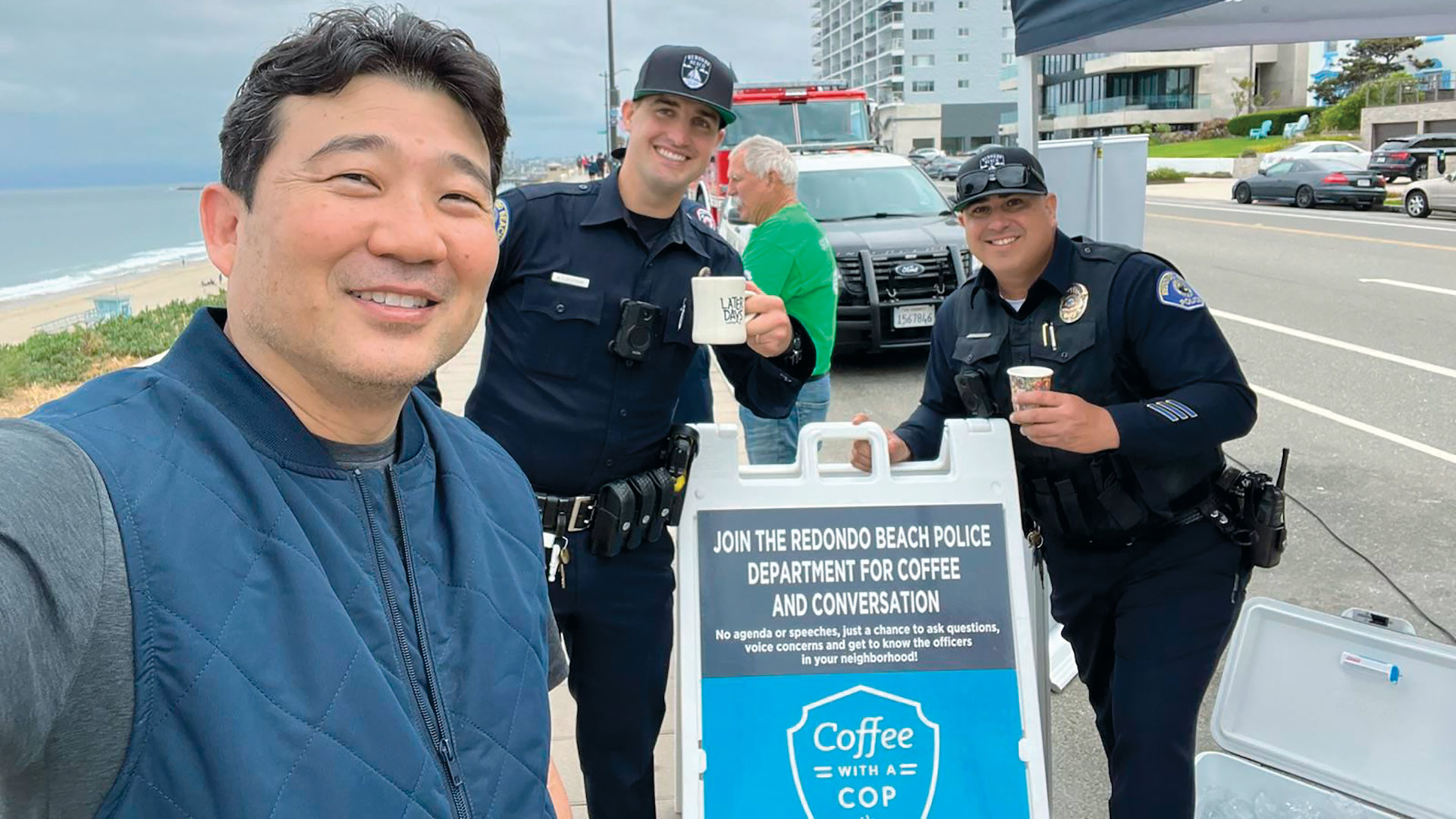
Coffee With a Cop events go a long way toward bringing the police and community together. (Redondo Beach, California, P.D.) (Mike Ishii)

The International Association of Chiefs of Police’s (IACP) official policy asserts that “trust and transparency between law enforcement agencies and the people they serve is vital to community stability, officer safety and effective policing.” While the concept looks good on paper, how does such a relationship come about, as it’s not likely to occur without intentionality and specific action steps?

A previous APB article from March (tinyurl.com/3uvkpax7) presented numerous evidence-based action steps developed by researchers, academics and governmental agencies, each one proven to positively enhance police–community relations.

Here, we offer some insights and guidance from authoritative law enforcement agencies, such as the IACP, which are dedicated to developing research-based solutions for some of the entrenched problems in this arena, as well as from individuals who have served in law enforcement leadership positions after having risen through the ranks, and who possess direct, real-world knowledge about such issues from the ground up.

There are many ways to define community policing — though it all ultimately boils down to what works for the locals.

One such expert in this area is Robert King, who is an APB contributor. He is a 30-year veteran of policing who retired as commander for the Portland Police Bureau (Oregon) before transitioning to an advisory role in the office of Mayor Ted Wheeler in April 2019, shortly before having to navigate months of widespread civil unrest that engulfed Portland after George Floyd’s death in 2020

Commander King’s 30-year career in public service has been rooted in a deep desire to support law enforcement officers and their families. He is involved on the board of Police-2-Peace (P2P), a national organization seeking to bridge the gaps between law enforcement agencies and their communities by implementing positive policing practices designed to foster understanding, cooperation and trust. Half of the P2P advisory board is comprised of retired and active law enforcement leaders.

Unfortunately, as King notes, there has been a steady erosion of trust in policing and the criminal justice system across the globe, as tracked by the Edelman Trust Barometer, a 20-year project created by an international team uniting the best minds in research, analytics and behavioral science, who’ve determined that in most of the democracies they studied, public institutions, including law enforcement, are trusted by less than half the population, including the U.S., where trust runs at about 43%.

King asserts that the first thing that needs to be addressed in improving police–community relations is building or rebuilding trust between both entities. “That also means across the various cultural identities of what community means. It’s everybody. It’s the young, old, white, Black, gay, straight, Christian, Muslim, Jew and LGBTQ.”

He explains that this also requires a very sincere and authentic approach on the part of LEOs. “A willingness to be vulnerable and to really want to do things that will make a difference for their community. Usually, that starts out with listening to the community’s concerns and listening-type sessions, such as Coffee With a Cop,” referring to the innovative program launched in Hawthorne, California, over a decade ago, where the local police department began looking for ways to interact more successfully with the citizens they served.

Coffee With a Cop events are now held in all 50 states and is one of the most successful community-oriented policing programs in the U.S. The key to Coffee With a Cop’s growing success is that it opens the door for interactions outside of the crisis situations that typically bring law enforcement and community members together.

Recently appointed as head of the DOJ’s Community Oriented Policing Services (COPS), Hugh T. Clements Jr., former chief of Providence, Rhode Island’s police department, brings over three decades of law enforcement experience to this nation’s primary resource for community policing. “The position is almost tailor-made for a police chief who’s done it in the field,” he notes. In Clements’ view, there are many ways to define community policing — though it all ultimately boils down to what works for the locals. “For a police department to be effective in their community, for them to have better outcomes, they have to be so connected to that community, they have to be engaged,” Clements explains.

Fresno P.D. Assistant Chief Burke Farrah speaks with a community member during Coffee With a Cop (Chris Cognac) (Chris Cognac)

Other nationally recognized leaders I interviewed stated that local agencies must do something about cops who consistently behave like bullies because this minority causes community members to view the entire force similarly. As a means of correcting behavior, such individuals should be mandated to attend evaluations and sessions with a police psychologist, for example.

They also stressed the importance of hiring the right candidates for the job to begin with. “You pick the people who are the brightest stars, those who, by their nature, are more interested in humanity and are more oriented toward community policing types of things.”

One foundational element that was reported was the degree to which favoritism and sycophancy play a role in internal promotional and selection processes, as this can negatively affect the morale and trust among the rank and file and, in turn, agency performance. De-escalation training was also cited. “It is a crucial need and a valuable investment. However, there should also be a next-level ‘non-escalation’ training modality that emphasizes ways that help prevent peace officers from knowingly or unknowingly escalating already tense situations.”

Some leaders also pointed out the value of local LE agencies aggressively working toward mirroring their community’s ethnic and sexual identity demographics, for example, via the DOJ-approved “30 by 30” initiative, to attain a 30% female sworn officer ratio by 2030. Additionally, achieving watermark standards, such as those created by the Commission on Accreditation for Law Enforcement Agencies, or CALEA (calea.org), demonstrates that a law enforcement agency is following national policing best practices.

Some of the LE leaders who were contacted for this article were far from optimistic about the prospects for improving police–community relations, and they seemed to feel that the enmity between cops and citizens has been so firmly entrenched over time that significant positive changes may be too far out of reach at this point.

That said, one concluding comment from King may serve to sum up what may be the most accessible and positive goals going forward. “People always like seeing when the police are willing to look critically at themselves and acknowledge mistakes, do things that are responsive to their concerns and do a better job in training, supervision, management and communications. That’s what they want to see — people want compassionate, accountable, transparent police work. That’s what they want.”


References

Coffee with a Cop. coffeewithacop.com/about.
Greg Friese, 9 memorable quotes on leading LEOs from the ‘What cops want’ webinar. tinyurl.com/zzkf736d. 
Police-2-Peace. tinyurl.com/yeyv9f69.
IACP Oath of Honor. tinyurl.com/k6dw8vwb.
Luke Barr, ABC News, “New DOJ chief talks importance of community policing.” tinyurl.com/ydvwv6eh.

Dr. Gene Ira Katz, DMCJ

Dr. Gene Ira Katz, DMCJ

Gene Ira Katz holds a doctorate in criminal justice management and authored the International Impact Award-winning book Reconsidering Criminal Justice and Law Enforcement. He has also written for Law Enforcement Today, Command, the US-China Law Review and other publications. A member of the IACP and the NSA, he regularly speaks at conferences, including the Academy of Criminal Justice Sciences, the Illinois Association of Chiefs of Police and the Stockholm Criminology Symposium, among others.

View articles by Dr. Gene Ira Katz, DMCJ

As seen in the May 2024 issue of American Police Beat magazine.
Don’t miss out on another issue today! Click below:


SUBSCRIBE TODAY!

Categories: Community

Primary Sidebar

Recent Articles

  • Train them to ask why
  • Nobody is coming to do it for you
  • Protecting America with the USA PATRIOT Act
  • The shift happens long before the resignation letter
  • Out of chaos comes opportunity
  • From warrior to peacekeeper
  • Pittsburgh mounted patrol officer helps inner-city kids saddle up
  • NLEOMF announces 2026 National Officer Safety and Wellness Award Winners
  • Could cadaver otters help close cold cases?
  • GOSAFE Technology announces public safety initiative focused on firearm security and risk reduction

Footer

Our Mission
To serve as a trusted voice of the nation’s law enforcement community, providing informative, entertaining and inspiring content on interesting and engaging topics affecting peace officers today.

Contact us: info@apbweb.com | (800) 234-0056.

  • Facebook
  • Instagram
  • Twitter

Categories

  • Editor’s Picks
  • On the Job
  • Labor
  • Tech
  • Training
  • Policy
  • Health/Wellness
  • Community
  • Offbeat
  • We Remember
  • Jobs and Careers
  • Events

Editor’s Picks

No two days are ever the same

No two days are ever the same

July 24, 2026

Training dipshittery, Part 2

Training dipshittery, Part 2

July 23, 2026

Tactical medicine for cops

Tactical medicine for cops

July 18, 2026

Why good cops quit

Why good cops quit

July 14, 2026

Policies | Consent Preferences | Copyright © 2026 APB Media, LLC | Website design, development and maintenance by 911MEDIA

Open

Subscribe

Close

Receive the latest news and updates from American Police Beat directly to your inbox!

  • This field is for validation purposes and should be left unchanged.