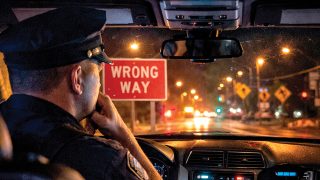
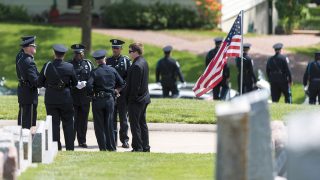
There, but for the grace of God, go I” is a phrase that invades many cops’ thoughts as they stand at attention, holding a salute in front of a church while a flag-draped casket of a fallen police officer passes before them — a poignant reminder of the dangers of their profession.
Among all the training police officers receive, the most important is survival training — to live to fight another day. Yet it doesn’t always work that way. The loss of an officer in the line of duty is a cold, cruel uppercut to the chin of every law enforcement officer.
How does a police officer process the loss and continue doing the job that killed their brother or sister? The police academy does not cover this, probably because there is no standard answer, and it cannot be taught. Everyone experiences loss differently. There is no right or wrong way to express grief. It is personal, with no rules and no training manual.
I am not a psychologist. I cannot explain how officers cope with line-of-duty deaths. I can only share my experiences. My department did not lose a single officer throughout the first 16 years of my 27-year career. Some suffered gunshot wounds and many other types of serious injuries, but there were no line-of-duty deaths. Sometimes I thought, “Wow, I just might get through this without losing friends.” Then, in 29 horrible minutes, from 9:59 a.m. to 10:28 a.m. on September 11, 2001, my department suffered 37 line-of-duty deaths.
Later that evening, the squad of cops I was with made our way to the department’s temporary command post. Upon arrival, I heard talk of dead cops. I couldn’t comprehend what I heard and thought, “No, we don’t lose cops, that doesn’t happen to us.” The names I heard were of people I knew, whom I worked with and counted on to ensure I made it home after each tour. How could they be gone?
Though the names and number of the dead were not yet fully known, a list of the missing was available. It was chilling to see my name and the names of the officers I was with on that list. In my denial, I even checked to see if I was really alive. I know that sounds bizarre, but what we went through, at least for me, was an unprecedented assault on my senses to the point of not thinking clearly.
Being at the site from the moment the first tower collapsed until late at night, I knew there would be many deaths, possibly even thousands, but I never considered the possibility of police being killed. Perhaps my mind was so focused on the tasks at hand that it didn’t allow me to think about our danger. Even today, I don’t have a clear picture of that day. I guess sometimes the mind protects in ways not meant for me to understand.
So does life return to normal? I am not sure about that. Based on my experience, I do know that life goes on. And that includes the “normal” things I do, but I always feel a part of me is missing. Of course, I miss our fallen, and that sadness and hurt have never left me. What, though, is missing is the invincibility I felt I always possessed.
As a cop, I would prefer to face a man with a gun rather than enter a burning building. Shortly after September 11, 2001, I responded to a fire in the upper reaches of a building. The fire department had not yet arrived when I asked if everyone was out of the building. I couldn’t get a positive response, so my partner and I searched up to the fire floor. At one point, I turned around and saw firefighters climbing the stairs. I immediately told them, “You guys got this, we’re out of here.” My sense of invincibility was gone; in my mind, this was a definite result of my experience. It’s not something I am proud of, but I recognized it as a reaction to my environment.
In the station house, every cop wore the same palpable sense of loss on their faces as I did. Due to the attacks on our country, the department, like many others, essentially went on a war footing. In the initial months, we worked 12-hour shifts with no time off. Every cop understood what their job entailed and how it changed dramatically, but what was not considered was the time to grieve.
Planning a single line-of-duty funeral is daunting for a department. However, planning 37 funerals is nearly an impossible task. Yet, 37 line-of-duty funerals were conducted. Unfortunately, this was not done with the overwhelming turnout usually seen. Many members never had the chance to thank or say goodbye to their friends, resulting in an unexperienced grieving process.
Grieving is an essential part of healing after suffering a loss. It helps us explore and understand our emotions as we seek a way to move on. It also allows us to cherish our appreciation for those we lost. Without grieving, at least in my experience, the hole created by the loss never closes. When I view a photo of a lost member of my department, emotions swell within me. My feelings are similar when I see a picture or video of the twin towers majestically looming over the New York City skyline. This sight transports me to another place and time, through a fog that continues in my life.
The effects on leadership were evident. The commanding officer of my command was killed in the attack. The command’s executive officer was elevated to the command position. It seemed like months before she attended a roll call. Then one day, the new commanding officer showed up at a day tour roll call with a copy of The New York Times. She informed the roll call that the newspaper reported our department suffered the most significant loss of life in a single incident in the history of American law enforcement. After stating that, she left the roll call, leaving cops and supervisors with dumbfounded expressions. It wasn’t the message that surprised us all; we were aware of that. It was the appearance of a leader who could not comprehend the command’s sense of loss and sadness. I couldn’t help but think of the shock she was dealing with.
The sacrifice continues for the department, with officers succumbing to 9/11 World Trade Center illnesses. The number of names on department memorials keeps increasing. This year, as in years past during National Police Week, more names of fallen Port Authority of New York and New Jersey police officers will take their places of honor on the granite walls of the National Law Enforcement Officers Memorial in Washington, D.C.
The young police officers in my department — some of whom were not even born at the time of the attacks on America — understand that tragedy and sacrifice are integral to their law enforcement lineage. They have had to navigate their early years while experiencing loss, much different than the start of my journey. They recognize that they work in the shadows of the 37 lost on September 11, 2001, and those who sacrificed their lives for others both before and afterward.
Law enforcement is a dangerous profession. Police officers work daily to protect others from dangers, selflessly risking their safety. When their work ends in a tragic line-of-duty death, the sorrow and pain affect everyone in the profession. Furthermore, awareness of the dangers they face has increased.
It is difficult to explain to someone outside the law enforcement profession the emotions officers experience when they lose one of their own. The best explanation of that experience I heard came from a fellow officer, who stated truthfully and personally: “They all died and went to heaven. We lived and went to hell.”

Bobby Egbert
As seen in the May 2025 issue of American Police Beat magazine.
Don’t miss out on another issue today! Click below: