
• Skip to primary navigation
  • Skip to main content
  • Skip to primary sidebar
  • Skip to footer
  • Home
  • About
  • The Magazine
  • Events
  • Partners
  • Products
  • Contact
  • Jobs and Careers
  • Advertise
  • Facebook
  • Instagram
  • Twitter
  • Subscribe
American Police Beat

American Police Beat Magazine

Law Enforcement Publication

  • Home
  • Leadership
    • Understanding the boundaries of professional relationships with the...
      Why you should lead from 30,000 feet
      Public perception and trust
      When performance reviews are a waste of time
      Taking a page from Toyota’s playbook
  • Topics
    • Leadership
      • Understanding the boundaries of professional relationships with the...
        Why you should lead from 30,000 feet
        Public perception and trust
        When performance reviews are a waste of time
        Taking a page from Toyota’s playbook
    • Editor’s Picks
      • Liability challenges in contemporary policing
        When performance reviews are a waste of time
        Proactive wellness visits
        Taking a page from Toyota’s playbook
        Law enforcement’s missing weapon
    • On the Job
      • Villains and heroes in the Big Apple
        Right place, right time — again
        Some good news on crime
        Mom-to-be named Cop of the Year
        Fatherly instincts save boy from icy water
    • Labor
      • The Promise Gap
        Cut the cops, save a dollar?
        Labor release under fire
        Who’s watching the watchmen?
        Crime and punishment (or lack thereof) in Seattle
    • Tech
      • New Mexico license plate readers save lives, lead to “precise...
        A modern field guide to understanding research in policing
        Gear that moves with you
        A new breed of cop car
        The future of patrol is here
    • Training
      • The five minutes before the ambulance
        Navigating danger
        Critical thinking in police training
        Threshold neuroscience
        Integrated virtual reality training
    • Policy
      • Corruption, collusion and impunity
        E-bikes spark public safety concerns
        Try racing without wheels
        Law enforcement accreditation: Why it matters
        Liability challenges in contemporary policing
    • Health/Wellness
      • Addressing stress, vicarious trauma and burnout
        Nervous system regulation
        The nature of the job
        Promoting organizational wellness
        Telling cops to get more sleep isn’t working
    • Community
      • Improving autism awareness
        Shop with a Cop
        Community engagement: What is it moving forward?
        Contradictory crossroads
        Back-to-school season brings out police support nationwide
    • Offbeat
      • An unexpected burglar
        Police humor only a cop would understand
        Not eggzactly a perfect heist
        Pizza … with a side of alligator?
        Wisconsin man charged with impersonating Border Patrol agent twice in...
    • We Remember
      • Heroes of the World Trade Center
        Forty heroes: United Airlines Flight 93
        The Pentagon
        A nation propelled to war, lives changed forever
        A Christmas loss
    • HOT Mail
      • The War on Cops Continues Unabated
  • On the Job
    • Villains and heroes in the Big Apple
      Right place, right time — again
      Some good news on crime
      Mom-to-be named Cop of the Year
      Fatherly instincts save boy from icy water
  • Labor
    • The Promise Gap
      Cut the cops, save a dollar?
      Labor release under fire
      Who’s watching the watchmen?
      Crime and punishment (or lack thereof) in Seattle
  • Tech
    • New Mexico license plate readers save lives, lead to “precise...
      A modern field guide to understanding research in policing
      Gear that moves with you
      A new breed of cop car
      The future of patrol is here
  • Training
    • The five minutes before the ambulance
      Navigating danger
      Critical thinking in police training
      Threshold neuroscience
      Integrated virtual reality training
  • Policy
    • Corruption, collusion and impunity
      E-bikes spark public safety concerns
      Try racing without wheels
      Law enforcement accreditation: Why it matters
      Liability challenges in contemporary policing
  • Health/Wellness
    • Addressing stress, vicarious trauma and burnout
      Nervous system regulation
      The nature of the job
      Promoting organizational wellness
      Telling cops to get more sleep isn’t working
  • Community
    • Improving autism awareness
      Shop with a Cop
      Community engagement: What is it moving forward?
      Contradictory crossroads
      Back-to-school season brings out police support nationwide
  • Offbeat
    • An unexpected burglar
      Police humor only a cop would understand
      Not eggzactly a perfect heist
      Pizza … with a side of alligator?
      Wisconsin man charged with impersonating Border Patrol agent twice in...
  • We Remember
    • Heroes of the World Trade Center
      Forty heroes: United Airlines Flight 93
      The Pentagon
      A nation propelled to war, lives changed forever
      A Christmas loss
  • HOT Mail
    • The War on Cops Continues Unabated
  • About
  • The Magazine
  • Events
  • Partners
  • Products
  • Contact
  • Jobs and Careers
  • Advertise
  • Subscribe
Search

On the Job

What’s with all the gear?

Dan and Lauren Kickert Published May 29, 2025 @ 10:26 am PDT

iStock.com/aijohn784

The beginning of policing and the first forms of policing can be debated to some degree; however, most of us would agree that modern-day policing started with Sir Robert Peel in London around 1829. This primitive police force carried, you guessed it, some primitive gear. The standard loadout of a Bobby in London at that time was a wooden truncheon, handcuffs, a wooden rattle to signal for help and an oil lantern for a light. If you think about it, it’s the modern-day equivalent of an ASP, handcuffs, a radio and a flashlight — the basic level of gear that the majority of us carry.

If you think about where the world was just shy of 200 years ago, it was a very different place. Back then in the U.S., there were only 24 states. Andrew Jackson had just been elected as the seventh president, slavery was still 45 years away from being abolished and women still had almost 100 years before they could vote. This country and the world were very much a different place. Thinking about how different things were back then, it begs the question: why does the gear we carry serve the same purpose as it did way back then? The answer lies in a sad, simple truth: human nature. No matter the changes in policy, advancements in technology or breakthroughs in science, human nature remains very much the same.

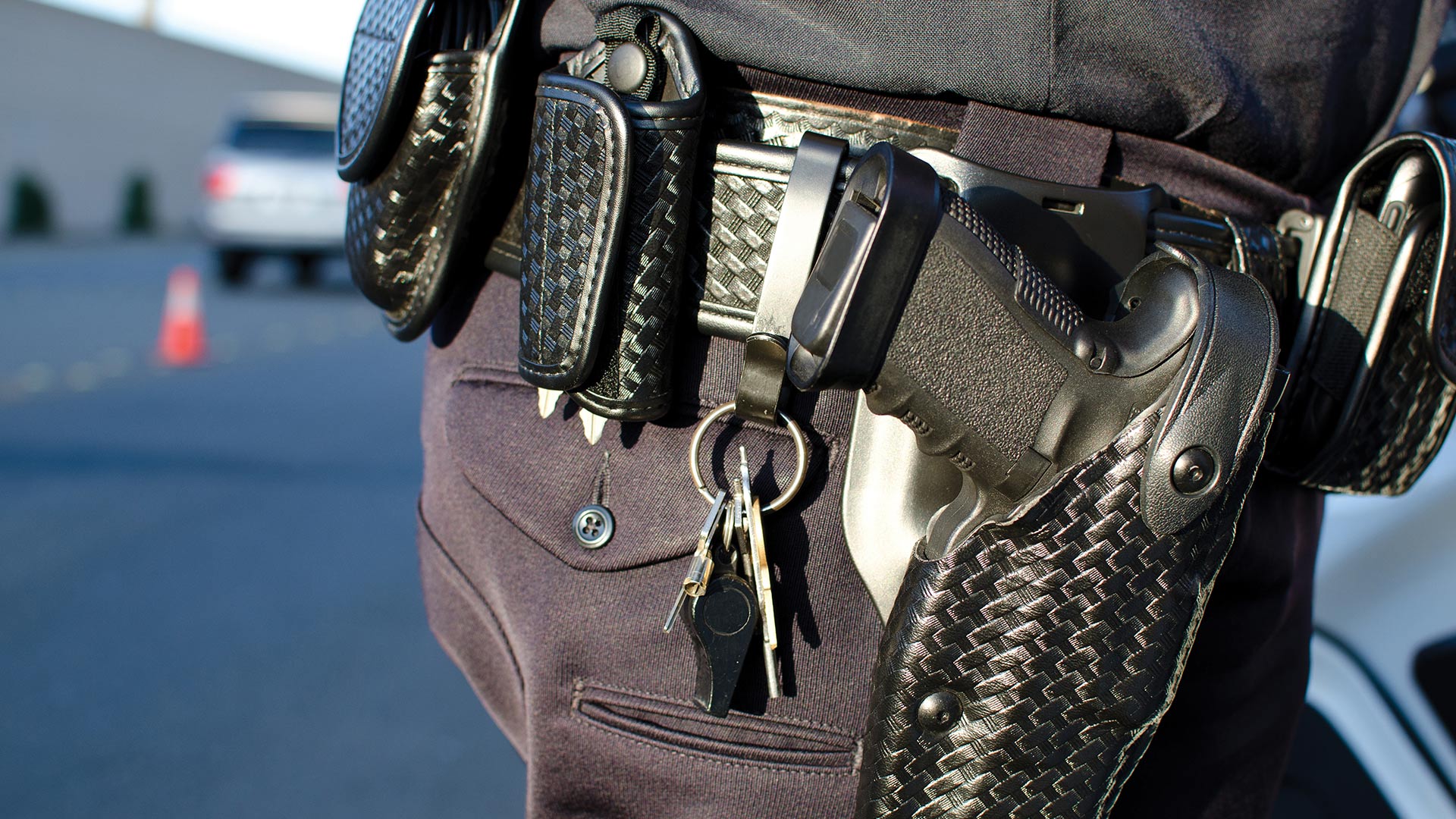
So let’s take a look at some of the gear we currently carry, where we carry it and, most importantly, why we carry it. We know that some of you carry gear because you have to or it’s mandated by agency policy. So let’s look at possibilities as to why your agency mandates you to carry what you carry. We all carry guns, and that could be an entirely different article. With that being said, we both carry Zev OZ9 Duty pistols. They take the same magazines as a Glock 17, offering interchangeability with many other officers in their area; accept Glock Gen 3 parts, which are readily accessible; and we prefer the ergonomics over those of a Glock. We all also carry knives and flashlights (which we have discussed in previous articles), Tasers and radios, which are typically issued by agency.

The best, most expensive piece of gear in the world is worthless if you cannot get to it when you need it.

So let’s talk about everything else we carry. We both carry an ASP baton directly behind our duty guns. We have carried 36-inch hickory sticks, or synthetic batons; however, unless you know you’re going to a shit show, you usually don’t have it with you. The ASP is on your belt and ready to go. Dan tried carrying a Monadnock expandable baton because he liked the idea of their “power tip,” but he needed to break a vehicle window to render aid in a serious car crash, and the Monadnock would not break the window. An assisting officer from another agency arrived on scene with a rescue hammer to break the window. Let’s be honest with ourselves — how many times have we actually used our batons as impact weapons, versus how often we’ve used them to break windows? Dan threw his Monadnock in the middle of the street and left it there after that incident. We need to make sure we are honest with ourselves about why we carry a particular piece of equipment and ensure that the equipment serves its true purpose.

In the last few years, most of us have also started carrying tourniquets. There is no argument that they save lives, but let’s just make sure we know when to use them. We have been on the scene of a shooting and watched an officer place tourniquets on both arms and both legs of a “victim.” The victim sustained gunshot wounds to all his extremities; however, none of the wounds resulted in an arterial bleed. None of those wounds required a tourniquet. After ensuring you know when to use a tourniquet, we need to make sure we know what types of tourniquets are best suited for what applications. The C-A-T 7 and the SOF Tourniquet are extremely simple to use for self-aid, and are simple to apply to someone else, even if you are wounded. However, they present some issues if you try to apply them to a small child or even some extremely small adults. The SWAT-T Tourniquet is undoubtedly more difficult to place on yourself or utilize while wounded; however, it can be cut in half and used on smaller people. Ideally, if you plan on carrying a tourniquet, you should plan on investing in at least one of each type.

Handcuffs are a must but are often restricted by agency policy. The final tips we have to offer are to get as much gear off of your belt as possible and get it on your vest. Taking weight off of your belt will prevent future back and hip issues, which is important in the long run. However, and honestly more importantly, it helps keep your gear closer to the center of your body. This will aid you in getting your gear quicker, and it will make it accessible to both hands. This means you can grab a pair of cuffs, your light or reload with either your right or left hand. Most of us have done training with some kind of simunitions and know gloves are a must because you typically get shot in the hands. The best, most expensive piece of gear in the world is worthless if you cannot get to it when you need it.

Dan and Lauren Kickert

Dan and Lauren Kickert

Dan Kickert has been a police officer in the south suburbs of Chicago for 20 years. He currently serves the City of Chicago Heights Police Department as a patrol officer. He has served with two other agencies in the past and was assigned to the South Suburban Major Crimes Task Force as a homicide detective. He has also served as a field training officer, department armorer, range master, tactics instructor, juvenile officer and many other roles.

Lauren Kickert has been a police officer for nine years. She currently serves with the Grant Park, Illinois, Police Department and has served with two other agencies in the past. She finished her master’s degree in criminal social justice at Lewis University in Romeoville, Illinois. She has served as a crisis intervention team officer, an accident reconstructionist, a juvenile specialist and in firearms training, in addition to volunteering her time to coordinate events such as the National Night Out Against Crime and Cop on Top fundraisers for the Special Olympics of Illinois.

View articles by Dan and Lauren Kickert

As seen in the May 2025 issue of American Police Beat magazine.
Don’t miss out on another issue today! Click below:


SUBSCRIBE TODAY!

Categories: On the Job

Primary Sidebar

Recent Articles

  • Heroes of the World Trade Center
  • The Promise Gap
  • Corruption, collusion and impunity
  • The five minutes before the ambulance
  • New Mexico license plate readers save lives, lead to “precise policing”
  • Addressing stress, vicarious trauma and burnout
  • Understanding the boundaries of professional relationships with the boss
  • E-bikes spark public safety concerns
  • Improving autism awareness
  • Cut the cops, save a dollar?

Footer

Our Mission
To serve as a trusted voice of the nation’s law enforcement community, providing informative, entertaining and inspiring content on interesting and engaging topics affecting peace officers today.

Contact us: info@apbweb.com | (800) 234-0056.

  • Facebook
  • Instagram
  • Twitter

Categories

  • Editor’s Picks
  • On the Job
  • Labor
  • Tech
  • Training
  • Policy
  • Health/Wellness
  • Community
  • Offbeat
  • We Remember
  • Jobs and Careers
  • Events

Editor’s Picks

Liability challenges in contemporary policing

Liability challenges in contemporary policing

February 27, 2026

When performance reviews are a waste of time

When performance reviews are a waste of time

February 26, 2026

Proactive wellness visits

Proactive wellness visits

February 25, 2026

Taking a page from Toyota’s playbook

Taking a page from Toyota’s playbook

February 23, 2026

Policies | Consent Preferences | Copyright © 2026 APB Media, LLC | Website design, development and maintenance by 911MEDIA

Open

Subscribe

Close

Receive the latest news and updates from American Police Beat directly to your inbox!

  • This field is for validation purposes and should be left unchanged.


