• Skip to primary navigation
  • Skip to main content
  • Skip to primary sidebar
  • Skip to footer
  • Home
  • About
  • The Magazine
  • Events
  • Partners
  • Products
  • Contact
  • Jobs and Careers
  • Advertise
  • Facebook
  • Instagram
  • Twitter
  • Subscribe
American Police Beat

American Police Beat Magazine

Law Enforcement Publication

  • Home
  • Leadership
    • Clarifying your “true north”
      The job has changed — have you?
      Perpetual recognition of line-of-duty deaths
      Understanding the boundaries of professional relationships with the...
      Why you should lead from 30,000 feet
  • Topics
    • Leadership
      • Clarifying your “true north”
        The job has changed — have you?
        Perpetual recognition of line-of-duty deaths
        Understanding the boundaries of professional relationships with the...
        Why you should lead from 30,000 feet
    • Editor’s Picks
      • Smile and let them swing
        The job has changed — have you?
        The days that follow
        Perpetual recognition of line-of-duty deaths
        Let’s get moving!
    • On the Job
      • K-9 officer turns children’s book author
        K-9 Day demonstrates scope of officers’ duties
        Testing the waters — literally
        Frankpledge to forensics: A brief history of law enforcement
        Villains and heroes in the Big Apple
    • Labor
      • Smile and let them swing
        The Promise Gap
        Cut the cops, save a dollar?
        Labor release under fire
        Who’s watching the watchmen?
    • Tech
      • NYC’s electric vehicle fleet for LE passes milestone
        New Mexico license plate readers save lives, lead to “precise...
        A modern field guide to understanding research in policing
        Gear that moves with you
        A new breed of cop car
    • Training
      • Rules or results?
        Enhance your preparedness
        Good enough never is
        Pushback as a training signal
        Let’s get moving!
    • Policy
      • Police and local government leaders join forces to build community...
        Police pause license plate readers
        Corruption, collusion and impunity
        E-bikes spark public safety concerns
        Try racing without wheels
    • Health/Wellness
      • The days that follow
        Addressing stress, vicarious trauma and burnout
        Nervous system regulation
        The nature of the job
        Promoting organizational wellness
    • Community
      • Cops promote National Donate Life Month
        Police officer kicks up social media praise
        Donning denim in solidarity with victims and survivors of sexual...
        Improving autism awareness
        Shop with a Cop
    • Offbeat
      • “Teenage Mutant Ninja Deer” rescued
        An unexpected burglar
        Police humor only a cop would understand
        Not eggzactly a perfect heist
        Pizza … with a side of alligator?
    • We Remember
      • The sacrifice continues
        A Tribute to Fallen Heroes
        Markers of service and remembrance
        Tragedy strikes Baker to Vegas
        Heroes of the World Trade Center
    • HOT Mail
      • The War on Cops Continues Unabated
  • On the Job
    • K-9 officer turns children’s book author
      K-9 Day demonstrates scope of officers’ duties
      Testing the waters — literally
      Frankpledge to forensics: A brief history of law enforcement
      Villains and heroes in the Big Apple
  • Labor
    • Smile and let them swing
      The Promise Gap
      Cut the cops, save a dollar?
      Labor release under fire
      Who’s watching the watchmen?
  • Tech
    • NYC’s electric vehicle fleet for LE passes milestone
      New Mexico license plate readers save lives, lead to “precise...
      A modern field guide to understanding research in policing
      Gear that moves with you
      A new breed of cop car
  • Training
    • Rules or results?
      Enhance your preparedness
      Good enough never is
      Pushback as a training signal
      Let’s get moving!
  • Policy
    • Police and local government leaders join forces to build community...
      Police pause license plate readers
      Corruption, collusion and impunity
      E-bikes spark public safety concerns
      Try racing without wheels
  • Health/Wellness
    • The days that follow
      Addressing stress, vicarious trauma and burnout
      Nervous system regulation
      The nature of the job
      Promoting organizational wellness
  • Community
    • Cops promote National Donate Life Month
      Police officer kicks up social media praise
      Donning denim in solidarity with victims and survivors of sexual...
      Improving autism awareness
      Shop with a Cop
  • Offbeat
    • “Teenage Mutant Ninja Deer” rescued
      An unexpected burglar
      Police humor only a cop would understand
      Not eggzactly a perfect heist
      Pizza … with a side of alligator?
  • We Remember
    • The sacrifice continues
      A Tribute to Fallen Heroes
      Markers of service and remembrance
      Tragedy strikes Baker to Vegas
      Heroes of the World Trade Center
  • HOT Mail
    • The War on Cops Continues Unabated
  • About
  • The Magazine
  • Events
  • Partners
  • Products
  • Contact
  • Jobs and Careers
  • Advertise
  • Subscribe
Search

On the Job

Pursuing investigations into overdose deaths

Keven Hendricks Published November 19, 2022 @ 6:00 am PST

iStock.com/Stas_V

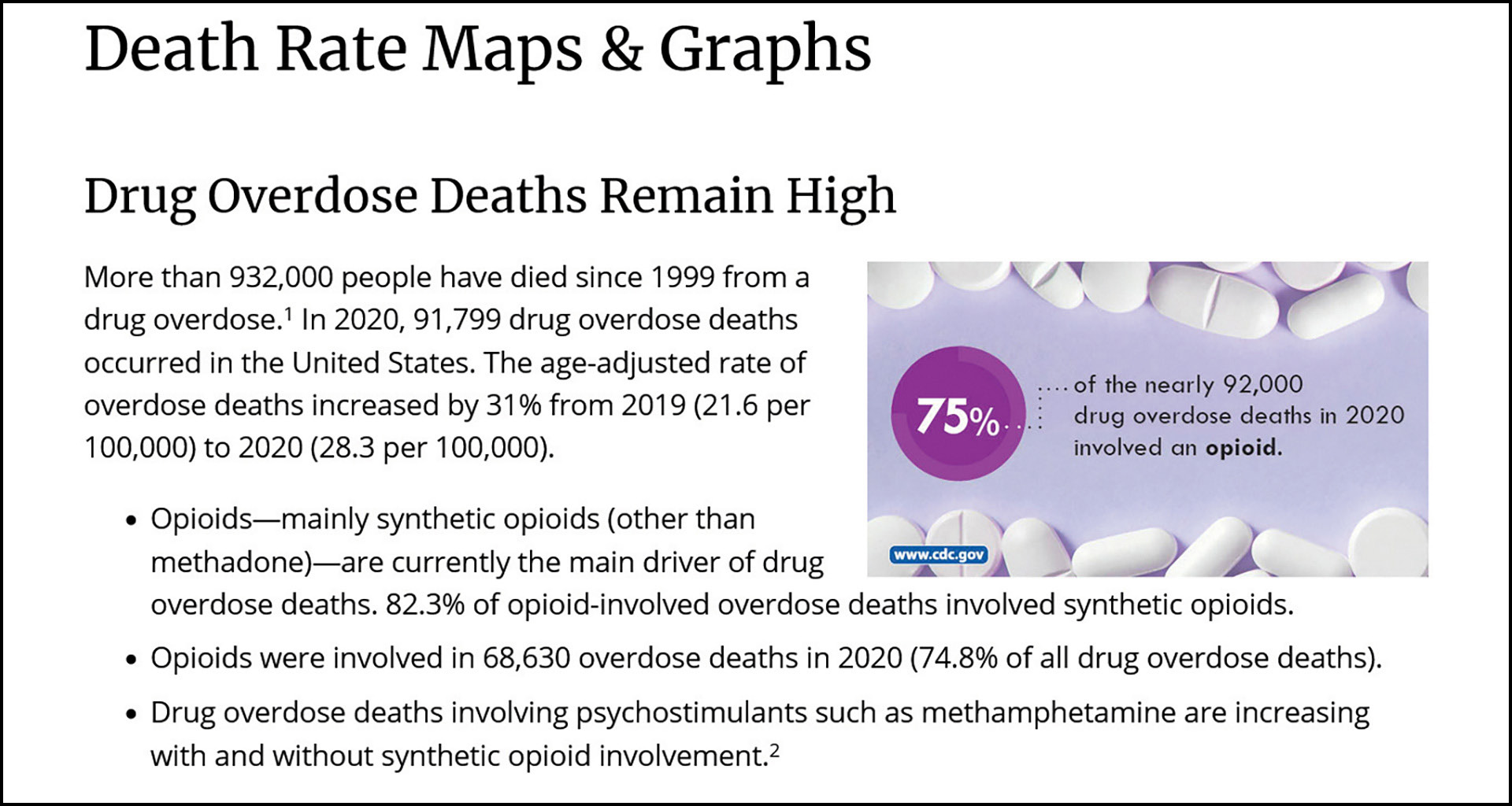
For the past two years, the United States has seen the most overdose deaths in history, with estimations showing over 100,000 overdose deaths occurring in 2020 and 2021. When it seemed like our country overcame the scourge of the pharmaceutical industry flooding patients with opioids, we now sit on the precipice of something far worse: the fentanyl scourge. For us in law enforcement, Narcan deployments evolved from something seldom used by EMS personnel to a common occurrence during a shift, deployed now by responding officers. The opioid epidemic is back — worse than before — and the body count is only rising. The question I ask is, “Are we in law enforcement doing enough?”

That may not be an easy question to answer. Whether you view it as rhetorical or philosophical, the answer is unequivocally “No.” When I teach law enforcement officers across the country, I can see their eyes rolling or heavy exhales when I bring up overdose deaths. You may see political pundits blaming policies from our elected officials as a reason fentanyl is so prevalent, and you may have your own views as to why the statistics are so harrowing. But the metric nobody talks about is that from those approximated 100,000 overdose deaths we saw in our country each of the past two years, how many of those deaths were investigated? After scouring the depths of Google to find a concrete answer, the collective consensus is an average of less than 1%.

Earlier in 2022, four people were charged with the overdose death of actor Michael K. Williams (tinyurl.com/yz6be57u) — a phenomenal case worked by the NYPD in tandem with Homeland Security Investigations. 

In April 2022, a man was sentenced for the overdose death of rapper Mac Miller, one of three people originally charged
(tinyurl.com/3z4z2sdk). 

In 2019, a former Los Angeles Angels communications director was charged for the overdose death of pitcher Tyler Skaggs
(tinyurl.com/52sxabhm). 

To the lay observer, it would seem only when a person of wealth or status perishes from an overdose does law enforcement care. But the truth is, every overdose death can be investigated to the same degree. While federal partners like the DEA, HSI, FBI and FDA-OCI are often involved in cases surrounded by publicity, the reality is that state, local and tribal law enforcement (SLTT) are the ones responding to the overdose calls. 

How these calls are handled from the onset is key. Do we view overdose calls as medical calls, or do we view them as crime scenes? Are we looking to clear up, or are we looking for evidence to help further an investigation? 

Why do overdose death investigations harbor such a stigma? Perhaps it’s the perception about overdoses or substance abuse in the first place. For us in law enforcement, do we even view those who die from overdoses as “victims?” If somebody is killed by gunfire, regardless of if the homicide victim was involved in some criminal activity, an investigation is launched in full force. A crime scene is secured, evidence is processed … we have shows like The First 48 on A&E that celebrate this process. And yet, when officers respond to an overdose death, why isn’t the same protocol followed? 
CDC.gov overdose deaths

My first suggestion is that we should be looking for evidence. The most apparent: the deceased’s cell phone. A case that I was personally involved with came from a local detective analyzing an overdose victim’s cell phone, which led to intelligence regarding a local dealer who had purchased the fake Oxycodone pills from a dark web vendor (tinyurl.com/yvs4zc97). Most departments have direct access to phone-analytic tools in-house, but for those that don’t, federal partners like the DEA, HSI and FBI can directly assist in cases involving overdoses. 

Since 2016, states across the country have been enacting laws to help assist in overdose liability prosecution (tinyurl.com/5f4ksfzd). However, even if a specific state does not have a de facto liability statute for overdoses, the federal codes can still take precedence. With the Drug Enforcement Administration’s new harm reduction approach to the overdose epidemic (tinyurl.com/jfem5965), federal partners are at the ready to assist in overdose death cases. But in order for there to be any type of involvement from federal partners, the SLTT first responders must be looking into the overdose death in the first place!

Something I feel is the most important and overlooked tool that law enforcement has at its disposal is the ability to talk to people. Whether it’s a friend of the overdose victim, a family member or if the overdose victim is able to be revived, so much actionable intelligence can be gained just from having the compassion to ask questions in the first place. 

In New Jersey, we enacted the Overdose Protection & Legal Immunity Act (tinyurl.com/thz38mwt) in 2013, which provides immunity from arrest, prosecution or conviction for use or a simple possession drug charge when a person, in good faith, seeks medical assistance for themselves or for another. 

Those who may find themselves in the midst of an overdose need not fear facing criminal charges for the possession and consumption of the narcotic. Quintessentially, these overdose victims or bystanders/partakers can be interviewed with impunity for their actions. Talking to law enforcement may prove to be a cathartic moment for them and help hold those who may have sold them fentanyl-laced drugs accountable. 

While I will humbly admit that my expertise lies with cybercrime and the dark web, this begs the question: “How many overdose deaths have a nexus to the dark web?” 

The answer: We don’t know. 

The reason: We aren’t looking or asking the questions. This is relative to the message I am espousing: We need to do more. Recently, the notorious “Alphabay” administrator DeSnake boasted his “harm reduction” campaign on Alphabay by employing secret shoppers to find fentanyl products (tinyurl.com/mt4mtndv). 

I will share with you that in 2018, I lost a very close friend to narcotics, who had purchased drugs off the dark web. The local police that responded did not look into their death beyond chalking it up as another overdose death to add to the statistics. They deserved better. All 100,000-plus overdose victims deserve the same treatment as Michael K. Williams, Mac Miller and Tyler Skaggs. I promise that unless we have the wherewithal to take these cases on, the statistics will get worse before they get better.

Keven Hendricks

Keven Hendricks

Keven Hendricks is an 18-year law enforcement veteran serving on FBI and DEA task forces combating cybercrime. He is a published author with the FBI Law Enforcement Bulletin and is currently working as an instructor for various training companies, teaching classes for law enforcement on the dark web and cybercrimes. He is recognized as a subject-matter expert in the field of dark web investigations and the founder of the Ubivis Project (ubivisproject.org).

View articles by Keven Hendricks

As seen in the November 2022 issue of American Police Beat magazine.
Don’t miss out on another issue today! Click below:


SUBSCRIBE TODAY!

Categories: On the Job

Primary Sidebar

Recent Articles

  • Cheektowaga P.D. boosts patrol efficiency with Patrolfinder
  • “Teenage Mutant Ninja Deer” rescued
  • NLEOMF announces April 2026 Officers of the Month
  • Rules or results?
  • The sacrifice continues
  • Enhance your preparedness
  • K-9 officer turns children’s book author
  • Police and local government leaders join forces to build community trust
  • K-9 Day demonstrates scope of officers’ duties
  • Cops promote National Donate Life Month

Footer

Our Mission
To serve as a trusted voice of the nation’s law enforcement community, providing informative, entertaining and inspiring content on interesting and engaging topics affecting peace officers today.

Contact us: info@apbweb.com | (800) 234-0056.

  • Facebook
  • Instagram
  • Twitter

Categories

  • Editor’s Picks
  • On the Job
  • Labor
  • Tech
  • Training
  • Policy
  • Health/Wellness
  • Community
  • Offbeat
  • We Remember
  • Jobs and Careers
  • Events

Editor’s Picks

Smile and let them swing

Smile and let them swing

May 16, 2026

The job has changed — have you?

The job has changed — have you?

May 15, 2026

The days that follow

The days that follow

May 11, 2026

Perpetual recognition of line-of-duty deaths

Perpetual recognition of line-of-duty deaths

May 10, 2026

Policies | Consent Preferences | Copyright © 2026 APB Media, LLC | Website design, development and maintenance by 911MEDIA

Open

Subscribe

Close

Receive the latest news and updates from American Police Beat directly to your inbox!

  • This field is for validation purposes and should be left unchanged.