
We are now on the fourth of five total factors that, if implemented, can influence your performance during high-risk, low-frequency events. Hopefully, you have been able to gain some understanding regarding the overall training concept and its goal. The last three articles introduced you to the speed, internal and external factors that can make a noticeable difference in your ability to perform at higher levels when utilized within a structured training program. Adding these factors to your training regimen will fundamentally increase your ability to prevail during high-stress situations encountered in the field. Once you have implemented all five factors listed below, the highest training-to-performance benefit will be readily achievable.
- Speed factors
- Internal factors
- External factors
- Learning factors
- Application factors
Now, it is time to focus our attention on the three learning factors that can help you increase your chances to prevail in situations that require top-tier performance. But first, let us start with a question.
Knowing your learning style will change the game in your ability to capture and retain information at increased levels.
Do you know your specific learning style?
If not, you should. Knowing your learning style will change the game in your ability to capture and retain information at increased levels. This, in turn, will help you improve your on-duty performance with increased information absorption and retention. Identifying your learning style is not difficult. There is a plethora of websites that offer free learning style tests (do a Google search with the keywords “learning style test.”) These tests will give you an understanding of how you can better comprehend and retain information. Just set a few minutes aside to take the online test, and if you believe the results are accurate, you will be on your way to increased learning and performance. The free website I utilize offers a 20-question test and breaks down learning styles by percentage. It also gives you an in-depth narrative to help
you confirm the results (https://bit.ly/3LBvdHs).
The following result is my actual learning style breakdown from the online test:
- 50% Tactile
- 35% Visual
- 15% Auditory
What this means is that I am a “hands-on” learner. I need to “do it for myself” if I want to comprehend the tactic or technique at my highest level of learning. Additionally, I want you to notice that each learning style has a percentage attached to it. We can all learn from any one of the three learning styles. However, it is much easier for us to comprehend the information if it is received in the learning style that we have the highest percentage. As you can see, I can also capture information in a visual format (35% — think videos or visual demonstrations), but it will never be as beneficial as learning in tactile form. Additionally, if I want to comprehend the information at the highest level I can ever hope to possibly achieve, then I would want to capture the information in a visual and tactile format (50% + 35% = 85% — think videos and then transitioning immediately to hands-on learning). If I can learn in those two formats in a single training session, I can be sure that my learning will be at its absolute peak.
If I had tested out at 50% auditory, I would most likely be able to comprehend the information and grasp the technique by just hearing it explained to me. I would not necessarily need to have it taught to me in a “hands-on” format. Again, comprehension and retention will depend on your specific learning style and percentages. Each learning style is broken down a little later in this article. I just wanted to give you an overview of how knowing your learning style can help you tremendously in training, which will directly translate to performance on duty.
Anything above 50% in a specific learning style equates to a high learner in that category. For example, I had a student who scored 70% in visual learning. And it was obvious he was a high visual learner. He sat in the front of the class and did not take his eyes off me even while I was teaching and moving about the room. If he lost visual contact during a highly complex lesson, he would have had a lot of trouble connecting the dots and comprehending the information. As an instructor, it can be a little awkward (and comical) to glance at a student and notice that every time you look at them, you lock eyes as they are intensely staring right back at you. But I digress …
Let us jump into each of the learning styles and find out how it can translate to increased learning.
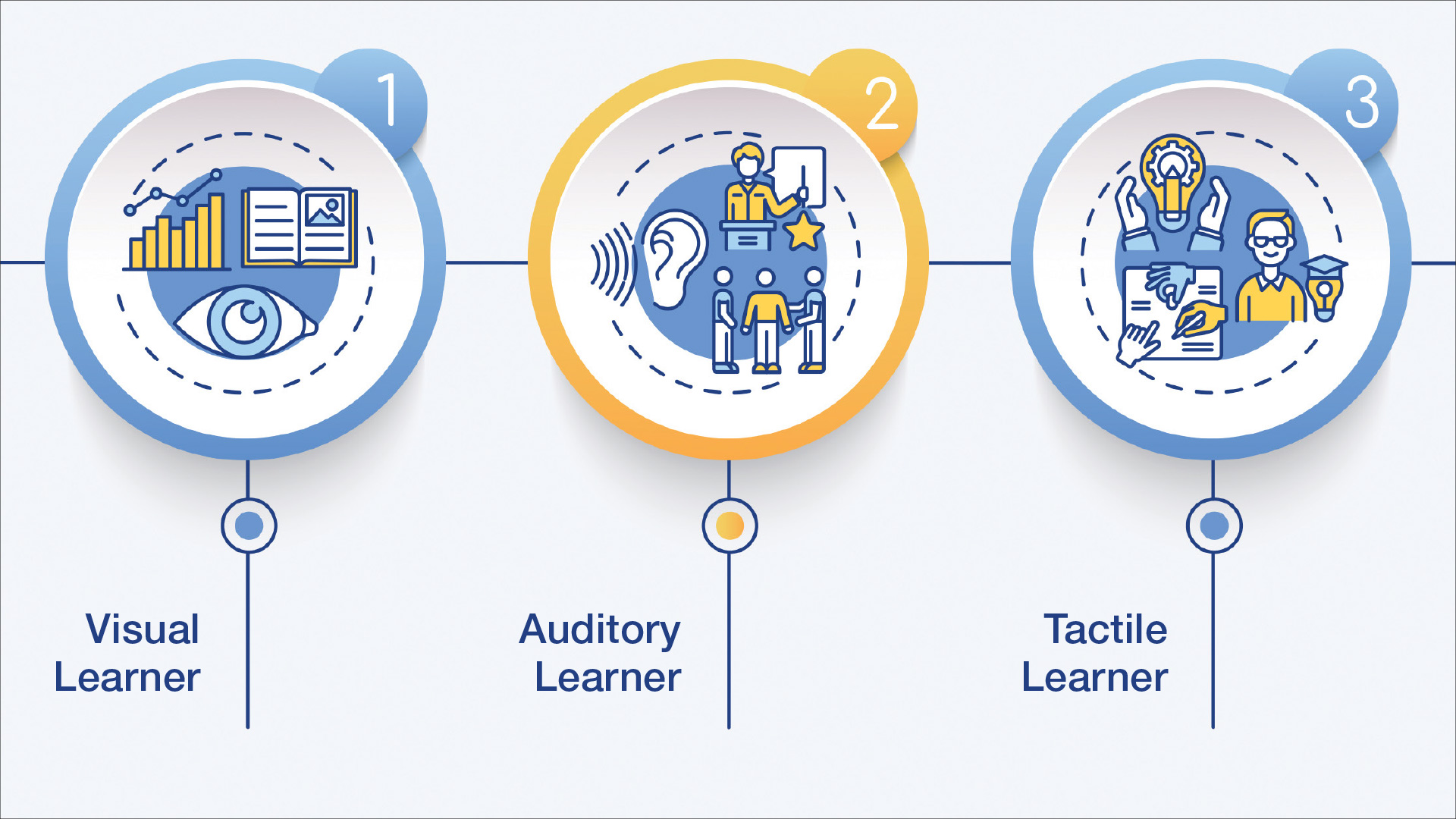
Auditory. This learning style obviously benefits most from audio learning. So, if you test out as an audio learner and can capture information in a clear, concise, verbal/audio delivery, you will be able to absorb most of the information that is being presented without necessarily needing to have it presented in any other format.
It is surprising how much a high audio learner can capture without ever looking at the presentation. I have personally observed high audio learners staring at a computer or phone screen for at least 15 minutes while I am teaching a certain topic and still being able to recite specific information about the topic when questioned. As a matter of fact, that is how I can identify a high audio learner. If they constantly appear to be distracted (looking at their phone or computer or even texting) but can answer my topic questions, I am confident they will test out as a high audio learner. For the most part, high audio learners can absorb almost all auditory information presented to them because they are literally
“all ears.”
Visual. As you would assume, visual learners learn best when they can see the information being presented. As mentioned above, high visual learners can be identified by certain actions. These actions are not absolute but pretty accurate. It is all about clear visuals, so avoiding visual obstructions during a presentation is very important to a high visual learner. That is why you may find yourself choosing to sit near the front of the classroom (to minimize visual obstructions). As a high visual learner, you will notice that you must keep an eye on the instructor to be able to absorb most of the information during a lecture. You also capture a lot more information if it is presented by way of videos, pictures and other visual aids within the learning environment. When I teach firearm courses, I will intentionally add large physical movements, visual gestures and detailed props as part of my presentation to ensure information absorption is high for the visual learner.
Tactile. This learning style relies heavily upon a “hands-on” type of instruction. It is crucial for tactile learners to have information delivered in a way that allows them to “do it for yourself.” Therefore, hands-on activities are a must for high-tactile learners. Increased absorption rates will occur when you participate in activities that allow you to move and physically interact during the training session. For example, if I were to sit down at a computer and attempt to teach you how to navigate the home screen on a Windows-enabled PC, the first thing you would need to do is move me out of the chair. Then, you would have to sit down and get your “hands on” the mouse. Finally, you would have to “do it for yourself” and personally move the mouse around to learn how to navigate the home screen. This is the most effective learning format for tactile learners to be successful during a training session. Although hands-on learning can be time-consuming (depending on the tactic or technique being learned), it is the only way a high-tactile learner can absorb the most amount of information during a training session.
Now, if you have a balance of all three learning styles (say 35%, 35% and 30%), then you can learn through any one of the three. However, you will notice that you typically need to utilize two of the three learning styles in order to achieve a higher level of absorption during the learning episode. Your specific balance of percentages will also play into which two you need to lean on for increased comprehension.
Hopefully, I was able to relay the importance of knowing your personal learning style and percentages. If you intentionally utilize the learning factors, coupled with the other factors, I can guarantee you an increase in performance. If you consider the logic behind identifying your learning style and then implementing a learning program that caters to your highest learning potential, the outcome is clear… increased performance.
That was a brief breakdown of the learning factors that influence performance. Stay tuned for the next installment that will round out all five factors that increase performance. Thank you for continuing to allow me to relay my thoughts in print and online. If you have any questions, please get in touch. Until then, #staysafe and #stayready.

Clint Armitage
As seen in the November 2023 issue of American Police Beat magazine.
Don’t miss out on another issue today! Click below:




