This will be the last time he pulls his car into the school parking lot. It has been two weeks since he walked the narrow halls and one hour since he uploaded his manifesto. The morning sun shines through the windshield of his aging sedan, illuminating the rifle between his legs. The backpack of homemade improvised devices sits to his right. Years of thought and months of preparation have led him to this day. The head-mounted camera is now livestreaming. It is 9:45 in the morning, class is in session and he is walking into the building.…
The active shooter scenario is still one of the most spontaneous, chaotic and unpredictable crisis responses a law enforcement officer will face. Preparation and training aside, there is a fog associated with crisis response that slows decision-making and is managed very differently from person to person. The time needed to filter available information when audible or visual cues are not immediately identifiable causes further delay and has led to catastrophic consequences for first responders and citizens. To cut through the fog of uncertainty, law enforcement requires precise intelligence, not just more information. The challenge is collecting and giving that intelligence to first responders — quickly and accurately. Fortunately, technology and tactical innovations are on the precipice of enhancing the tactical capabilities of law enforcement in the future by rapidly accessing, filtering and giving actionable intelligence to first responders in real time.
The wicked problem
A study in 2022 by J. Pete Blair and Aaron Duron in Police Journal found that “a police officer is shot in one out of every six active shooter events in the United States.” Today’s suspects, raised on active shooter drills, are escalating the pace of their assaults and strategically ambushing responding officers, who must rush to the scene with limited to no information, instead looking for visible cues upon arrival and formulating a plan. Moving to the sound of gunfire to make it stop is the mantra of active shooter response scenarios. Speed is necessary in this type of crisis response, and without actionable intelligence, officers can be at a significant disadvantage.
In 2018 at the Borderline Bar and Grill in Ventura, California, Sergeant Ron Helus was killed by a lone shooter who used video surveillance to ambush him as he rushed to enter the building to aid victims of a mass shooting. In March 2023, the Covenant School in Nashville, Tennessee, was attacked by a lone shooter. In this assault, the suspect was firing on responding officers from an elevated position, allowing a small team of officers to swiftly find and neutralize the suspect within four minutes. Just two weeks later, a mass shooting at Old National Bank in Louisville, Kentucky, saw officers again quickly respond to an active shooting only to be ambushed through lobby glass, resulting in a critical injury to Officer Nicholas Wilt. In each assault, the suspects expected the arrival of law enforcement, and the information available to officers was limited and stale until they arrived at the scene.
This shift in suspect tactics, particularly the increased risk of ambush upon arrival when officers lack accurate information, underscores the urgent need to use real-time intelligence in crisis response. Providing real-time intelligence is a significant tactical advantage for law enforcement officers in these chaotic and rapidly evolving scenarios. Read a debrief on any recent active shooter crisis response and think about how real-time intelligence opportunities could have enhanced the safety of the officers responding while increasing the speed and precision of that response. Imagine a future where early identification systems immediately alert law enforcement and potential victims to a threat and take autonomous actions to slow the suspect while directing law enforcement precisely to the suspect’s location. The evolving real-time crime center of the future will do just that.

Crisis response in real time
Real-time crime centers (RTCCs) have made great strides since New York launched the first real-time network of CCTV cameras in 2005 as a response to 9/11. Today they are being adopted and enhanced throughout the nation. According to the National Real Time Crime Center Association, there are more than 150 operational RTCCs as of 2024.
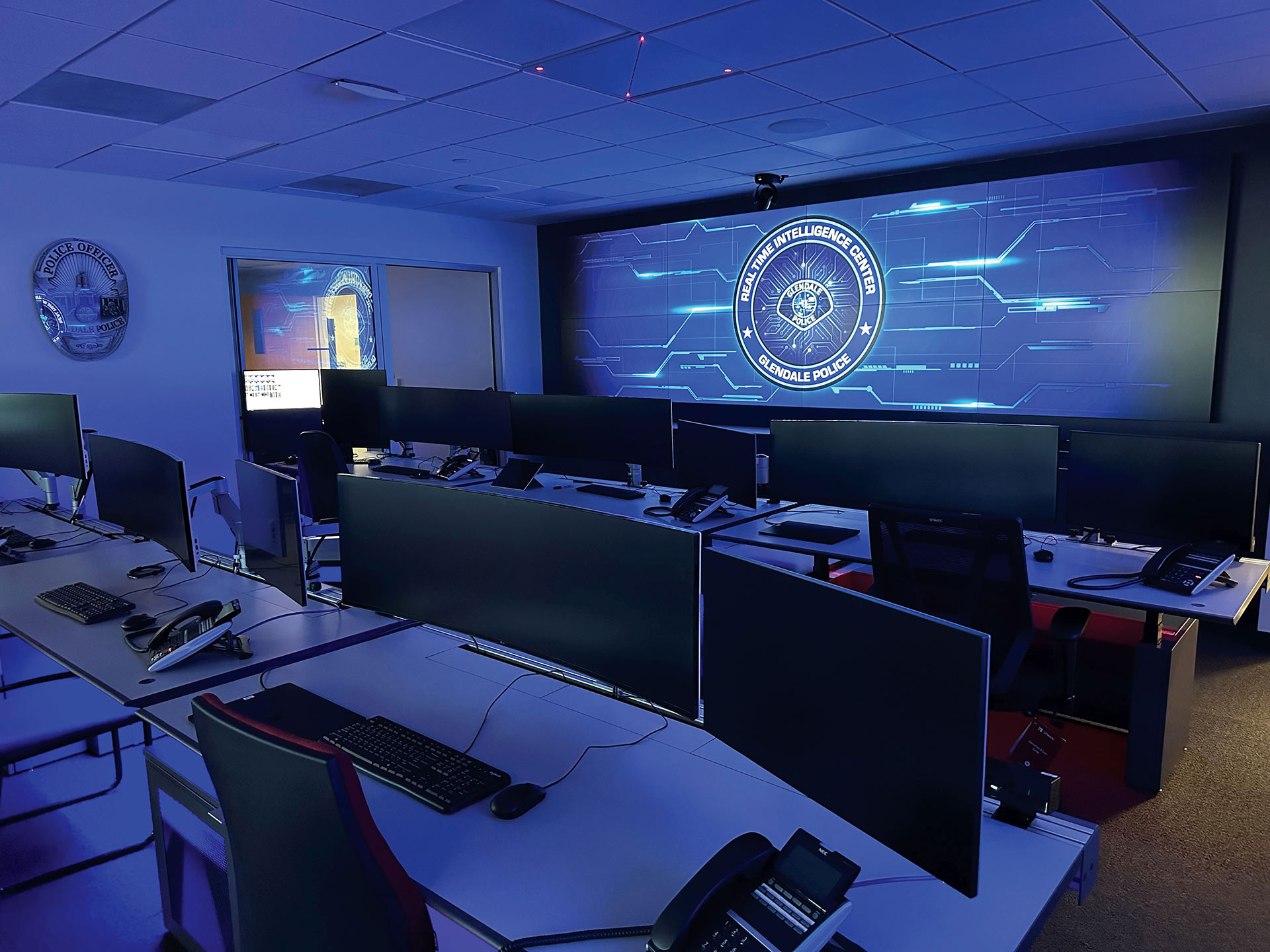
Several Southern California agencies have developed robust real-time networks, and future collaboration between agencies will likely result in regionalized intelligence hubs, providing real-time intelligence to law enforcement officers across the United States. In one example, the Glendale Police Department in Southern California will soon launch its comprehensive Real-Time Intelligence Center (RTIC), integrating multiple real-time data sources into a central location that can be relayed to officers in the field. Lieutenants Sean Riley and Manny Fernandez were tasked by Chief Manny Cid to be the architects of this venture. As the RTIC commander, Riley says, “Regional partnerships will be the future and will allow agencies to share resources and collaborate in real time to provide 24-hour coverage, seven days a week, to multiple cities.”
The innovation of RTCCs is in how they are expanding to collect and send data. The Hawthorne Police Department, also in Southern California, announced plans in May to deploy the first autonomous 9-1-1 response drone developed by Brinc by year’s end, allowing the drone to self-deploy the moment a 9-1-1 call is received. Comprehensive cloud networks are linking data sources throughout cities to revolutionize the way actionable intelligence is collected, analyzed and given to first responders. These real-time network enhancements will ensure immediate access to critical information, enhancing responsiveness, safety and operational effectiveness. Peregrine is one company at the forefront of this integration, offering a real-time decision and operation management platform to centralize all an agency’s data from any source, allowing for real-time organizational data access and analysis instantaneously.
With this explosion of real-time enhancements, emerging technologies, particularly advances in AI, will significantly boost the future effectiveness of these centers by further aiding real-time decision-making and enhancing the speed and efficacy of police responses. AI is already enhancing so many things we do, and there is compelling evidence that AI will help us long before it will replace us. As AI technology continues to be integrated into various projects and operations, its potential to revolutionize law enforcement operations is becoming increasingly clear.
Lieutenant Cory Leeper of the La Verne, California, Police Department is actively exploring the ability to integrate AI into operations, representing a forward-thinking approach that highlights the potential of technology in transforming law enforcement. Leeper has been building out private AI channels to serve a variety of needs in his testing and evaluation of the platform. According to him, “AI’s integration into law enforcement is transforming the profession, making it more efficient, effective and responsive. From enhancing front desk operations to supporting complex tactical decisions, AI is a valuable tool in all aspects of police work.” Given the pace of development, it is likely that AI will soon play a crucial role in analyzing real-time intelligence, offering instant guidance to dispatchers, officers and first responders during crisis situations.
The path forward
It is clear everything is connected, and it is crucial we stay connected to everything. The concepts here may be challenging to implement today, but they offer a promising path toward a safer community through collaboration and innovation. Here are some recommendations for agencies to leverage real-time intelligence technologies.
- Get excited: In 2023, incoming Pasadena, California, Police Chief Gene Harris set out on a contemporary rebranding effort, establishing two phrases as symbols of that vision and the forthcoming changes: “Tradition cannot stop progress” and “Enthusiasm is the force that creates momentum.” Law enforcement agencies nationwide must stay enthusiastic about the future and continue to adopt and innovate the use of new technologies, especially those that can convey real-time intelligence to officers in the field.
- Evaluate your situation: If this is new to your organization, start by visiting an RTCC/RTIC near you. In fact, visit as many as possible. Research the topic. Join the National Real Time Crime Center Association (NRTCCA) and consider attending an upcoming NRTCCA Conference.
- Develop partnerships: The future of the RTCC will be incorporating private-party partnerships with regional law enforcement entities to further enhance the access and availability of real-time data sources. Building relationships and trust with the community will pay dividends when you ask for technology and access. Regional partnerships could provide more access to equipment and services that may be limited by available funding sources.
- Act: The time is right now to take the next step. You may be well on your way to making the next breakthrough in real-time intelligence or you may be just starting out; either way, you could do something. Our role will be pivotal — not just as guardians of physical safety, but as architects of a safer, more resilient society that thrives on innovation while upholding the core values of trust and mutual respect.

Anthony Russo
As seen in the October 2024 issue of American Police Beat magazine.
Don’t miss out on another issue today! Click below: