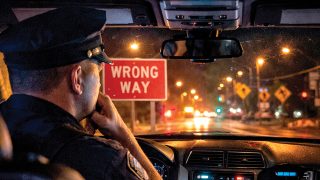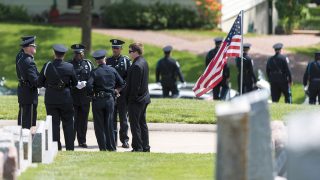
Defunding the police, anti-police rhetoric by politicians and special interest groups, legislative handcuffs put on cops and the pandemic just might lead to no one answering your 9-1-1 call. Some in law enforcement leadership are sounding an alarm.
“They completely burned down the institution of policing and law and order, and now we’re living in the ashes,” Joe Gamaldi, national vice president of the Fraternal Order of Police (FOP), said of politicians and special interest groups and their “constant bashing of law enforcement,” adding, “it’s horrible what they’ve done to our communities.” Gamaldi is also a Houston Police Department sergeant who works a patrol assignment. He sees the effects of the current climate firsthand daily. He said, “We are seeing a perfect storm with retirements up 45% and resignations increasing to 20%, resulting in an unmitigated disaster. Our profession is dying off.”
Crime is on the rise as many police departments operate with staffing shortages that reduce the law enforcement services provided to their communities. Gamaldi is concerned about what he is seeing: More and more police departments only respond to the most urgent calls, telling citizens to report other incidents online. These other incidents may not be priority calls for the police department, but they are extremely important to the citizen who expects a police officer to come to their door.
Gamaldi explained that staffing shortages have forced departments to create service models eliminating a physical police response. Removing the police officer is akin to the first domino falling. The patrol function, typically the largest component of police officers in a department, is the pool from which personnel are pulled to staff other operations, such as investigations, supervision, specialized units and command staff. If patrol attrition is not addressed, vacancies in other sections are not filled — meaning a backlog of investigations, a lack of promotions, personnel reductions in specialized units and diminishing police–community relations. The rest of the dominos now begin to tumble. And what usually happens is the public becomes dismayed with its police, further fostering the false anti-police narrative put forth by the special interest groups that have captured the political attention.
Mick McHale, a career Florida cop and president of the National Association of Police Organizations (NAPO), which represents approximately 1,100 law enforcement unions with about 260,000 members, said the lack of interest in law enforcement careers is not only affecting major urban departments, but also impacting local police departments and sheriff’s offices. “There is a high number of officers retiring early, abandoning a position they use to hold in high regard,” McHale stated. He added that it is not the dangers of police work causing a lack of interest, but the outcome of the lack of support for law enforcement and the reforms instituted that can dramatically raise a police officer’s liability for performing as trained. McHale added that a major issue is when an isolated incident of misconduct is portrayed as a normal, everyday occurrence, continuing the false narrative about law enforcement. The knee-jerk reforms can translate into severe penalties for a police officer performing their job. “Thousands upon thousands of police officers who took an oath are continuing to do the job; however, the decisions being made determine if they remain or go into another profession,” he said.
A telling trend is the reduction of legacy candidates, according to McHale. Legacy candidates are the children of law enforcement officers who follow their parents into the profession. And it is not just what these children are seeing and hearing that factors into their decision. As McHale stated, “This is a time in our history the current members of law enforcement are discouraging their children from entering the profession.” A New York area sergeant told his family’s story: His father, with whom he shared the same name, preceded him on the job. The sergeant’s son, also of the same name, followed him onto the same job. The sergeant, who is soon looking at retirement, said, “For more than 60 years, and now counting, a police officer of the same name wore the same badge on the same job.” A fitting example of the type of legacy that just may be ending.
Coupled with the anti-police narrative is the “defund the police” movement, which saw many police departments cut police budgets. Captain Aaron McCraney, commanding officer of the Los Angeles Police Department Recruitment and Employment Division, indicated that a partial loss of funding may result in the lack of hiring. He said the LAPD “hires to attrition,” putting about 500 recruits through the LAPD Academy yearly. When funding is cut for recruit classes, attrition replenishment ceases, leaving a department shorthanded. In a department like the LAPD, a two-year period of attrition amounts to approximately 1,000 officers leaving without being replaced by new officers. McCraney said that is the situation the LAPD is in now. After police funding was reduced in 2020–2021, the LAPD hired only 79 recruits, yet attrition continued, creating a cumulative effect through 2022 of a 600-member reduction from the LAPD’s pre-2020 staffing of approximately 10,000 sworn personnel. Complicating the effort of trying to play catchup were the shutdowns and restrictions on personal movement caused by the COVID pandemic. Captain McCraney said the pandemic impacted the ability to conduct face-to-face recruiting, such as setting up recruitment fairs and on-site recruitment at colleges, churches and community organizations.
Steve Weiler, second vice president of the National Fraternal Order of Police, offered the following results of a recent Philadelphia Police Department entrance exam as an example of the difficulty filling academy seats. In March 2022, the Philadelphia Police Department invited 1,220 people who indicated interest in taking the entrance exam. Of those invited, only 28 attended the initial testing phase, with only two passing and moving on to other phases. This comes at a time when the department has less than 6,000 sworn personnel. Weiler, who is also a Philadelphia police officer, said when he came on the job in 1993, the department counted approximately 6,800 police officers. The current staffing problems of the department may also be a result of additional occurrences the past two years. The first is that the City Council passed an ordinance requiring police applicants to have lived in the city for one year prior to taking the police exam. That proved to have negative effects on recruitment and has since been rescinded, which Weiler called “a good step forward.” Second is the fact the city went two years without an entrance exam, and third, the department loses 10 officers a month to retirements, injuries and those who resign to go to other departments. Currently, the Philadelphia Police Academy is conducting three concurrent classes that should bolster the Department’s 21 districts by approximately 200 rookies.
The recruitment crisis seems to be nationwide, leading Joe Gamaldi to say, “There will always be police officers and we will always be there for our community, but the community needs to decide very quickly what kind of policing they want.” He added, “We are quickly reaching the point of no return regarding crime, staffing and our ability to control it.” Gamaldi offered a warning of the consequences that may be waiting: “If we can’t find enough people to become police officers, the only way forward is to drastically cut the services we provide, which will have a vast impact on our communities, especially our most vulnerable.”

Bobby Egbert
As seen in the May 2022 issue of American Police Beat magazine.
Don’t miss out on another issue today! Click below: