
• Skip to primary navigation
  • Skip to main content
  • Skip to primary sidebar
  • Skip to footer
  • Home
  • About
  • The Magazine
  • Events
  • Partners
  • Products
  • Contact
  • Jobs and Careers
  • Advertise
  • Facebook
  • Instagram
  • Twitter
  • Subscribe
American Police Beat

American Police Beat Magazine

Law Enforcement Publication

  • Home
  • Leadership
    • Police leadership development
      Can they do it? Will they do it?
      A unique approach to salvaging a troubled employee
      The relentless pursuit of excellence
      An effective strategy for difficult discussions
  • Topics
    • Leadership
      • Police leadership development
        Can they do it? Will they do it?
        A unique approach to salvaging a troubled employee
        The relentless pursuit of excellence
        An effective strategy for difficult discussions
    • Editor’s Picks
      • No two days are ever the same
        Training dipshittery, Part 2
        Tactical medicine for cops
        Why good cops quit
        Smile and let them swing
    • On the Job
      • Frankpledge to forensics: A brief history of law enforcement
        The sixth sense in policing
        From warrior to peacekeeper
        Hats off to a new uniform look
        Overcoming climate and conditions to rescue child
    • Labor
      • The shift happens long before the resignation letter
        Facing the oral board
        Why good cops quit
        Succession planning
        Why more staff won’t fix your operational slowdowns
    • Tech
      • Accentuating safety for first responders
        Take Me Home program offers effective tool for police and families
        Get the most out of simulation training
        The virtual beat
        Training with an AI partner?
    • Training
      • More than just a red shirt and a Sharpie
        Train them to ask why
        Nobody is coming to do it for you
        Precision, adaptability and response: The need for LPVOs in equipping...
        Training dipshittery, Part 2
    • Policy
      • Out of chaos comes opportunity
        Massachusetts law establishes fund to care for retired K-9s
        Portlanders will not vote on diverting climate funds for police...
        Surviving internal affairs investigations
        Fighting human trafficking at the local level
    • Health/Wellness
      • Understanding why police officers think alcohol works
        Has the job quietly stolen your humanity?
        No two days are ever the same
        Changing the narrative
        Supporting your peer support team
    • Community
      • National Night Out 2026
        Pittsburgh mounted patrol officer helps inner-city kids saddle up
        Wyoming girl on a mission to collect “hero patches”
        Texas sheriff’s office nominates 7-year-old for commendation
        Cops try to net DEA agents
    • Offbeat
      • A surprise sting operation
        Could cadaver otters help close cold cases?
        Police chief catches cat in the act
        “Teenage Mutant Ninja Deer” rescued
        An unexpected burglar
    • We Remember
      • Honoring the Fallen Heroes of 9-11
        Steel Across America
        The first officers on scene on September 11
        Protecting America with the USA PATRIOT Act
        Distant cousins connect to honor fallen family member 110 years after...
    • HOT Mail
      • The War on Cops Continues Unabated
  • On the Job
    • Frankpledge to forensics: A brief history of law enforcement
      The sixth sense in policing
      From warrior to peacekeeper
      Hats off to a new uniform look
      Overcoming climate and conditions to rescue child
  • Labor
    • The shift happens long before the resignation letter
      Facing the oral board
      Why good cops quit
      Succession planning
      Why more staff won’t fix your operational slowdowns
  • Tech
    • Accentuating safety for first responders
      Take Me Home program offers effective tool for police and families
      Get the most out of simulation training
      The virtual beat
      Training with an AI partner?
  • Training
    • More than just a red shirt and a Sharpie
      Train them to ask why
      Nobody is coming to do it for you
      Precision, adaptability and response: The need for LPVOs in equipping...
      Training dipshittery, Part 2
  • Policy
    • Out of chaos comes opportunity
      Massachusetts law establishes fund to care for retired K-9s
      Portlanders will not vote on diverting climate funds for police...
      Surviving internal affairs investigations
      Fighting human trafficking at the local level
  • Health/Wellness
    • Understanding why police officers think alcohol works
      Has the job quietly stolen your humanity?
      No two days are ever the same
      Changing the narrative
      Supporting your peer support team
  • Community
    • National Night Out 2026
      Pittsburgh mounted patrol officer helps inner-city kids saddle up
      Wyoming girl on a mission to collect “hero patches”
      Texas sheriff’s office nominates 7-year-old for commendation
      Cops try to net DEA agents
  • Offbeat
    • A surprise sting operation
      Could cadaver otters help close cold cases?
      Police chief catches cat in the act
      “Teenage Mutant Ninja Deer” rescued
      An unexpected burglar
  • We Remember
    • Honoring the Fallen Heroes of 9-11
      Steel Across America
      The first officers on scene on September 11
      Protecting America with the USA PATRIOT Act
      Distant cousins connect to honor fallen family member 110 years after...
  • HOT Mail
    • The War on Cops Continues Unabated
  • About
  • The Magazine
  • Events
  • Partners
  • Products
  • Contact
  • Jobs and Careers
  • Advertise
  • Subscribe
Search

Tech

Miniaturized red dot sights in law enforcement

Dan Kickert and Lauren Sheehan Published October 20, 2022 @ 6:00 am PDT

iStock.com/N Rotteveel

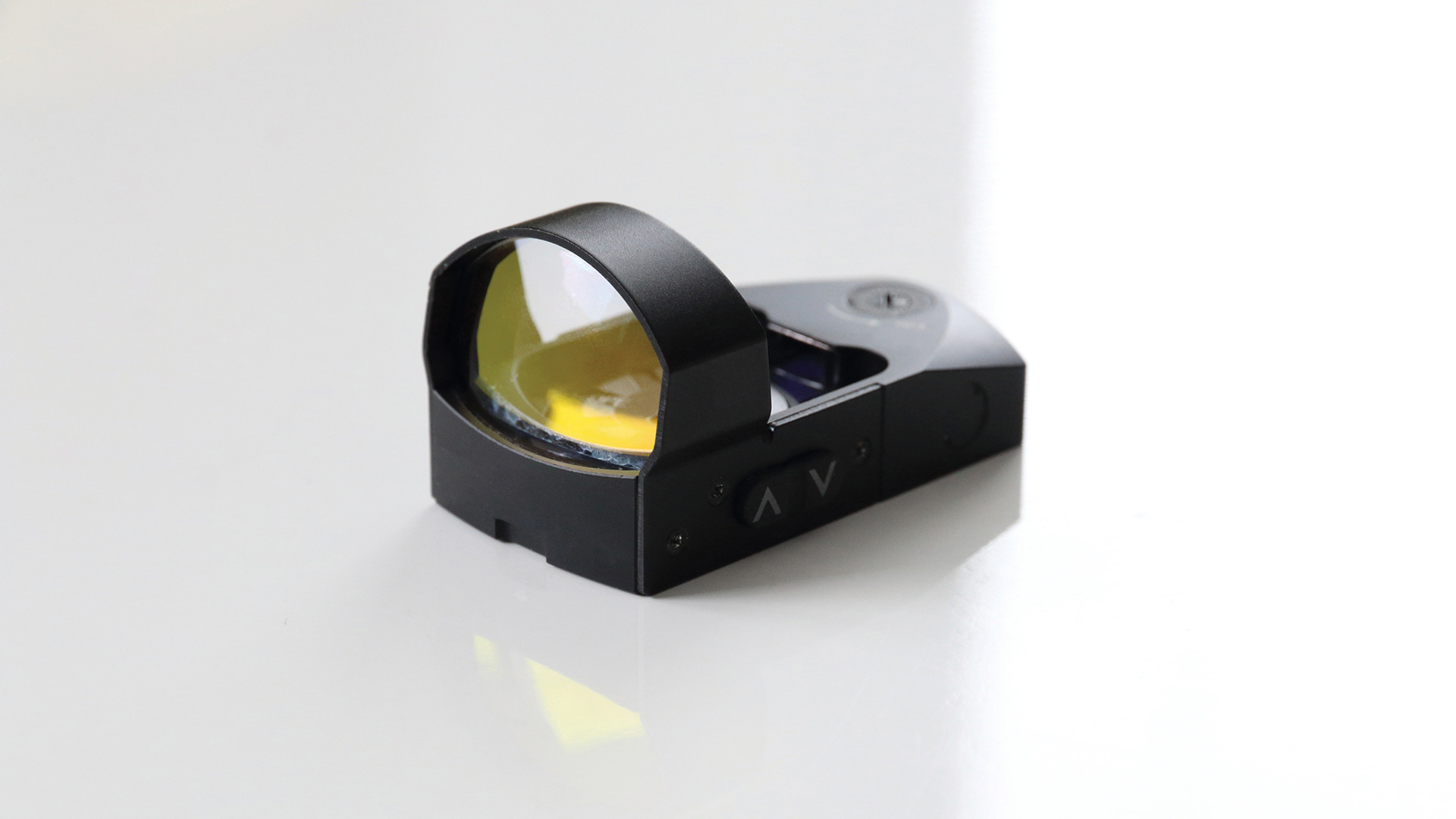
When it comes to pistol sighting systems, there have been many innovations over the last several decades. First, there was the introduction of night sights including tritium tubes that gave off a green glow in darkness. Then came high-visibility sights that incorporated pieces of fluorescent fiber optics, which absorbed light, emitting a glow in light and low-light situations. There have been some modifications to night sights, which mainly consist of adding bright colors around the tritium tube to better draw the shooter’s eye during situations in which there is ample light. Now, the newest innovation is the miniaturized red dot sight (MRDS).

The full-sized sights have been used on long guns for years and have been widely accepted by the law enforcement community. However, miniaturized versions for handguns seem to have come under a great deal of scrutiny. Reputable manufacturers such as Trijicon, Holosun, Aimpoint and Leupold are making these sights. Virtually every agency has some other sighting system made by those manufacturers in use. Why the scrutiny over the MRDS? The simple answer is that the law enforcement community is very skeptical of change. Even when confronted with the inevitability of change, we are one of the slowest industries to truly embrace it. All too often, we hear the phrase “Why change now? This is the way we’ve always done it.” 

Let’s identify some advantages the MRDS presents users with, as opposed to a traditional sighting system. The most glaring advantage is the ability to stay threat-focused. While using traditional iron sights, the shooter must focus on the threat, then the front sight, then the rear sight, then maintain focus on the front sight while the threat is blurry. This means the shooter has all their focus on the front sight of their firearm. The threat, which is the reason they are deploying their firearm, is blurry to them. Firearms instructors all around the country have been saying “Front sight, squeeze” for decades while the threat or object the shooter is firing at is blurry and out of focus. When using an MRDS, the shooter can focus on the threat, simply see the “dot” superimposed on the threat and squeeze the trigger. This allows the shooter to stay completely focused on the threat. This is an extremely big deal. It means that the threat stays in focus. The shooter will see more of the threat and see the threat more clearly. This allows not only more information, but also more accurate information to be processed by the shooter, potentially greatly reducing the risk of being involved in a “mistake of fact shooting.” When the threat is blurry, a cellphone could possibly look like a firearm or other weapon; however, when the threat is crisp, clear and in focus, so are their hands and any object in them. 

A second advantage of the MRDS is the simplicity of use. The shooter simply puts the dot where they want the projectile to impact. The dot is completely independent of any other sighting system, regardless of the ability to co-witness. It will not magically make the user a better shooter. However, it will eliminate some issues, such as looking over traditional iron sights. 

Many agency administrators are aware of the advantages of an MRDS but remain hesitant because they are not sure how to construct a policy governing its use. The question those administrators need to ask themselves is “Do I have a policy governing the use of night sights, fiber-optic sights, aperture sights or any other type of sights?” The answer is most popularly going to be “No.” So why construct a policy for this type of sight? The second obstacle someone may have to overcome with agency administrators is the question “What if the window becomes obstructed by fog, rain, snow, or mud?” The answer is simple. When using a MRDS, your brain will simply take over. You will see the dot with one eye and the threat with the other. Your eyes will work together to place the dot on the threat. This is called occluded eye shooting. 

If you have decided an MRDS may be for you, there are several different offerings from a multitude of companies. Make sure you explore all of them, do your research and have definitive answers to the choices you are going to make. Some of these choices include if you are going to opt for a modular system and could swap optics through the use of a plate on the slide of your weapon, or if you are going to have your slide milled for a specific optic. There are advantages and disadvantages to both. By having your slide milled for a specific optic, you gain strength, durability and simplicity; however, you use the ability to mount other types of optics to that slide. You will also have to consider the brand of optic. There is a great deal of give and take with the myriad of offerings out there right now. The things to consider are battery life, emitter type (open or enclosed) and singular or dual emitter. For a law enforcement officer, durability and battery life should take priority.

Once you have selected your MRDS, make sure you get some quality formal training. There are several phenomenal trainers out there who have been teaching MRDS shooting for years. After you take your classes, continue to get your reps in. The key is finding the dot. The key to finding the dot is repetition. Remember, small, precise muscle movements are often difficult to duplicate in training and nearly impossible to duplicate under stress. Make your adjustments with the largest muscle groups possible during draw and presentation. Start with your shoulders and elbows, and try not to make the small adjustments with your wrists. While conducting training and practice, the dot will become easier to find faster than you could ever find your front sight. Once “finding the dot” becomes automatic, you will become noticeably faster from the draw and during target transitions. Precision shots at distance will also become easier due to the ability to stay threat-focused.

Dan Kickert and Lauren Sheehan

Dan Kickert and Lauren Sheehan

Dan Kickert is a police officer in the south suburbs of Chicago with 15 years of experience. He is currently assigned to patrol and training. He serves his agency as a field training officer, range master, tactics instructor and training coordinator. He was previously assigned to investigations, where he worked as a homicide investigator in a task force setting for seven years.

Lauren Sheehan spent four years with the Olympia Fields Police Department before going to work as a deputy sheriff in a collar county of Chicago. She has an M.S. in criminal social justice from Lewis University. She has served as a crisis intervention team officer, accident reconstructionist, juvenile specialist and firearms trainer, as well as volunteering to coordinate events such as the National Night Out Against Crime and Cop on Top fundraisers for the Special Olympics of Illinois.

View articles by Dan Kickert and Lauren Sheehan

As seen in the October 2022 issue of American Police Beat magazine.
Don’t miss out on another issue today! Click below:


SUBSCRIBE TODAY!

Categories: Tech

Primary Sidebar

Recent Articles

  • Honoring the Fallen Heroes of 9-11
  • Serving every survivor, every sacrifice
  • Steel Across America
  • The first officers on scene on September 11
  • National Night Out 2026
  • Accentuating safety for first responders
  • A surprise sting operation
  • Frankpledge to forensics: A brief history of law enforcement
  • NLEOMF announces July 2026 Officer of the Month
  • Police leadership development

Footer

Our Mission
To serve as a trusted voice of the nation’s law enforcement community, providing informative, entertaining and inspiring content on interesting and engaging topics affecting peace officers today.

Contact us: info@apbweb.com | (800) 234-0056.

  • Facebook
  • Instagram
  • Twitter

Categories

  • Editor’s Picks
  • On the Job
  • Labor
  • Tech
  • Training
  • Policy
  • Health/Wellness
  • Community
  • Offbeat
  • We Remember
  • Jobs and Careers
  • Events

Editor’s Picks

No two days are ever the same

No two days are ever the same

July 24, 2026

Training dipshittery, Part 2

Training dipshittery, Part 2

July 23, 2026

Tactical medicine for cops

Tactical medicine for cops

July 18, 2026

Why good cops quit

Why good cops quit

July 14, 2026

Policies | Consent Preferences | Copyright © 2026 APB Media, LLC | Website design, development and maintenance by 911MEDIA

Open

Subscribe

Close

Receive the latest news and updates from American Police Beat directly to your inbox!

  • This field is for validation purposes and should be left unchanged.