• Skip to primary navigation
  • Skip to main content
  • Skip to primary sidebar
  • Skip to footer
  • Home
  • About
  • The Magazine
  • Events
  • Partners
  • Products
  • Contact
  • Jobs and Careers
  • Advertise
  • Facebook
  • Instagram
  • Twitter
  • Subscribe
American Police Beat

American Police Beat Magazine

Law Enforcement Publication

  • Home
  • Leadership
    • Developing and enhancing assertiveness
      Clarifying your “true north”
      The job has changed — have you?
      Perpetual recognition of line-of-duty deaths
      Understanding the boundaries of professional relationships with the...
  • Topics
    • Leadership
      • Developing and enhancing assertiveness
        Clarifying your “true north”
        The job has changed — have you?
        Perpetual recognition of line-of-duty deaths
        Understanding the boundaries of professional relationships with the...
    • Editor’s Picks
      • Smile and let them swing
        The job has changed — have you?
        The days that follow
        Perpetual recognition of line-of-duty deaths
        Let’s get moving!
    • On the Job
      • Coffee shop intel
        Curbing teen takeovers
        2026 Top Cops
        High-rise rescue in Brooklyn
        Swift thinking
    • Labor
      • Why more staff won’t fix your operational slowdowns
        Drama in Georgia: Mayor fires entire police department for...
        Smile and let them swing
        The Promise Gap
        Cut the cops, save a dollar?
    • Tech
      • The virtual beat
        Training with an AI partner?
        NYC’s electric vehicle fleet for LE passes milestone
        New Mexico license plate readers save lives, lead to “precise...
        A modern field guide to understanding research in policing
    • Training
      • Rules or results?
        Enhance your preparedness
        Good enough never is
        Pushback as a training signal
        Let’s get moving!
    • Policy
      • The impact of the Graham v. Connor decision
        Mexican cartels recruit like industry titans on both sides of the...
        Police and local government leaders join forces to build community...
        Police pause license plate readers
        Corruption, collusion and impunity
    • Health/Wellness
      • Down to divorce
        The days that follow
        Addressing stress, vicarious trauma and burnout
        Nervous system regulation
        The nature of the job
    • Community
      • Working community connections
        Cops promote National Donate Life Month
        Police officer kicks up social media praise
        Donning denim in solidarity with victims and survivors of sexual...
        Improving autism awareness
    • Offbeat
      • “Teenage Mutant Ninja Deer” rescued
        An unexpected burglar
        Police humor only a cop would understand
        Not eggzactly a perfect heist
        Pizza … with a side of alligator?
    • We Remember
      • Unsung heroes: New York City correction officers
        National Police Week 2026
        Shooting of Chicago police officers prompts call for new regulations...
        The sacrifice continues
        A Tribute to Fallen Heroes
    • HOT Mail
      • The War on Cops Continues Unabated
  • On the Job
    • Coffee shop intel
      Curbing teen takeovers
      2026 Top Cops
      High-rise rescue in Brooklyn
      Swift thinking
  • Labor
    • Why more staff won’t fix your operational slowdowns
      Drama in Georgia: Mayor fires entire police department for...
      Smile and let them swing
      The Promise Gap
      Cut the cops, save a dollar?
  • Tech
    • The virtual beat
      Training with an AI partner?
      NYC’s electric vehicle fleet for LE passes milestone
      New Mexico license plate readers save lives, lead to “precise...
      A modern field guide to understanding research in policing
  • Training
    • Rules or results?
      Enhance your preparedness
      Good enough never is
      Pushback as a training signal
      Let’s get moving!
  • Policy
    • The impact of the Graham v. Connor decision
      Mexican cartels recruit like industry titans on both sides of the...
      Police and local government leaders join forces to build community...
      Police pause license plate readers
      Corruption, collusion and impunity
  • Health/Wellness
    • Down to divorce
      The days that follow
      Addressing stress, vicarious trauma and burnout
      Nervous system regulation
      The nature of the job
  • Community
    • Working community connections
      Cops promote National Donate Life Month
      Police officer kicks up social media praise
      Donning denim in solidarity with victims and survivors of sexual...
      Improving autism awareness
  • Offbeat
    • “Teenage Mutant Ninja Deer” rescued
      An unexpected burglar
      Police humor only a cop would understand
      Not eggzactly a perfect heist
      Pizza … with a side of alligator?
  • We Remember
    • Unsung heroes: New York City correction officers
      National Police Week 2026
      Shooting of Chicago police officers prompts call for new regulations...
      The sacrifice continues
      A Tribute to Fallen Heroes
  • HOT Mail
    • The War on Cops Continues Unabated
  • About
  • The Magazine
  • Events
  • Partners
  • Products
  • Contact
  • Jobs and Careers
  • Advertise
  • Subscribe
Search

Leadership

Do you know your emotional intelligence?

Why it can matter more than IQ

Mike Geier Published August 17, 2025 @ 6:00 am PDT

iStock.com/Anastasiia_New

About five years ago, while researching material for a leadership training class I was putting together for the sergeants, lieutenants, commanders and deputy chiefs of my department, I came across a book in the library that caught my eye. It was one of several that I reviewed in preparation for the training. As their new chief, I wanted to make the presentation impactful and worth their time. The book, written by Daniel Goleman, was titled Emotional Intelligence: Why It Can Matter More Than IQ.

I reviewed different leadership styles, such as transactional and transformational leadership, and also looked into the concepts of servant leadership and heart-focused leadership. I soon recognized that leaders use different management approaches, ranging from hands-off, facilitative styles to autocratic micromanagement. Some of these styles are polar opposites in their underlying theories of management and motivation. There definitely is no “one size fits all” when it comes to leadership styles.

As I read Goleman’s book, I began to see the importance of emotional intelligence for law enforcement leaders. He believed that a leader could have all the training and occupational acumen in the world, but they wouldn’t be a good leader if they lacked emotional intelligence. The more I learned about emotional intelligence, the more I became a believer. I realized that police agencies today, more than ever, need competent leaders at the helm. But instead of being driven by what’s in their own best interest, leaders with high emotional intelligence are aware of the needs of their employees and take that into consideration with every decision they make. I became convinced that emotional intelligence does make better leaders, and I decided to include a segment on emotional intelligence in my leadership development training.

The key points of my training focused on the four dimensions of emotional intelligence: self-awareness, self-management, social awareness and relationship management. Figure 1 shows the key components of these dimensions.

Emotional intelligence isn’t just a ‘feel good’ approach — it’s a foundation for organizational success.
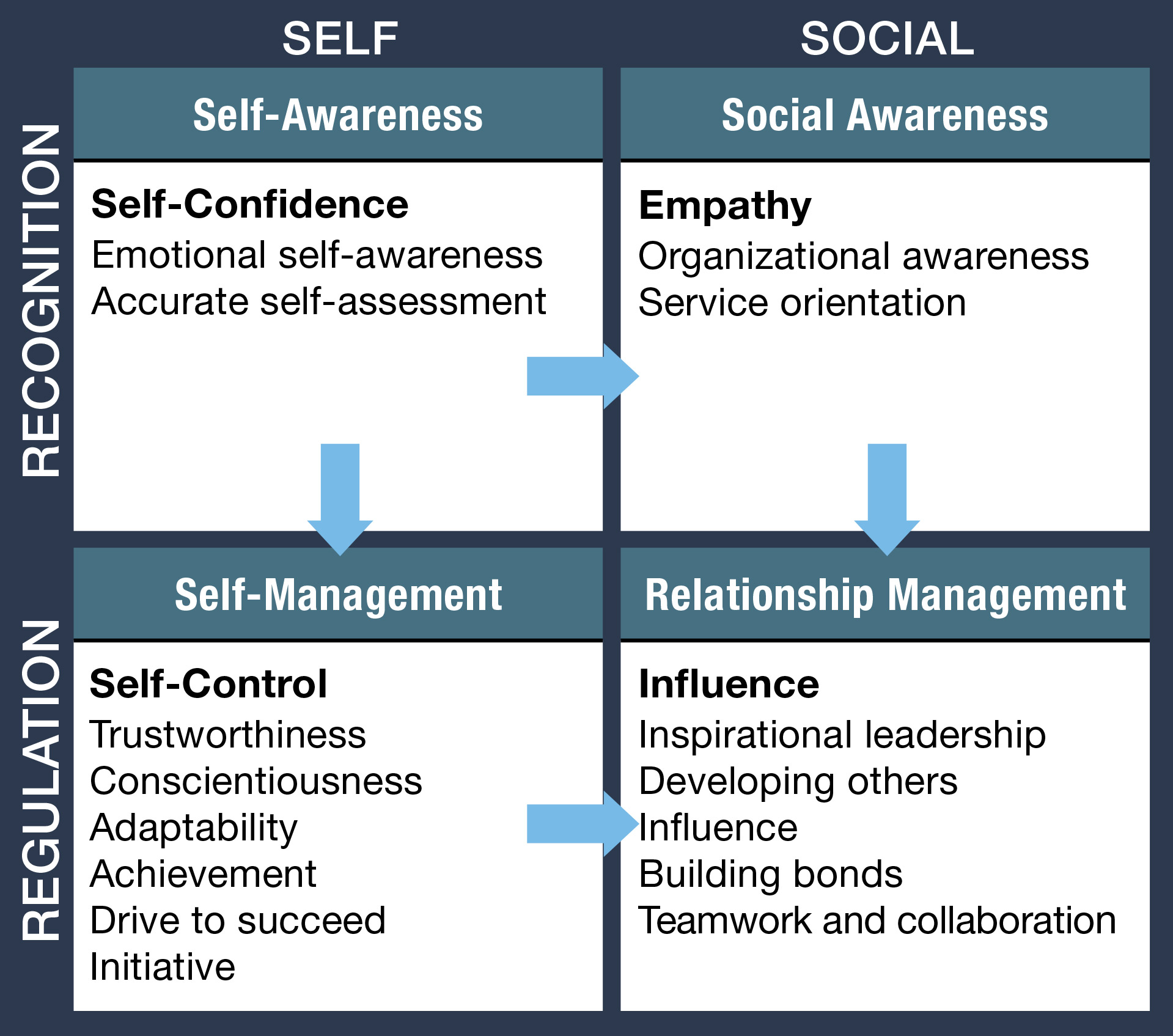
Figure 1 (Mike Geier)

Most police leaders would probably believe they are empathetic toward their employees’ needs and concerns. However, having come up through the ranks in two different departments, I think a significant number of officers would disagree. Too many of my superiors over the years were self-serving. But after delving into Goleman’s book, I began to see some universal principles and traits that apply to almost every leadership interaction. I wanted to get that point across in my training to my command staff, middle managers and first-line supervisors.

Emotional intelligence is a multifaceted concept encompassing the ability to recognize, understand, manage and use emotions effectively in oneself and in others. It plays a critical role in interpersonal communication, self-awareness and decision-making. We often celebrate leaders for the traits they embody — grit, self-confidence, determination, honesty and perseverance. These qualities are widely applauded, and many aspiring leaders strive to model themselves after those who possess them. But there’s one trait that gets overlooked, and I believe it’s one of the most important of all: emotional intelligence. Also referred to as EQ or EI, emotional intelligence is more pronounced in leaders who are driven by people, not by self-importance or outside interests. Renowned leadership author Simon Sinek once said, “The true price of leadership is the willingness to place the needs of others above your own. Great leaders truly care about those they are privileged to lead and understand that the true cost of the leadership privilege comes at the expense of self-interest.”

Why is emotional intelligence one of the most critical leadership traits? Emotional intelligence is generally understood to include certain core skills: emotional awareness — the ability to identify and recognize one’s own emotions; the ability to harness those emotions and apply them to tasks such as open-minded thinking and problem solving; and the ability to manage emotions, both one’s own and those of others. Through these attributes, emotionally intelligent leaders aren’t only in tune with their own emotions but can also recognize and guide the emotions and needs of those they influence when necessary to help others.

Leaders who are driven by their people stand out within their departments and their communities.

Policing as we know it looks much different today than it did years ago. Mental health has become a serious issue in this post-pandemic climate. Officer wellness is now a major topic within our law enforcement communities. Many members of our agencies are more stressed, anxious, emotionally exhausted or burnt out at their current positions. These matters are cause for alarm. In addition to serious recruitment challenges and new crime problems related to gun violence, homelessness and fentanyl abuse, we are also navigating a mental health crisis within our own ranks. Alcoholism, substance abuse, depression and even incidents of domestic violence and suicide are affecting many departments today.

Agencies experiencing high employee turnover should look at the emotional intelligence of their leadership. Officers are doing everything they can to protect every ounce of their well-being. The result of poor leadership is that officers are leaving departments they no longer want to work for. They are no longer willing to stay in jobs that negatively impact their mental and even physical health. Leaders who are self-aware and empathetic to the needs of their employees prioritize what matters most to their employees. This could look like granting teams more flexibility and autonomy in their jobs, making confidential mental health resources and care easily accessible to those who feel overwhelmed by all the stress, anxiety and burnout they’ve never had to navigate before, or establishing new policies that grant workers more sick leave or personal time off so they can take better care of themselves and achieve a better work–life balance.

Only when we value and respect the needs and best interests of our own employees can we create a culture that supports our people while advancing our mission to serve and protect. The well-being of our officers should be an agency’s top priority. Emotional intelligence isn’t just a “feel good” approach — it’s a foundation for organizational success. Leaders who are driven by their people stand out within their departments and their communities. This is especially important now, given the many challenges we face in today’s climate. Police leaders need emotional intelligence to succeed. Departments with emotionally intelligent leaders have happier employees, and that often leads to higher retention rates. A happier workforce is a more engaged and productive one, which can contribute to reduced crime and an improved quality of life in our jurisdictions. Our officers and citizens shouldn’t settle for anything less.

Mike Geier

Mike Geier

Mike Geier is the former chief of police of the Albuquerque, New Mexico, Police Department. His career began in 1974 with the Wilmette, Illinois, Police Department, where he retired as a lieutenant after 20 years in 1994. He then joined APD as a recruit and served another 20 years, retiring in 2014 as a commander to become the police chief in Rio Rancho, New Mexico. He returned to APD in 2017 as the chief until he retired in 2020. For additional information on reality-based training, contact rbtconsulting.net.

View articles by Mike Geier

As seen in the August 2025 issue of American Police Beat magazine.
Don’t miss out on another issue today! Click below:


SUBSCRIBE TODAY!

Categories: Leadership, Editor's Picks

Primary Sidebar

Recent Articles

  • The impact of the Graham v. Connor decision
  • Coffee shop intel
  • Developing and enhancing assertiveness
  • Mexican cartels recruit like industry titans on both sides of the border — and it’s working
  • Down to divorce
  • Unsung heroes: New York City correction officers
  • The virtual beat
  • Why more staff won’t fix your operational slowdowns
  • Training with an AI partner?
  • Curbing teen takeovers

Footer

Our Mission
To serve as a trusted voice of the nation’s law enforcement community, providing informative, entertaining and inspiring content on interesting and engaging topics affecting peace officers today.

Contact us: info@apbweb.com | (800) 234-0056.

  • Facebook
  • Instagram
  • Twitter

Categories

  • Editor’s Picks
  • On the Job
  • Labor
  • Tech
  • Training
  • Policy
  • Health/Wellness
  • Community
  • Offbeat
  • We Remember
  • Jobs and Careers
  • Events

Editor’s Picks

Smile and let them swing

Smile and let them swing

May 16, 2026

The job has changed — have you?

The job has changed — have you?

May 15, 2026

The days that follow

The days that follow

May 11, 2026

Perpetual recognition of line-of-duty deaths

Perpetual recognition of line-of-duty deaths

May 10, 2026

Policies | Consent Preferences | Copyright © 2026 APB Media, LLC | Website design, development and maintenance by 911MEDIA

Open

Subscribe

Close

Receive the latest news and updates from American Police Beat directly to your inbox!

  • This field is for validation purposes and should be left unchanged.